THE
BHAGAVAD-GITA
The Book of Devotion
Dialogue Between Krishna,
Lord of Devotion,
And Arjuna,
Prince of India
Versified Edition
From the Sanscrit
By WILLIAM Q. JUDGE
Preface to the Versified Edition
The present versified edition was inspired by the acute need felt among students of Theosophy to study W.Q. Judge's rendition of the Bhagavad-Gītā pari-passu with the original ślōkas, while simultaneously facilitating correlation with alternative translations and commentaries. Consequently, W.Q. Judge's rendition has been aligned to the numbering of the standardized recension and their associated original Sanskrit ślōkas, which comprises 700 verses and was largely systematized in the commentary by Śrī Śaṅkarāchārya.
In instances where semantically significant recensions exist, the variant most consistent with the interpretation suggested by W.Q. Judge has been selected. And conversely, for semantically neutral variations, the most widely recognized version has been utilized. Documentation of these editorial decisions is provided in Appendix A. Although the rendition by W.Q. Judge is not a literal translation, it still maintains remarkable alignment with the source text. Aside from verses 12:2 and 12:3, where a minor rearrangement of phrases was necessary to preserve alignment with the original ślōkas, the rendition has been completely preserved in its original form. We offer explanatory notes for certain verses and point out significant deviations from generally accepted meaning to highlight WQJ's unique interpretation.
— Editor of the Electronic Edition (e-Ed).
Contents
- ANTECEDENT WORDSvii
- Chapter I — THE DESPONDENCY OF ARJUNA1
- Chapter II — APPLICATION TO THE SPECULATIVE DOCTRINES9
- Chapter III — THE RIGHT PERFORMANCE OF ACTION22
- Chapter IV — SPIRITUAL KNOWLEDGE30
- Chapter V — RENUNCIATION OF ACTION38
- Chapter VI — SELF-RESTRAINT44
- Chapter VII — SPIRITUAL DISCERNMENT53
- Chapter VIII — THE OMNIPRESENT SPIRIT NAMED AS OM58
- Chapter IX — THE KINGLY KNOWLEDGE AND THE KINGLY MYSTERY64
- Chapter X — DEVOTION BY MEANS OF THE UNIVERSAL DIVINE PERFECTIONS70
- Chapter XI — VISION OF THE DIVINE FORM AS INCLUDING ALL FORMS78
- Chapter XII — DEVOTION BY MEANS OF FAITH89
- Chapter XIII — DISCRIMINATION OF THE KSHETRA FROM KSHETRAJNA93
- Chapter XIV — SEPARATION FROM THE THREE QUALITIES100
- Chapter XV — KNOWLEDGE OF THE SUPREME SPIRIT105
- Chapter XVI — DISCRIMINATING BETWEEN GODLIKE AND DEMONIACAL NATURES110
- Chapter XVII — THE THREE KINDS OF FAITH115
- Chapter XVIII — RENUNCIATION AND FINAL LIBERATION121
Antecedent Words
THE Bhagavad-Gîtâ is an episode of the Mahâbhârata, which is said to have been written by Vyasa. Who this Vyasa is and when he lived is not known.
J. Cockburn Thomson, in his translation of the Bhagavad-Gîtâ, says: "The Mahâbhârata, as all students of Sanskrit well know, is the great epic of India, which from its popularity and extent would seem to correspond with the Iliad among the Greeks. The theme of the whole work is a certain war which was carried on between two branches of one tribe, the descendants of Kuru, for the sovereignty of Hâstinapura, commonly supposed to be the same as the modern Delhi. The elder branch is called by the general name of the whole tribe, Kurus; the younger goes by the patronymic, from Pandu, the father of the five principal leaders.
"This war between the Kurus and Pandavas occupies about twenty thousand slokas, or a quarter of the whole work as we now possess it. . . . In order to understand the allusions there [in the Bhagavad-Gîtâ] a knowledge is requisite of the previous history of the tribe, which will now be given as follows.
"Of the name Kuru we know but little, but that little is sufficient to prove that it is one of great importance. We have no means of deriving it from any Sanskrit root, nor has it, like too many of the Hindû names, the appearance of being explanatory of the peculiarities of the person or persons whom it designates. It is therefore in all probability a name of considerable antiquity, brought by the Aryan race from their first seat in Central Asia. Its use in Sanskrit is fourfold. It is the name of the northern quarter or Dwipa of the world, and is described as lying between the most northern range of snowy mountains and the polar sea. It is further the name of the most northern of the nine varshas of the known world. Among the long genealogies of the tribe itself it is known as the name of an ancient king to whom the foundation of the tribe is attributed. Lastly, it designates an Aryan tribe of sufficient importance to disturb the whole of northern India with its factions, and to make its battles the theme of the longest epic of olden time.
"Viewing these facts together we should be inclined to draw the conclusion that the name was originally that of a race inhabiting Central Asia beyond the Himalaya, who emigrated with other races into the northwest of the peninsula and with them formed the great people who styled themselves unitedly Arya, or the noble, to distinguish them from the aborigines whom they subdued and on whose territories they eventually settled. . . .
"At the time when the plot of the Mahâbhârata was enacted this tribe was situated in the plain of the Doab, and their particular region lying between the Jumna and Sursooty rivers, was called Kurukshetra, or the plain of the Kurus. The capital of this country was Hâstinapura, and here reigned at a period of which we cannot give the exact date a king named Vichitravirya. He was the son of Shantanu and Satyavati; and Bhîshma and Krishna Dwaipayana, the Vyasa, were his half-brothers; the former being his father's, the latter his mother's son. He married two sisters—Amba and Ambalika—but dying shortly after marriage, he left no progeny; and his half-brother, the Vyasa, instigated by divine compassion, married his widow and begat two sons, Dhritarâshtra and Pandu. The former had one hundred sons, the eldest of whom was Duryodhana. The latter married firstly Prîtha, or Kuntî, the daughter of Shura, and secondly Madri. The children of these wives were the five Pandava princes; but as their mortal father, while hunting, had been cursed by a deer to be childless all his life, these children were mystically begotten by different deities. Thus Yudhishthira, Bhîma, and Arjuna were the sons of Prîtha by Dharma, Vayu, and Indra respectively. Nakula was the son of Madri by Nasatya the elder, and Sahadeva by Darsa the younger of the twin Ashwinau, the physicians of the gods. This story would seem to be a fiction invented to give a divine origin to the five heroes of the poem; but however that may be, Duryodhana and his brothers are the leaders of the Kuru, or elder branch of the tribe; and the five Pandava princes those of the Pandava or younger branch.
"Dhritarâshtra was blind, but, although thus incapacitated for governing, he retained the throne, while his son Duryodhana really directed the affairs of the state. . . . He prevailed on his father to banish his cousins, the Pandava princes, from the country. After long wanderings and varied hardships, these princes collected their friends around them, formed by the help of many neighboring kings a vast army, and prepared to attack their unjust oppressor, who had in like manner assembled his forces.
"The hostile armies meet on the plain of the Kurus. Bhîshma, the half-brother of Vichitravirya, being the oldest warrior among them, has command of the Kuru faction; Bhîma, the second son of Pandu, noted for his strength and prowess, is the general of the other party [Arjuna's]. The scene of our poem now opens and remains throughout the same—the field of battle. In order to introduce to the reader the names of the principal chieftains in each army, Duryodhana is made to approach Drôna, his military preceptor, and name them one by one. The challenge is then suddenly given by Bhîshma, the Kuru general, by blowing his conch; and he is seconded by all his followers. It is returned by Arjuna, who is in the same chariot with the god Krishna, who, in compassion for the persecution he had suffered, had become his intimate friend, and was acting the part of a charioteer to him. He is followed by all the generals of the Pandavas. The fight then begins with a volley of arrows from both sides; but when Arjuna perceives it he begs Krishna to draw up the chariot in the space between the two armies while he examines the lines of the enemy. The god does so and points out in those lines the numerous relatives of his friend. Arjuna is horror-struck at the idea of committing fratricide by slaying his near relations, and throws down his bow and arrows, declaring that he would rather be killed without defending himself than fight against them. Krishna replies with the arguments which form the didactic and philosophical doctrines of the work, and endeavors to persuade him that he mistakes in forming such a resolution. Arjuna is eventually overruled. The fight goes on, and the Pandavas defeat their opponents."
This quotation from Thomson's edition gives the student a brief statement of what is more or less mythological and allegorical, but if the story of the Mahâbhârata be taken as that of Man in his evolutionary development, as I think it ought to be, the whole can be raised from the plane of fable, and the student will then have before him an account, to some extent, of that evolution.
Thus looking at it from the Theosophical point of view, the king Dhritarâshtra, is the human body which is acquired by the immortal Monad in order to go through the evolutionary journey; the mortal envelope is brought into existence by means of Tanha, or thirst for life. He is blind because the body without the faculties within is merely senseless matter, and thus is "incapacitated for governing," and some other person is represented in the Mahâbhârata as being the governor of the state, the nominal king being the body—Dhritarâshtra. As the Theosophical scheme holds that there is a double line of evolution within us, we find that the Kurus spoken of in the poem represent the more material side of those two lines, and the Pandava princes, of whom Arjuna is one, stand for the spiritual side of the stream—that is, Arjuna represents the immortal Spark.
The learned Brahmin Theosophist, Subba Row, says in his Notes on the Bhagavad-Gîtâ (Vide The Theosophist, Vol. VIII, p. 299): "Krishna was intended to represent the Logos. . . and Arjuna, who was called Nara, was intended to represent the human monad." Nara also means Man. The alleged celestial origin for the two branches of the family, the Kurus and Pandavas, is in perfect consonance with this, for the body, or Dhritarâshtra, being solely material and the lower plane in which the development takes place, the Kurus and Pandavas are our inheritance from the celestial beings often referred to in Mme. Blavatsky's Secret Doctrine, the one tending towards materiality, the other being spiritual. The Kurus, then, the lower portion of our nature earliest developed, obtain the power on this plane for the time being, and one of them, Duryodhana, "prevails," so that the Pandavas, or the more spiritual parts of our nature, are banished temporarily from the country, that is, from governing Man. "The long wanderings and varied hardships" of the Pandavas are wanderings caused by the necessities of evolution before these better parts are able to make a stand for the purpose of gaining the control in Man's evolutionary struggle. This also has reference to the cyclic rise and fall of nations and the race.
The hostile armies, then, who meet on the plain of the Kurus are these two collections of the human faculties and powers, those on one side tending to drag us down, those on the other aspiring towards spiritual illumination. The battle refers not only to the great warfare that mankind as a whole carries on, but also to the struggle which is inevitable as soon as any one unit in the human family resolves to allow his higher nature to govern him in his life. Hence, bearing in mind the suggestion made by Subba Row, we see that Arjuna, called Nara, represents not only Man as a race, but also any individual who resolves upon the task of developing his better nature. What is described as happening in the poem to him will come to every such individual. Opposition from friends and from all the habits he has acquired, and also that which naturally arises from hereditary tendencies, will confront him, and then it will depend upon how he listens to Krishna, who is the Logos shining within and speaking within, whether he will succeed or fail.
With these suggestions the student will find that the mythology and allegory spoken of by Thomson and others are useful instead of being merely ornamental, or, as some think, superfluous and misleading.
The only cheap edition of the Bhagavad-Gîtâ hitherto within the reach of Theosophical students of limited means has been one which was published in Bombay by Brother Tookeram Tatya, F. T. S., whose efforts in that direction are entitled to the highest praise. But that one was simply a reprint of the first English translation made one hundred years ago by Wilkins. The great attention of late bestowed on the poem by nearly all members of the Theosophical Society in America has created an imperative demand for an edition which shall be at least free from some of the glaring typographical mistakes and blind renderings so frequent in the Wilkins reprint. To meet this demand the present has been made up. It is the result of a careful comparison of all the English editions and of a complete retranslation from the original wherever any obscurity or omission was evident in the various renderings consulted.
The making of a commentary has not been essayed, because it is believed that the Bhagavad-Gîtâ should stand on its own merits without comments, each student being left to himself to see deeper as he advances. The publisher of this edition holds that the poem can be read in many different ways, each depending on the view-point taken, e.g., whether it is considered in its application to the individual, or to cosmogenesis, or to the evolution of the Astral world, or the Hierarchies in Nature, or to the moral nature, and so on. To attach a commentary, except such an one as only a sage like Sankaracharya could write, would be audacious, and therefore the poem is given undisfigured.
The Bhagavad-Gîtâ tends to impress upon the individual two things: first, selflessness, and second, action; the studying of and living by it will arouse the belief that there is but one Spirit and not several; that we cannot live for ourselves alone, but must come to realize that there is no such thing as separateness, and no possibility of escaping from the collective Karma of the race to which one belongs, and then, that we must think and act in accordance with such belief.
The poem is held in the highest esteem by all sects in Hindustan except the Mahommedan and Christian. It has been translated into many languages, both Asiatic and European; it is being read to-day by hundreds of sincere Theosophists in every part of the world. To those and to all others who truly love their fellowmen, and who aspire to learn and teach the science of devotion, this edition of the Bhagavad-Gîtâ is offered.
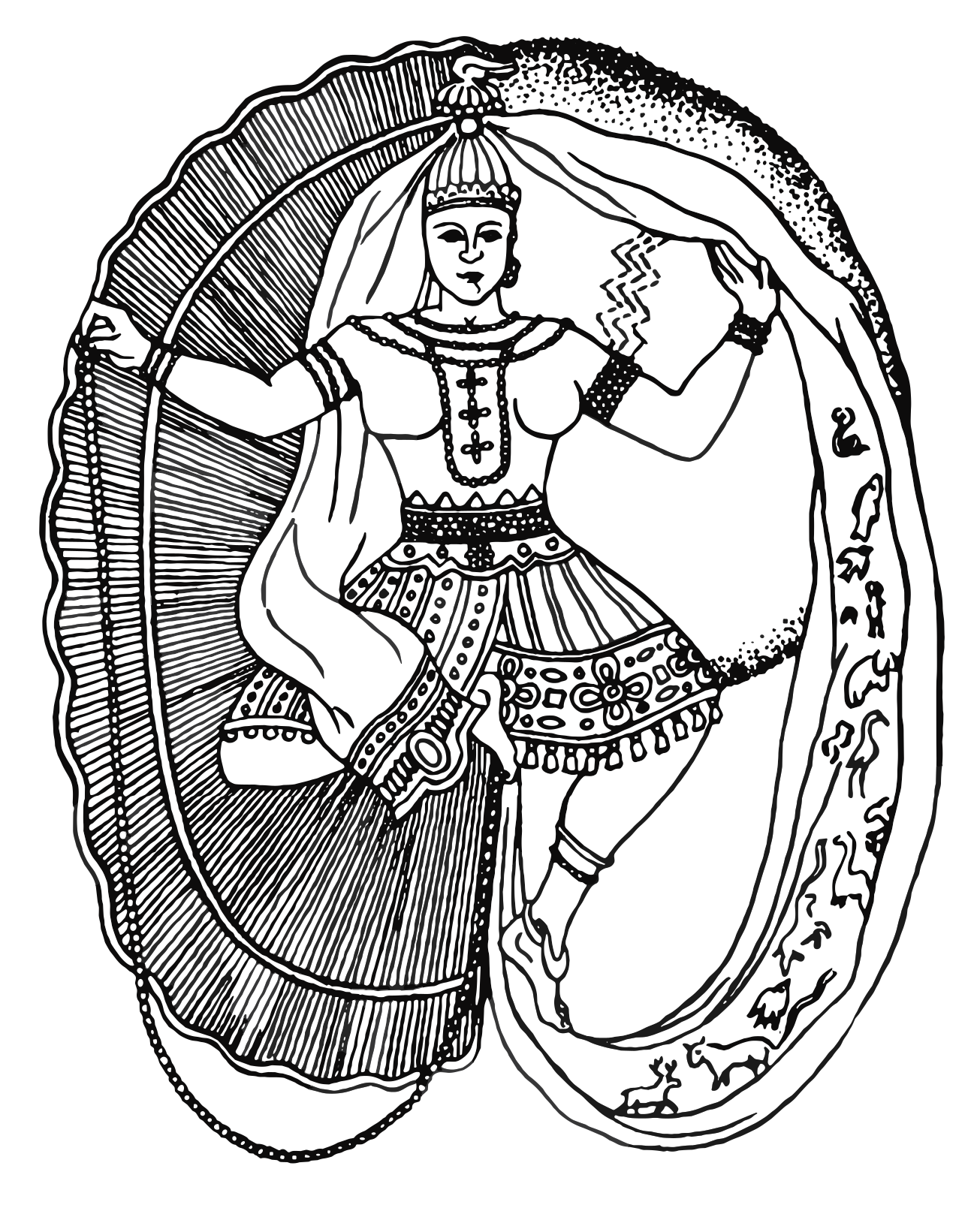
"I established this whole Universe with a single portion of myself,
and remain separate." — Tenth Chapter.
The Bhagavad-Gita
The Book of Devotion
CHAPTER I
THE DESPONDENCY OF ARJUNA
OM!
- The key for reading the Bhagavad-Gita is to be applied to this first verse. If we look at the poem in its application to a man aspiring to devotion, then the battlefield is the body acquired by Karma and Tanha, thirst for life, while the speaker and his party represent the lower self, and the Pandus the Higher Self. But if this and succeeding chapters are regarded from the cosmic standpoint, then the speaker, the plain of Kuru, the generals described in the first chapter, together with their instruments and weapons, are beings, forces, planes, and planets in the universe, of which it would be out of place to treat here. As applied to ourselves, the poem is of greater interest and importance: it opens with the battle inevitable between the higher and lower natures of man, and then, from this viewpoint, Krishna—who is the Higher Self,—in order to encourage Arjuna, becomes his instructor in philosophy and right ethics, so that he may be fit to fight and conquer.
CHAPTER II
DEVOTION THROUGH APPLICATION TO THE SPECULATIVE DOCTRINES
- Kshatriya is the second or military caste of India.
- Dhananjaya—despiser of wealth.
- Keshava—he whose rays manifest themselves as omniscience—a name of Krishna.
- Muni—a wise man.
CHAPTER III
DEVOTION THROUGH THE RIGHT PERFORMANCE OF ACTION
- Rajas is one of the three great qualities; the driving power of nature; active and bad.
- The burnished metal mirrors are here referred to.
- The discriminating principle is Buddhi.
- "He," the Supreme Spirit, the true Ego.
CHAPTER IV
DEVOTION THROUGH SPIRITUAL KNOWLEDGE
- Vivaswat, the sun, first manifestation of divine wisdom at the beginning of evolution.
- Manu, generic title for the reigning spirit of the sensuous universe; the present one being Vaivashwata Manu.
- Ikshwaku, the founder of the Indian solar dynasty.
- Rajarshees, Royal Sages.
- Maya, Illusion.
- See also the Varaha Upanishad of Krishna-Yajur Veda, viz; "The whole of the universe is evolved through Sankalpa [thought or ideation] alone; it is only through Sankalpa that the universe retains its appearance."
- This refers to the four great castes of India; the Brahmin, the soldier, the merchant, and the servant. Such division is plainly evident in every country, even when not named as such.
CHAPTER V
DEVOTION BY MEANS OF RENUNCIATION OF ACTION
- That is, one who has really renounced.
- That is, cold and heat, pleasure and pain, misery and happiness, etc.
- Sankhya school.
- Yoga school.
- Nirvana, or emancipation.
- This refers not only to the effect on the man now, in life, but also to the "binding to rebirth" which such action causes.
- That is, the body as having nine openings through which impressions are received, viz,: eyes, ears, mouth, nose, etc.
- The Sage who has united himself to true consciousness remains in the body for the benefit of mankind.
- In order to understand this clearly it is necessary to remember that in the Vedic philosophy it is held that all actions, whether they be good or bad, are brought about by the three great qualities—sattva, rajas, tamas—inherent in all throughout evolution. This is set forth at length in the 7th Chapter, and in Chapter 13 the manner in which those qualities show themselves is fully given.
- That is, direct knowledge of Self.
CHAPTER VI
DEVOTION BY MEANS OF SELF-RESTRAINT
- A Sannyasi.
- A Yogi
- Those ceremonies prescribed by the Brahmanical law.
- In this play upon "self" the Higher and the lower self are meant, in that the lower is the enemy of the Higher through its resistance to true development; and the lower self is at the same time the enemy of its own best interests through its downward tendency.
- These directions are for those hermits who have retired from the world. Many of the translators have variously construed the text; one reads that the devotee has "only skin and sheet to cover him and grass to lie upon"; another that "his goods are a cloth and deerskin and kusa grass." "Those who know" say that this is a description of a magnetically arranged seat and that kusa grass is laid on the ground, the skin on the grass, and the cloth on the skin. Philological discussion will never decide the point.
- "Reality," Nirvana and also complete realization of the True and the disappearance of the illusion as to objects and separateness.
- Madhu; a daitya or demon slain by Krishna, and representing the quality of passion in nature.
- "From both" here means the good Karma resulting from good deeds and spiritual knowledge acquired through yoga, or heaven and emancipation.
- "Without any support" refers to the support or sanction contained in the Brahmanical law in its promises to him who keeps it, for he who practices yoga is not abiding by the promises of the law, which are for those who obey that law and refrain from yoga.
- That is, Devachan.
- Madhusudana says this means in the family of a king or emperor.
CHAPTER VII
DEVOTION BY MEANS OF SPIRITUAL DISCERNMENT
- This means here the principle "Buddhi."
- In the original the word is "Mahatma."
CHAPTER VIII
DEVOTION TO THE OMNIPRESENT SPIRIT NAMED AS OM
- Karma here is, so to say, the action of the Supreme which is seen in manifestation throughout the evolution of the objective worlds.
- Brahmacharya vow is a vow to live a life of religious study and asceticism—"following Brahma."
- This refers to those who have acquired knowledge of the ultimate divisions of time, a power which is ascribed to the perfect yogi in Patanjali's Yoga Philosophy.
- The paragraph up to here is thought by some European Sanscritists to be an interpolation, but that view is not held by all, nor is it accepted by the Hindus.
CHAPTER IX
DEVOTION BY MEANS OF THE KINGLY KNOWLEDGE AND THE KINGLY MYSTERY
- That is to say, by the power of "prakriti."
- This reads that "they are inclined to the nature of the asuras and rakshasas," a class of evil elementals of beings, or, as some say, "of the nature of the very low constituents of nature."
- Among the Hindus the drinking of the soma at the end of a sacrifice is an act of great merit, with its analogy in the Christian faith in the drinking of the communion wine.
- "The region of Indra" is the highest of the celestial spheres. It is the devachan of theosophical literature, for Indra is the prince of the celestial beings who abide in deva-sthan.
- These evil spirits are the Bhutas, and are the same as the so-called spirits of the dead—the shells—worshipped or run after at spiritualistic seances.
- This may seem strange to those who have been born in Christendom, and perhaps appear to be testimony to harsh views on the part of Hindu sages respecting women, but in the Bible the same thing is to be found and even worse, where in I Tim. 2, 11-15, it is declared that the woman shall be saved through her husband, and that she must be subservient.
- Vaisyas and sudras are the two lower castes, or merchants and servitors.
CHAPTER X
DEVOTION BY MEANS OF THE UNIVERSAL DIVINE PERFECTIONS
- Beyond Brahma.
- In the original the first word is one which carries a blessing with it; it is a benediction and means "now then," but this in English conveys no idea of a benediction.
- Adityas, the twelve Sun-gods, who at the recurrence of the time for dissolution by fire, bring on the universal conflagration.
- The Gods of air.
- In Western language this may be said to be the Veda of song in the very highest sense of the power of song. Many nations held that song had the power to make even mere matter change and move obedient to the sound.
- In the original it is "Vasava" which is a name of Indra
- The heart or the mind.
- Spirits of a sensual nature.
- An order of evil spirits.
- Among the first created Beings of a high order.
- Said by some to be the North Pole.
- Jupiter, the teacher of the Devas.
- Celestial host of singers; they are a class of elementals.
- Poisonous serpents.
- Non-poisonous serpents of a fabled sort, said to have speech and wisdom.
- The Judge of the dead.
- Garuda, the bird of Vishnu, and also means esoterically the whole manvantaric cycle.
- The highest spiritual knowledge.
- A form of compound word in the Sanskrit which preserves the meaning of the words making up the compound.
- The month when the regular rains have stopped and the heat abated.
- Vyasa, the author of the Mahabharata.
CHAPTER XI
VISION OF THE DIVINE FORM AS INCLUDING ALL FORMS
- Hari, an epithet of Krishna, meaning that he has the power to remove all difficulty.
- Arjuna.
- This is the Hindu mode of salutation.
- These are the Uragas, said to be serpents. But it must refer to the great Masters of Wisdom, who were often called Serpents.
- Among human weapons this would be known as the discus, but here it means the whirling wheels of spiritual will and power.
- Purusha, the Eternal Person. The same name is also given to man by the Hindus.
- This cry is supposed to be for the benefit of the world, and has that meaning.
- All these names refer to different classes of celestial beings, some of which are now called in theosophical literature, "elementals"; the others are explained in H. P. Blavatsky's Secret Doctrine.
- Arjuna was a famous archer who could use the celestial bow, Gandiva, with either hand equally well.
- Arjuna wore a brilliant tiara.
- Krishna, by other names.
- That is, that into which the universe is resolved on the final dissolution.
- Arjuna had been accustomed to see Krishna in his four-armed form, not only in the images shown in youth, but also when Krishna came into incarnation, and could therefore look on the four-armed form without fear.
- A name of Krishna.
CHAPTER XII
DEVOTION BY MEANS OF FAITH
- That is, as described at the end of Chapter XI.
- The difficulty here stated is that caused by the personality, which causes us to see the Supreme as different and separate from ourselves.
- The works referred to here are special works of all kinds performed for the sake of the Supreme Being, which will have their effect upon the performer in future lives.
- In the original this reads as "not peering about."
CHAPTER XIII
DEVOTION BY MEANS OF THE DISCRIMINATION OF THE KSHETRA FROM KSHETRAJNA
- Prakriti, matter or nature, is the cause of all action throughout the universe, as it is the basis by which action may take place; and herein are included all actions, whether of men, of gods, powers, or what not.
- Purusha is the aspect of the individual spirit in every human breast; it is the cause of our experiencing pain and pleasure through the connection with nature found in the body.
- Here purusha is the persisting individuality which connects all reincarnations, as if it were the thread, and has hence been called the "thread Soul."
- This last sentence means that they thus lay such a foundation as that in subsequent lives they will reach the other states and then to immortality.
- This refers to what has previously been said about the great illusion produced by nature in causing us to see objects as different from Spirit, and it agrees with Patanjali, who says that, although the perfectly illuminated being has destroyed the illusion, it still has a hold upon those who are not illuminated—they will have to go through repeated rebirths until their time of deliverance also comes.
CHAPTER XIV
DEVOTION BY MEANS OF SEPARATION FROM THE THREE QUALITIES
- In this verse Brahmâ is to be taken as prakriti, or nature.
CHAPTER XV
DEVOTION THROUGH KNOWLEDGE OF THE SUPREME SPIRIT
- This is a symbol for the universe, which, although apparently destroyed and then again renovated, is never ending, for it is the same as the Evolutionary Stream.
- See preceding Chapter.
- This means that the bound Ego cannot understand it.
- It is the place of the Supreme.
CHAPTER XVI
DEVOTION THROUGH DISCRIMINATING BETWEEN GODLIKE AND DEMONIACAL NATURES
- This refers to the irregular performance of Vedic sacrifices by those who are without the right spiritual gifts, and only wish to imitate ostentatiously the right performance.
- This is final annihilation of those who deny their own soul and thus lose it. It is worse than the hell before spoken of for there is no return.
CHAPTER XVII
DEVOTION AS REGARDS THE THREE KINDS OF FAITH
- It reads "Brahmanas," and does not seem to refer to any caste.
CHAPTER XVIII
DEVOTION AS REGARDS RENUNCIATION AND FINAL LIBERATION
- Keshin was a daitya, a demon, fabled to have been sent by Kansa for the purpose of destroying Krishna.
- This verse refers not only to effects after death in the post-mortem states, but also to subsequent lives in the body upon reincarnating.
- This is Buddhi, the highest intellection, the power of judgment.
- The word is "Achyuta."
- One of the names of Vishnu, and also applied to Krishna.
Appendix A
The following is a comprehensive list of verses containing alternate recensions that deviate from the specific variants adopted for this edition, along with an assessment of their semantic significance. In instances where differences are deemed significant, the variant most consistent with WQJ's rendition has been selected; conversely, where the variation is negligible, the more widely recognized reading has been utilized.
| Chapter | Verse | Alternate Recension | Chosen Version | Semantically Significant? |
|---|---|---|---|---|
| 1 | 5 | काशी | काशि | No |
| 1 | 8 | सौमदत्तिर्जयद्रथः | सौमदत्तिस्तथैव च | Yes |
| 1 | 19 | तुमुलोऽभ्यनुनादयन् | तुमुलो व्यनुनादयन् | No |
| 1 | 34 | स्यालाः | श्याला: | No |
| 1 | 44 | नरकेऽनियतं | नरके नियतं | Yes |
| 2 | 64 | रागद्वेषवियुक्तैस्तु | रागद्वेषविमुक्तैस्तु | No |
| 4 | 35 | भूतान्यशेषेण | भूतान्यशेषाणि | Yes |
| 6 | 19 | यदा दीपो | यथा दीपो | Yes |
| 8 | 7 | संशयम् | संशय: | No |
| 11 | 20 | रूपमुग्रं | रूपमिदं | Yes |
| 13 | 1 | अर्जुन उवाच । प्रकृतिं पुरुषं चैव क्षेत्रं क्षेत्रज्ञमेव च । एतद्वेदितुमिच्छामि ज्ञानं ज्ञेयं च केशव || |
This verse is absent. | Yes |
| 13 | 21 | कार्यकरणकर्तृत्वे | कार्यकारणकर्तृत्वे | Yes |
| 14 | 23 | इत्येवं | इत्येव | Yes |
| 16 | 13 | लब्धमिदं | लब्धमिमं | No |
| 18 | 35 | सा तामसी मता | सा पार्थ तामसी | Yes |
| 18 | 59 | यदहङ्कारमाश्रित्य | यद्यहङ्कारमाश्रित्य | Yes |