Pistis-Sophia.
(Translated and annotated by G. R. S. M., with additional notes by H. P. B.)
Preface to the Electronic Edition
This volume collates all serialized segments of the groundbreaking English translation of Pistis Sophia published in Lucifer magazine between April 1890 and May 1891 by G. R. S. Mead with additional notes by H. P. Blavatsky. Later in 1896, Mead published his scholarly translation of Pistis Sophia which may be of greater interest to academicians. However for students of Theosophy, these early articles bridge the gap between strict textual scholarship and deep esoteric philosophy by explaining much of the Gnostic symbolism in the light of Theosophy. In her polemics with Abbé Roca, H. P. B. says that "the true Christians died with the last of the Gnostics, and the Christians of our day are but the usurpers of a name they no longer understand." Hence, these articles are reproduced here with the hope that they can aid the "christianized" Western mind in rediscovering the mystic tradition it has lost for over a millenium.
We have retained the same page-breaks and footnotes as the original Lucifer printing while also annotating the sequencial page numbers of this volume with the corresponding Lucifer magazine and page number to aid cross-referencing. We have also linked the page numbers of the original codex indicated in square brackets to the 1896 online edition at gnosis.org in order to facilitate comparitive study. Diagrams have been programatically redrawn, combined into animations where appropriate and individual elements made to highlight on mouse hover. It is hoped that these features will aid the student in studying the text which H. P. B called the "the highest and noblest" of all Gnostic systems.
Contents
- First Book
- April 18902
- May 18909
- June 189021
- July 189030
- August 189040
- September 189051
- October 189060
- Second Book
- November 189069
- December 189080
- January 189191
- February 1891100
- March 1891108
- April 1891117
- May 1891124
Lucifer April 1890
INTRODUCTION.
IN the present translation and annotation of the Gnostic Gospel Pistis-Sophia, it is proposed to treat this most mystical and interesting treatise in the simplest manner possible. As the text contains much verbiage and many repetitions which are wearisome and of no importance to the main narrative, such passages will be condensed or omitted.
As yet, no translation of Pistis-Sophia exists in English, with the exception of some passages which will be found in The Gnostics and their Remains by the late C. W . King. In France a translation has been attempted in the Encyclopédie Thèologique of the Abbé Migne, vol. xxiii. As a reliable version, however, it is worthless, for some of the most important passages, sometimes as many as thirty pages of the original Coptic text, are bodily omitted, and in other respects scant justice is done to the "heretics" by the pious translators, who, at the end of their introduction, discredit their own labours by declaring: "Le but qui nous a guidés dans cette tentative pénible et ingrate, a été de montrer ce qu'étaient les incompréhensibles et stériles aberrations ou s'égaraient aux premiers siècles de I'ère chrétienne les penseurs qui s'écartaient des routes de la véritè."3
The simplest and fairest account of the text, from an exoteric standpoint, is to be found in the interesting and learned work of the late C. W. King, in which he speaks of Pistis-Sophia with the greatest enthusiasm, as the most precious and perfect relic of the followers of the Gnosis. Throughout his work he continually refers to it as the highest authority of Gnosticism still extant. On page 14 of the Second Edition we read:—
"This treatise, ascribed to Valentinus (I know not on what authority), was discovered by Schwartze in a Coptic MS. preserved in the British Museum(1). He transcribed the Coptic text and translated it into Latin; both texts and version were published by Petermann in the year 1853(2). The original is copiously interspersed with Greek words and phrases; in fact, the Coptic was evidently so poor a language as to have no terms of its own to express any but the most materialistic ideas. . . . The authorship of this record is assigned by itself in several places to Philip the Apostle, whom the Saviour bids to sit down and write these things! This circumstance made me at first conclude it to be the lost gospel of Philip quoted by Epiphanius, but the particular anecdote adduced by him from that gospel is not to be discovered anywhere in this. But as the original is full of wide lacunae, which often fall in very interesting places, as if purposely defaced to escape the eyes of the profane, such an omission is not altogether conclusive against the identity of the two."
As to the date of the text, there is no certainty, and we must conclude with M. Matter in his Histoire du Gnosticisme, that it is "difficult to make any precise statement," even so far as to place it, as he does, "between the ends of the second and fifth centuries".
The present translation is made from the Latin and Greek version of the shortlived German orientalist Maurice G. Schwartze, which was edited and copiously emendated by Petermann. Whenever these scholars disagree,
(1) Experts say that it is the oldest Coptic MS. in the Museum.
(2) 1851, for we find in the Journal des Savants (1852, p. 333), a review of this work.
3 Translation of the French text: "The goal that guided us in this arduous and thankless endeavor was to show what the incomprehensible and sterile aberrations were, or into which the thinkers who strayed from the paths of truth went astray in the early centuries of the Christian era." — e-Ed.
the rendering most in keeping with the spirit of this mystical allegory of Initiation is preferred. Coptic scholars are a rarity even outside the T. S.; in fact, as we are informed by one of them, in Europe they may be counted on the fingers of one hand. Therefore, we must take things as we find them, and though we cannot hope to give the exact translation of the original, still, we may promise ourselves a rendering of Pistis-Sophia which will sufficiently inform us of the main ideas of the Gnostic scheme, especially as the original is innocent of elaborate constructions and meta-physical dissertations.
It will greatly add to the clear understanding of the mystic narrative if the reader bears in mind that the term "Jesus" stands for Christos, the glorified Initiate; and that Christos is the typical term for its prototype—the Higher Ego or Manas merged in Atma-Buddhi, and thus becomes one in three. Those unacquainted with the theosophical terminology may be informed that the word Atma means Universal Spirit; Buddhi, "Universal Spiritual Soul"; and Manas, the "Universal Mind"—of which only the latter two are individualised in man (1).
Pistis-Sophia (2).
[1] (3) It came to pass when Jesus had risen (4) from the dead and passed eleven years speaking with his Disciples, and teaching them only up to the
(1) The mystical and technical terms with which the narrative is crowded will be printed in capitals. In the Notes the abbreviation S. stands for Schwartze, and P. for Petermann. The Italics in the text are meant to draw the particular attention of the reader.
(2) It has been deemed advisable not to attempt any translation of this compound term. Pistis-Sophia is compounded of two substantives and, therefore, cannot be rendered La Fidèle Sagesse, as has been done by the translator or translators in the Dictionnaire des Apocryphes of the Abbé Migne's collection. If, again, we translate it by Faith-Wisdom, doubt will arise owing to the theological meaning of the first component, an idea which is totally foreign to the Gnostic scheme.
The reason for the term Pistis will be apparent from the following quotations from the text:
"O Light, in whom I have trusted (e-pist-eusa) from the beginning, for whose sake I have undergone these great trials, help me!" (Pag. 99.)
"With confidence I trusted (pistei e-pist-eusa) in the light, and recalling me to memory he has heard my hymn. . . . . Now, therefore, O Light, all the Rulers will see what thou hast done with me, so that they may fear and believe (pist-euôsi) in the Light." (Pag. 164.)
These passages are taken from the hymns of Pistis-Sophia to the Light.
The fundamental idea of the term Pistis will become apparent from the narrative.
(3) The numbers in square brackets denote the pages of the Coptic codex.
(4) "Was rising from the dead and passing. . . ." (S). The translation is of secondary importance; whichever rendering is adopted, the number eleven gives the key to the situation. The eleventh trial or degree of initiation had been safely passed through, and the twelfth and last which, if the candidate was successful, would crown the whole work, was now being entered upon. Hercules was to enter upon his twelfth labour, and the sun the twelfth sign of the Zodiac. Even the popular adage "at the eleventh hour," is an echo of this mystery. In the second volume of the Dogme et Rituel de la Haute Magie (pp. 386, et seqq), Eliphas Lévi gives the Nuctemeron of Appollonius of Tyana. Nuctemeron means the space of a day and a night or twenty-four hours. Each grade of initiation had two degrees, in all twenty-four. This explains "the First Mystery, which is the Four-and-Twentieth" of the text. Readers of the Abbé Constant's work, who are ignorant of Greek, should be warned that the French below the Greek is not even the vaguest possible
Regions (1) of the First Precepts (2) and of the First Mystery, the Mystery within the Veil, within the First Precept, to wit, the Four-and-Twentieth Mystery, and below those (Precepts) which are in the Second Space of the First Mystery, which is before all Mysteries, the Father in the likeness of a Dove (3), that Jesus said to his Disciples: "I am come from that First Mystery, which also is the Last (4), the Four-and-Twentieth Mystery". Now the Disciples knew not this Mystery, nor did they understand it, because (as they supposed) there was not anything within that Mystery (5); but they thought that it, indeed, was the Sum of the Universe and the Head of all things which are, and verily the End of all Ends. For Jesus told them that it comprehends the First Precept [2] and the Five Impressions, and the Great Light, and the Five Supporters, and also all the Treasure of Light.
Moreover, Jesus had not told his Disciples the whole emanation of all the Regions of the Great Invisible and of the Three Triple-Powers, and of the Four-and-Twentieth Invisibles (6), and of all their Regions, Æons and Orders, (that is to say) the manner in which the latter, which are also the Projections of the Great Invisible, are distributed.
Nor (had he spoken of) their Ungenerated, Self-generated, and Generated (7), their Light-givers and Unpaired (8), their Rulers and Powers, their Lords and Archangels, their Angels and Decans, their Ministers
paraphrase, but simply Levi's idea about the text. He is, however, right in saying that "these twelve symbolical hours, which may be compared with the signs of the Zodiac and the labours of Hercules, represent the cycle of degrees of Initiation". See Secret Doctrine I. 450.
(1) The Greek word translated by "Region" is topos; it corresponds to the Sanskrit loka. In the second volume of the Secret Doctrine, p. 174, we are told that "Sanja, the daughter of Viswakannan, married to the Sun, 'unable to endure the fervours of her lord,' gave him her Chhaya (shadow, image, or astral body), while she herself repaired to the jungle to perform religious devotions, or Tapas". Verb. sap.
(2) In Masonic Lodges the Tyler demands the sacramental words (or precepts) from the apprentice or candidate, thus repeating the ancient formulæ. As Ragon, following the occult tradition, has well proved, Masonry was a forced product of the Gnostic mysteries, born of a compromise between political Christianity and Gnosticism.
(3) Compare: "Thou art the First Mystery looking within, thou hast come from the spaces of the Height and the Mysteries of the Kingdom of Light, and thou has descended on the Vesture of Light, which thou didst receive from Barbelo, which vesture is Jesus, our Saviour, on which thou didst descend as a Dove." (Pag. 128.) Now, the Sccond Space of the First Mystery corresponds in Esoteric parlance to the second plane of consciousness from within or above, on which plane is Buddhi (the Spiritual Soul), the vehicle of Atman (Universal Spirit), the "First Mystery", which is also "the last Mystery" in the endless cycle of emanation and reabsorption. In Egyptian Esotericism the "dove symbol" of the Gnostics was represented by the glyph of the winged globe. The dove, that descends on "Jesus" at his baptism is typical of the conscious "descent" of the "Higher Self" or Soul (Atma Buddhi) on Manas, the Higher Ego; or in other words, the union during initiation of the Christos, with Chrestos [The words Christos and Chrestos seem to have been interchanged here — e-Ed.] or the imperishable "Individuality" in the All, with the transcendent Personality—the adept.
(4) In the same way that Atma is the first or seventh principle, as previously explained.
(5) "Because none of them had reached that Mystery." (S.)
(6) The triple Powers are an aspect of the triple Logos, and the 24 Invisibles are the 21 (7 x 3) emanating Rays, and their three Logoi.
(7) Or the Eternal unborn Powers—Aja, in Sanskrit: the Self-generated, the Anupadaka (parentless), the Self-existent—in Sanskrit, Swayambhu; and the generated, including both the emanations from higher Emanations (4th plane), and those Dhyan Chohans and Devas who have been men, i.e., already gone through the Manasic cycle.
(8) The "eternal celibates" the Kumaras; literally those without a Syzygy, double, pair, mate or counterpart. It is the Hierarchy of the Kumaras which incarnates in man as his Higher Ego or Manas.
and all the Houses of their Spheres, and all the Orders of each one of them.
Nor had Jesus told his Disciples the whole emanation of the Projections of the Treasure, and their Orders; nor of their (1) Saviours and their Orders; nor what is the Guardian beside each (Projection) of the Treasure of Light; nor the Region of the Saviour of the Twins, [3] who is the Child of the Child (2); nor in what Regions the Three Amens emanate; nor yet the Region of the Five Trees and Seven Amens, which are also the Seven Voices (3), according to the manner of their emanation.
Nor had Jesus told his Disciples of what type are the Five Supporters and the Region of their emanation; nor of the Five Impressions and the First Precept, in what type they are evolved (4); but in his teaching he merely stated that such things exist, and had not spoken of the emanation and Order of their Regions. This is the reason why they did not know that there were other Regions within that Mystery.
Moreover, he had not told his Disciples through what Region he passed while he was entering into that Mystery and while he was coming out therefrom; but teaching them he said (simply): "I am come from that Mystery". Therefore they thought that it was the End of all Ends [4] and the Sum of the Universe and the whole Plerôma (5).
It came to pass, therefore, when the Disciples were sitting by themselves on the Mount of Olives, speaking these words and rejoicing with great joy and being exceeding glad, saying one to another, "Blessed are we before all men who are on the earth, for the Saviour has revealed these things to us and we have received all fullness (6) and perfection," that Jesus sat a little removed from them.
It was on the fifteenth day of the moon of the month Tobe (7), the day of the full moon, when the sun had risen in its going, that there came forth after it a great flood of most brilliant light (8) of immeasurable brightness. For it came forth from the Light (8) of Lights from the Last Mystery, [5] to wit, the Four-and-Twentieth Mystery, from the Interiors to the Exteriors, which
(1) Sc. of the Projections. On pagg. 190 and 191 the scale of the twelve Saviours is given. The first seven preside over the projections or emanations of the seven Voices, Vowels, or Amens, and the last five over the five Trees; they are all of the Treasure of Light (II, 14).
(2) The "Child of the Child" is Manas, the child of Buddhi on a higher plane, and the lower Manas, the child of the higher, on an inferior semi-human plane. The "twins" are the dual Manas, in Esotericism.
(3) The "Three Amens" are: the upper triad in Septenary man; the region of the "Five Trees" is the earth and localities wherein the actual and past Five Root-races have developed; the "Seven Amens" and the "Seven Voices" are identical with the "Seven Aums and the Seven Mystic Voices", "the voice of the inner God" (vide Voice of the Silence, pp. 9 and 10). The "seven thunders" spoken of in Revelation are typical of the same mystery of spiritual Initiation. Again, from a Macrocosmic aspect the Seven Amens are the seven rays of each of the "Three Amens," making up the "Twenty-four Invisibles," and so on ad infinitum.
(4) As many of these terms are to a certain extent explained in the sequel, it will be unnecessary to go into an elaborate disquisition on the hierarchies. For the broad outline students should compare the Secret Doctrine, I, 213, 435, and also Part I of the Transactions of the Blavatsky Lodge.
(5) See Secret Doctrine, I. 406, 416, 449; II. 79, 506, and Isis Unveiled I. 302. From the esoteric point of view, the Plerôma in the Gnostic scheme corresponds to absolute space with its seven planes or degrees of Consciousness and the rest. See the passage on the "Seven Skinned Eternal Mother-Father" in the Secret Doctrine, vol. I, p. 9, and also Part I of the Transactions of the Blavatsky Lodge.
(6) Plerôma.
(7) From Dec. 20 to Jan. 18.
(8) The distinction between lux and lumen, both meaning light, has been preserved in the English by printing the word "light" with a capital when it stands for lumen.
are in the Orders of the Second Space of the First Mystery. Such a flood of Light came upon Jesus and surrounded him entirely. And the Disciples saw not Jesus because of the great Light with which he was surrounded, or which proceeded from him. For their eyes were darkened because of it. But they gazed upon the Light only, shooting forth great rays of light. Nor were the rays equal to one another, and the Light was of divers modes and various aspect, from the lower to the higher part thereof, each ray more admirable than its fellow in infinite manner, in the great radiance of the immeasurable Light. It stretched from the earth to the heavens. And the Disciples seeing the Light were in great fear and confusion. [6] It came to pass, therefore, when the flood of Light came upon Jesus, that it gradually surrounded him. Then Jesus was carried or soared into the Height, shining greatly with the immeasurable Light. And the Disciples gazed after him, none of them speaking, as long as Jesus was ascending into Heaven. But they remained all in deep silence. These things, then, were done on the fifteenth of the month Tobe, the day of the full moon (1).
It came to pass, therefore, when Jesus ascended into Heaven after the third hour that all the Powers of the Heavens were confused and shaken one with another, they and all their Æons, and Regions, and Orders, and the earth was disturbed, and all the inhabitants thereof. And confusion was upon all men in the World, and also among the Disciples, and all feared that the World was being destroyed. Nor did all the Powers which are in the Heaven cease to be in confusion one with another, even from the third hour of the fifteenth day to the ninth hour of the following day.
And all the Angels and their Archangels and all the Powers of the Height [7] sang hymns (2) in the Interior of Interiors, so that the whole World heard their voice, for they ceased not until the ninth hour of the next day. But the Disciples sat together in fear and were in the greatest possible distress. They feared because of the great confusion, and wept together, saying, What will be? Surely the Saviour will not destroy all the Regions? But on the ninth hour of the morrow, the Heavens were opened, and they saw Jesus descending, shining most exceedingly, with immeasurable rays. Nor was the light constant, but of divers modes and various aspects, some rays being more admirable than others in infinite manner. Yet it was light in every part. It was of three degrees, one surpassing the other in infinite manner. The second, which was in the midst, excelled the first which was below it, and the third, the most admirable of all, surpassed the other two.
The first radiance was placed below all like to the light which came upon Jesus [8] before he ascended into the Heavens, and was very regular as to its own peculiar Light. And the three degrees of the Light were of various light and aspect, excelling one another in infinite manner (3). Now it came to pass, when the Disciples had seen these things, that they feared exceedingly and were troubled. Jesus, therefore, being compassionate and merciful-minded, when he saw his Disciples thus troubled spoke with them saying: "Have courage; it is I, be not a fraid". And when the Disciples heard these words, they said, "Master! if thou drawest to thyself the radiant light, we shall be able to stand; but if not, our eyes
(1) This date proves that the above is a description of the Mysteries, all the greater Initiations being performed during full moon.
(2) See the Voice of the Silence, p. 65, when the hymn of nature proclaims: "A Master has arisen, a Master of the Day"; and also p. 72.
(3) On pagg. 17 and 18 the three Robes or Vestures are described. In Buddhism the three Buddhic bodies or forms are styled:— Nirmanakâya, Sambhogakâya, and Dharmakâya, as the Voice of the Silence informs us in the Glossary (p. 96), which see for a full description.
become blinded, and we are troubled, and the whole World is also troubled because of thy great Light". Then Jesus drew to himself the radiance of his Light; and all the Disciples taking heart came to him and bowed themselves together, beseeching him, and rejoicing with great joy, said unto him, "Rabbi, whither wentest thou? Or on what ministry didst thou go? Or wherefore are all these confusions and shakings? Then Jesus, in compassion, said unto them: "Rejoice and be glad from this hour, for I am come to the Regions from which I came out. [9] Wherefore, from this day forth, I will speak with you openly, from the beginning of Truth to th eend thereof, and I will speak to you face to face, without a parable. From this hour I will hide nothing from you of the things which pertain to the Height and to the Region of Truth. For authority has been given me by the Ineffable, the First Mystery of all Mysteries, to speak with you from the Beginning (1) to the Completion (2), both from the Interiors to the Exteriors, and from the Exteriors to the Interiors. Hearken, therefore, that I may tell you all things.
It came to pass when I was sitting a little removed from you on the Mount of Olives, reflecting on the Orders (duties?) of my Ministry, for which I was sent, how that it was fulfilled and the last Mystery had not yet sent me my Vesture which I placed in it, until its time should be completed; as the sun rose, the First Mystery, which was from the beginning, on account of which the universe was created and from which also now am I come out [10] (now only, not when they had not yet crucified me),— caused my Vesture of light to be sent me by him who gave it to me from the very beginning; which, indeed, I laid up with that Mystery until I should begin to speak with the human race, and should reveal to them all things from the beginning of the Truth to the end thereof. Rejoice, therefore, in that this has been given you.
Moreover, also, I have chosen you from the beginning through the First Mystery. Rejoice, therefore, and be glad, [11] for that after I came forth into the World I brought with me twelve Powers, as I told you from the beginning. I took them from the Twelve Saviours of the Treasure of Light according to the command of the First Mystery. These, therefore, when I came into the world, I cast into the womb of your mothers, which are in your body (3) to-day. For these Powers have been given to you before all the World, in that ye are to save the whole World, and in order that ye may be able to bear the threat of the Rulers of the World and the calamities thereof; and, moreover, all the dangers and persecutions that must be brought upon you by the Rulers of the Height. Many times have I said that I have brought the Power which is in you from the Twelve Saviours who are in the Treasure of Light, and that ye are not of the World . I also am not of it. For all men who are in the World, have taken their Soul from the Rulers of the Æons (4). But
(1) Archê.
(2) Plerôma.
(3) Notice the singular number of "womb" and "body".
(4) The four lower human Principles, we are taught in the Esoteric Philosophy, i.e., Body, Double, Life and Instinct (animal soul, or Kama, the passionate Principle), are derived by men from the Planetary Hierarchies and the Rulers of the lower terrestrial spheres—the rupa planes.
Compare the slokas of "Dzyan" in the Secret Doctrine, vol. II. 17.
"How are the Manushya born? The Manus with minds, how are they made? The Fathers called to their help their own fire; which is the fire which bums in Earth. The Spirit of the Earth called to his help the Solar Fire. These three produced in their joint efforts a good Rupa. It could stand, walk, run, recline, or fly. Yet it was still but a Chhaya, a shadow with no sense." . . . . "The Breath needed a form; the Fathers gave it. The Breath needed a gross body; the Earth moulded it. The Breath needed the Spirit of Life; the Solar Lhas breathed it into its form. The Breath needed a Mirror of its Body; 'We gave it our own,' said the Dhyanis. The Breath needed a Vehicle of Desires; 'It
the Power, which is in you, is from me. Of a truth your soul pertains to the Height (1). I brought twelve Powers from the Saviours of the Treasure of Light, which I took from a portion of the Power which I first received. [12] And when I had entered into the World, I came into the midst of the Rulers of the Sphere, like unto Gabriel the angel of the Æons, nor did the Rulers of the Æons know me, but thought that I was the angel Gabriel (2).
It came to pass, when I had come into the midst of the Rulers of the Æons, having looked from above into the World of men, I found Elizabeth, mother of John the Baptist, before she had conceived him. I planted the Power in her, which I had received from the Little iaô, the Good, who is in the Midst (3), that he should preach before me, and prepare my way, and baptize with water the remission of sins. This Power then is (4) in the body of John. Moreover, in the place of the Soul of the Rulers, appointed to receive it, I found the Soul of the prophet Elias in the Æons of the Sphere (5), and I took him, and receiving his Soul also, brought it to the Virgin of light, and she gave it to her Receivers, who led it to the Sphere of the Rulers and carried it into the womb of Elizabeth. So the Power of the Little iaô (6), the Good, who is in the Midst, and the Soul of the prophet Elias, are bound together in the body of John the Baptist.
[13] "For which cause, therefore, did ye doubt at that time, when I said unto you; John said, 'I am not the Christ': and ye said unto me: 'it is written in the Scriptures, if the Christ come, Elias comes before him, and will prepare his way'. And I replied: 'Elias, indeed, is come, and has prepared all things according as it was written; and they have done unto him whatsoever they would'. And when I perceived that you did not understand those things which I spake to you concerning the Soul of Elias, as bound in John the Baptist; I then answered openly and face to face: 'If ye will receive it, John the Baptist is that Elias who', I said, 'was coming'."
has it,' said the Drainer of Waters. But Breath needs a mind to embrace the Universe; 'We cannot give that,' said the Fathers. 'I never had it,' said the Spirit of the Earth. 'The form would be consumed were I to give it mine,' said the Great Fire. . . . ."
(1) The arupa or formless planes, which shows that "Jesus" is the type of the Mahatmic prototype, the Higher Manas.
(2) See Isis Unveiled II., p. 247.
(3) This is to say, that the Power planted is the reflection of the Higher Ego, or the lower Kama-Manas.
(4) Notice the tense, the orthodox John being dead years before.
(5) It is curious to remark the interchangeability of terms; at the end of pag. 12 we have the Rulers of the Sphere and the Rulers of the Æons, and now we have the Æons of the Sphere and a little below the Sphere of the Rulers. They are all intentional blinds.
(6) On page 194 we read of "the great Leader of the Midst whom the Rulers of the Æons call the Great iaô, according to the name of the great Ruler which is in their Region, . . . . . and the twelve Servants (Deacons), whereby ye received Form and Strength." "As above, so below"; this apparent dualism is quite in keeping with all esoteric systems.—Demon est Deus inversus."
Lucifer May 1890
Pistis-Sophia.
AS perhaps many of our readers are unfamiliar with the general scheme of the Gnosis, and as the Pistis-Sophia presupposes a thorough knowledge of the outlines of this scheme, we are compelled to depart somewhat from our original plan and insert a résumé of this sublime system. It is somewhat invidious to select any particular school, but perhaps that of Valentinus who flourished at the beginning of the second century a.d., will best serve our purpose.
The following is translated from the Refutation of All Heresies (1) attributed to Hippolytus, Bishop of Ostia (Portus), who was put to death a.d. 222. There is, however, doubt as to the identification and date of this writer; but, be that as it may, he is the fairest and most accurate of all the Church Fathers and his Refutation is one of the most reliable chronicles of the Gnostic period that we possess. (2)
After a most interesting review of the Pythagorean and Platonic systems of numbers and a comparison between these systems and that of Valentinus, in order to prove that the teaching of the latter was from the former philosophers and not of Christ, our author continues:—
For them, the beginning of all things is the Monad, (3) ingenerable, imperishable, incomprehensible, inconceptible, the creator and cause of the generation of all things that are generated. (4) This Monad is called by them the Father. Now as to its nature there is a difference of opinion among them; for some declare that the Father is devoid of femininity and without a syzygy (consort, pair, or sakti) and solitary; whereas others think that it is impossible that from a single male principle, the generation of all things should be, and so they are compelled to add to the Father of All, in order that it (5) may be a Father, the syzygy Silence (Sigê). But as to whether Silence is a syzygy or not, let them settle this dispute among themselves. (6)
In the Deginning, says (Valentinus), naught was that was generated. The Father alone was, ungenerated, without space (or region), time, counsellor, or any other essence (or attribute) capable of being conceived by any means. It was alone, solitary, and at rest, itself in itself, alone. But since it had the power of creating (emanating rather), it seemed good to it
(1) More generally known as the Philosophumena, Lib. IV. capp. 29 et seqq.
(2) But even so, when it is remembered that we get the following résumé from the writings of an opponent, it is evident that no partiality to the "heretics" colors the exposition, and that we have the barest possible justice at the best. What should we have learned from the pen of a Gnostic!
(3) See the Chart of the Plerôma, appended to this paper.
(4) Our author, with the usual materialising propensity of the ecclesiastic, thus makes the Valentinian System start from Brahmâ, the creator or third Logos; in other words he starts from the Plerôma. Bythus or the Monad, on the contrary, is the First Unmanifested Logos, the Potentiality of all Potentialities.
(5) Although our author expresses Bythus, or the Father, by masculine pronouns in his narrative, we prefer to follow Valentinus, who tells us that the Father was "without attributes". We, therefore, shall use impersonal pronouns when referring to the Monad, and so vindicate the teachings of the great Gnostic sage for all philosophical minds.
(6) That is the mystery of the First Unmanifested Logos and Mulaprakriti.
at length to generate and produce that which was most beautiful and most perfect in itself, for it loved not solitude. For Love, said (Valentinus), was all, but Love is not Love if there is nothing to be loved.
"Therefore, the Father, solitary as it was, emanated and generated Mind and Truth, the Duad, which is the Lady and Beginning and Mother of all the Æons which they reckon in the Plerôma. And Mind and Truth having emanated from the Father, possessing the power of generation like their parent, in imitation of the Father, emanated themselves also the Logos and Life. (1) And the Logos and Life emanate Man and the Assembly (ekklesia, Church). But Mind and Truth, when they saw that their own generations had become generators in their turn, gave thanks to the Father of All and offered it Ten Æons, the perfect number. For, said he, Mind and Truth could not offer the Father a more perfect number than this. For it was necessary that the Father which was perfect, should be worshipped with a perfect number, and the Ten is perfect because it is the first number of the plurality of digits. But the Father was more perfect still, because being itself ingenerable, alone through one and the first syzygy, Mind and Truth, it was able to emanate all the roots of all things which are."
[30] And when the Logos and Life also saw that Mind and Truth had celebrated the Father of All (All-Father) with a perfect number. The Logos together with Life wished to worship their own father and mother, Mind and Truth. But since Mind and Truth were generable and had not their own fatherhood perfect, viz., the quality of being themselves parentless, the Logos and Life do not worship their own father Mind with a perfect, but with an imperfect number, and offer their parents Twelve Æons.
"Now the following are the first roots of the Æons according to Valentinus: Mind and Truth, the Logos and Life, Man and the Assembly; Ten from Mind and Truth, and Twelve from the Logos and Life; eight-and-twenty in all. (2) These are called by the following names: Bythius and Mixis, Agêratus and Henôsis, Autophyês and Hêdonê, Akinêtus and Synkrásis, Monogenês and Makaria. These are the Ten Æons, which some derive from Mind and Truth, and others from the Logos and Life. Some again derive the Twelve of which we have been speaking from Man and the Assembly, and others from the Logos and Life; and the names they give these Twelve are—Paraklêtus and Pistis, Patrikus and Elpis, Mêtrikus and Agapê, Aênûs (Aeinous) and Synesis, Ekklesiastikus and Makariotes, Thelêtus and Sophia. (3)
Now, the twelfth of these Twelve, and the youngest of the eight-and-
(1) The verbs in this passage are singular, Mind and Truth being regarded as one duad.
(2) That is four sevens, three being still unmanifested even in the Divine Mind.
(3)
| DECAD. | DODECAD. | ||
 |
|
||
| Bythius (Bythus-like) |
Mixis (Mingling) |
Paraklêtus (Advocate or Comforter) |
PISTIS (Faith or Confidence) |
|
|
||
| Agêratus (Unaging) |
Henôsis (Union or Oneness) |
Patrikus (Father-like) |
Elpis (Hope) |
|
|
||
| Autophyês (Self-existent) |
Hêdonê (Bliss) |
Mêtrikus (Mother-like) |
Agapê (Love or Charity) |
|
|
||
| Akinêtus (Immovable) |
Synkrásis (Mixing) |
Aênûs (Everlasting or Everflowing) |
Synesis (Understanding) |
|
|
||
| Monogenês (Only-begotten) |
Makaria (Blessedness) |
Ekklesiastikus (Ecclesia-like) |
Makariotes (Happiness) |
|
|
||
| Thelêtus (The Longed-for or Desired) |
SOPHIA (Wisdom) |
||
twenty Æons, Sophia by name, a female Æon, beholding the multitude and power of the Æons which had generated, returned to the depth of the Father and perceived that all the rest of the Æons, being in their nature generated, generated through a syzygy. But the Father alone generated without a syzygy. She, therefore, desired to imitate the Father and generate by herself without her syzygy, in order that she might perform a work not inferior to that of the Father, being ignorant that the ungenerable, as it is fundamentally the beginning and root, and the deep and depth of all, could generate alone, whereas Sophia being generated and produced after many, could not possess the power of the ungenerated. For in the ungenerated, he said, are all things together, whereas in the generated the feminine has the power of emanating the essence, while the masculine has the power of informing the essence emanated by the feminine. Sophia, therefore, emanated the only thing which she could, viz., a formless and uninformed (unwrought) essence. This is what, he said, Moses said: 'The earth was invisible and unformed.' (1) This is, he said, the good and Celestial Jerusalem, into which God promised to lead the sons of Israel, saying: 'I will lead you into a land flowing with milk and honey.' (2)
"[31] And so ignorance having been produced through Sophia, within, in the Plerôma, and formlessness also by the generation (production) of Sophia, tumult arose in the Plerôma lest the generations (progeny) of the Æons should in like manner become formless and imperfect, and destruction in no long time seize on the Æons. All the Æons, therefore, betook themselves to praying to the Father to stop the sorrowing Sophia. For she was bewailing and groaning because of the Abortion generated by herself; for thus they call it. Therefore, the Father taking pity on the tears of Sophia and giving ear to the prayers of the Æons, ordered an additional emanation. For it was not himself that emanated, but Mind and Truth which (emanated) the Christos and Holy Spirit for the informing and differentiation of the Abortion and for the consolation and appeasing of the complaints of Sophia. So that together with the Christos and the Holy Spirit there are thirty Æons. (3) Now some of them think that she (the Holy Spirit) is the thirtieth Æon, while others maintain that Sigê co-exists with the Father, and that the Æons should be reckoned together with them. The Christos and Holy Spirit then, being after-emanated by Mind and Truth, immediately separated this formless Abortion of Sophia, which was generated by her alone without her syzygy, from the universal Æons, lest the perfect Æons seeing it should be thrown into confusion by its formlessness. In order then that the Abortion should not appear to the perfect Æons in all its formlessness, the Father again emanated additionally one Æon, the Staurus (Cross or Stock), which having become great, in as much as it was from the great and perfect Father, having been projected into the custody and stockade of the Æons, became the Hǒrus (Boundary) of the Plerôma (Completion) having within itself all
(1) Genesis i. 2.
(2) Exodus xxxiii. 3.
(3) 30 = 2 x 3 x 5 and also 3 x 10; and 3 x (7 + 3). Now if we remember that five is the number of the Pentagram or Man, we shall be able to see that the number 30 includes both Microcosmic and Macrocosmic numbers. If again we add to the Plerôma the Father, we get 31. Now 777 = 343 + 434, = (7 x 7 x 7) + (2 x 7 x 31). = 73 + (2 x 7) x (22 x 7 + 3).
Also 777 = 7 x 10² + 7 x 10 + 7.
Take the powers to represent planes and apply them to the geometrical Figures—Earnest esoteric students should take the hint and work out some of the marvellous permutations, combinations, and interchangeabilities of numbers and geometrical figures; but in this stupendous and mind-bewildering task each must do his own thinking for himself.
the Thirty Æons together. (1) Now it is called the Boundary, because it bounds the Hysterêma (Incompletion, Inferiority) without, from the Plerôma; again, it is called the Participator, because it partakes of the Hysterêma, and the Stake (or Stock), because it is fixed, without inclination and incapable of change ( lit: without repentance) (2), so that nothing of the Hysterêma should approach the Æons within the Plerôma.
"Without, then, this Boundary, Stake or Participator, is what they call the Ogdoad, (3) which is the Sophia-Without the Plerôma, which the Christos, who was an after-emanation of Mind and Truth, formed and fashioned into a perfect Æon, by no means inferior to those within the Plerôma. When then Sophia-Without had been fashioned, the Christos and Holy Spirit, emanated from Mind and Truth, as they could not in like manner remain outside the Plerôma, ascended from her whom they had informed, to Mind and Truth within the Boundary, glorifying the Father together with the rest of the Æons.
[32] When, then, there was, so to speak, a unity of peace and concord among all the Æons within the Plerôma, it seemed good to them, not only that they should have magnified the Father by their syzygies, but also that they should magnify him by the offering of fit fruits. All the Thirty Æons accordingly agreed to emanate one Æon as the common fruit of the Plerôma, as the sign of their unity, unanimity and peace. Now the only common emanation of all the Æons for the Father is that which they call the Common Fruit of the Plerôma. (4) Thus it was done within the Plerôma.
"So the Common Fruit of the Plerôma was emanated, viz., Jesus (for this was its name), the great High Priest (or Pontifex). (5) Now the Sophia without the Plerôma, missing the Christos who had informed her, and the Holy Spirit, was thrown into great alarm lest she should perish, now that he who had informed and strengthened her, was removed. So she mourned and was in great distress, pondering who was her informer (fashioner); what the Holy Spirit; whither they had departed; who prevented them from being with her; and who envied the beautiful and blessed spectacle thereof. In these sufferings she betook herself to prayer and beseeching him who had abandoned her. (6) And as she prayed the Christos within the Plerôma and all the other Æons took pity on her, and
(1) The Staurus or Cross (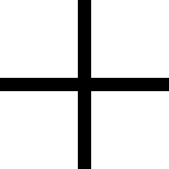 ) is the potentiality of the Positive and Negative, or Male and Female, forces in nature. They are also called the Participator, because, they share in the Creation Above, in an abstract sense, and in the Creation Below, in a concrete. In the abstract the ceases and becomes the
  , and therefore is called the Boundary, for the Below is the Natural Creation of Sex, whereas the Above is the Creation of the Gods or of Mind; in other words, of the Plerôma or Mahat. We see also this Fall into generation, or the Substitution of the Natural for the Divine Creation, typified in the Myths of Saturn emasculating Uranus, Zeus, Saturn, and Typhon, Osiris.
(2) "Without repentance," i.e., unconsciously, the forces acting as a Law of Nature.
(3) N.B.— All in the Plerôma is reflected without.
(4) For the whole Plerôma is a unity to those below.
(5) The Bridge-maker, he who extends the ray to the worthy or withdraws it from the unworthy, he who builds the "Bridge" between the Higher and the Lower Manas, viz. the Antaskarana.
It is hardly necessary to point out that Jesus and Christ are distinct entities, in fact as we shall see later on there are no less than three Christs in the Gnostic scheme.
Esoteric students will at once perceive that, from the Microcosmic standpoint, Jesus is the Lower Manas, the ray from the Higher Manas, even as, from the Macrocosmic standpoint, it corresponds to Manas, the ray from Mahat, the Divine Mind. Jesus is not Christos, just as the Personality is not the Individuality.
(6) Note also that her original syzygy is Thelêtus, the Desired or Longed-for.
sent out from the Pleroma the Common Fruit of the Pleroma, the syzygy of Sophia-Without and the corrector of her sufferings which she suffered, seeking for the Christos. So the Fruit becoming without the Pleroma and finding her in the first four afflictions, viz., fear, grief, helplessness and need (entreaty or prayer), set right her sufferings; but in doing so he perceived that it was not meet that those affections (or afflictions) which were of the Æons (or eternal) and peculiar to Sophia, should be destroyed, nor on the other hand that Sophia should be in such afflictions as fear, grief, supplications and distress. Accordingly, as he was so great an Æon and the progeny of the whole Pleroma, he made her afflictions depart from her, and transformed them into substantial essences. And fear he made a soulish (animal) essence; grief, a material; distress, a daemonial; and conversion (i.e. a turning to any one for help) and prayer and supplication he made the path of return (way up), (1) and repentance and the power of the soulish essence which is called 'right'. The Demiurge was made of fear. And this is the meaning of the scripture, he said, 'The fear of the Lord is the beginning of Wisdom (Sophia)'. (2) For this (fear) was the beginning of Sophia's woes. For she was first in fear, then in thus betook herself to prayer and supplication. Now the soulish (animal) essence, he said, was fiery and was called the Middle (or Mean), and the Hebdomad (3) and the Ancient of Days; of this essence was the Demiurge.
Now the power of fire, he said, was twofold. For there is a fire which is all-devouring and which cannot be quenched and . . . . [a lacuna occurs here unfortunately]. From this kind of fire then, the soul is a mortal thing, being a sort of mean; for it is the Hebdomad and Pause. It is, however, below the Ogdoad, (4) where is Sophia . . . . and the Common Fruit of the Pleroma, but it is above the Hyle (Matter) of which is the Demiurge. (5) If, therefore, it (the soul) is assimilated with the above, viz., the Ogdoad, it becomes immortal and passes to the Ogdoad, which is, according to Valentinus, the Celestial Jerusalem but if it is assimilated with Hyle, that is with material qualities, it will be destroyed and perish. (6)
"[33] As, therefore, the first and greatest power arose from the soulish essence . . . . [a lacuna occurs here] the image Diabolus, the ruler of this world: whereas Beelzebub is of the essence of the Dæmons which are bred of doubt (incapacity or distress), Sophia energizing from above, from the Ogdoad unto the Hebdomad. The Demiurge, they said, knows nothing at all, but is mindless and foolish, according to them, and he knows not what he does or operates. And as he knows not what he does, Sophia operates and strengthens all, and when she does so, he imagines that he is making the foundation of the world of himself: wherefore he began to say: 'I am God and besides me there is no other'. (7)
[34] "The Valentinian Tetractys ,(8) then, is the 'Source containing the roots of sempiternal (lit. ever-flow ing) nature', and Sophia that from which the soulish and material foundation (creation) was constituted. And Sophia is called Spirit; the Demiurge, Soul; Diabolus, the Ruler of this world; and Beelzebul, the (Ruler) of Dæmons. Such are their teachings.
"Moreover, there is a mathematical side to their doctrines; and they make the Thirty Æons in the Pleroma emanate again other Æons by
(1) Antaskarana from another aspect.
(2) Psalm cxi. 10.
(3) See Fig. 7; The "Seven" is in the middle.
(4) Study Figures 3, 7, 8, 15 and 18.
(5) See Fig. 9. The Horizontal diameter is above the greatest triangle of matter.
(6) Fig. 9. The triangles on whose bases are 4 Fires, are fourth in either series, and therefore have attained the turning point.
(7) Deuteronomy iv. 35.
(8) See the explanation of the figures.
analogy, so that the Pleroma should be collected in a perfect number. For like as the Pythagoreans divided into twelve, and thirty, and sixty; (1) so also they sub-divide the contents of the Pleroma. The numbers of the Ogdoad also are sub-divided; and Sophia who, according to them is the Mother of All Living, and the Common Fruit of the Pleroma, emanated Seventy Logoi, (2) which are celestial Messengers (angels), dwelling in Jerusalem, which is above in the Heavens. For this (mundane) Jerusalem is the Sophia without, and the Common Fruit of the Pleroma is her spouse. Moreover, it was the Demiurge who is the emanator of souls; for he is the essence of souls. According to them, the former is Abraham and the latter the children of Abraham (3). The Demiurge then, made bodies for the souls from the material (hylic) and diabolical essence. This is as it was said: 'And God shaped man, taking dirt from the earth, and breathed into his face (or appearance) the breath of life; and man becam e a living soul.' (4) This is, according to them the inner man, the soulish (principle), dwelling in the material body, which is material, perishable, imperfect, fashioned from the diabolical essence. The latter is the material man, according to them, as it were an inn or habitation, at one time of the soul alone, at another of the soul and Dæmons, at another of the soul and Logoi, which are the Logoi from above scattered from the Common Fruit of the Pleroma and Sophia into this world, dwelling in a Choïc body (i.e. the body of "dirt" or "slime" above mentioned), whenever the Dæmons do not cohabit with the soul. This, he said, was what was written in the scripture: 'For this cause I bow my knees unto the God and Father and Lord of our Lord Jesus Christ, in order that God may grant you that the Christos may dwell in your inner man', (5) that is the soulish and not the corporeal (man), 'that ye may be strong to know what is the depth', that is to say, the Father of All, 'and the breadth', which is the Stake, the Boundary of the Pleroma, 'or length', (or height), which means the Pleroma of the Æons. Therefore, he said: 'the soulish (animal) man does not perceive those things which are of the Spirit of God; for he is foolish'. (6) Now foolishness, he said, is the power of the Demiurge: for he was foolish and mindless and thought that he himself was fabricating the world, being ignorant that it was Sophia, the Mother, the Ogdoad, (7) who operated all for the constitution of the world for him not knowing.
"[35] All the prophets, therefore, and law babbled (8) under the
(1) 12 = 4 x 3, = 22 x 3: = 60 = 12 x 5, = 3 x 4 x 5, = 22 x 3 x 5.
Also 60 = (7 + 5) x 5, = (7 + 3 + 2) x 5, = (10 + 2) x 5.
All of which may be applied to planes and principles.
(2) 70 = 7 x 10, = 21 + 49, = 3 x 7 + 7 x 7.
(3) See Cap. 36 infra, and compare the passages in the Bible where "father Abraham" and "the seed of Abraham" are spoken of, and perhaps quite a new meaning of these familiar phrases will present itself. Cf. for "father Abraham" Mat. iii, 9; Luke iii, 8; i, 73; xvi, 24 and 30; John viii, 39, 53, and 56; Acts vii, 2; Rom. iv, 1, 12, and 16; and Jam. ii, 21; and for "seed of Abraham" Luke i, 55; John viii, 33 and 37; Rom. iv, 13; ix, 7 ; xi, 1; Gal. iii, 16 and 29 ; and Heb. ii, 16.
(4) Genesis ii. 70.
(5) Ephes. iii. 14, 16— 18.
(6) I. Cor. ii. 14.
(7) Sophia, the Ogdoad, is of course the reflection of the Pleromic Heptad plus Sige; viz., Sophia, plus the Abortion, the Tetrad, and plus the Common Fruit, the spouse or syzygy of the Abortion, the Triad; eight in all, the Ogdoad.
Perhaps also by a careful study of the Figure, a raison d'etre for the nefast "Eighth Sphere" (which is not the moon) may be suggested.
(8) The very word used of John the Baptist in John 1. 37. Indeed the first chapters of John can only be interpreted by a Gnostic student; every verse bristles with technicalities of the Gnosis; even the apparently most unimportant words are full of meaning.
inspiration of the Demiurge, foolish know-nothings (inspired by) a foolish God, according to him. For which cause, said he, the Saviour said: 'All who came before me are thieves and robbers', (1) and the Apostle: 'the mystery which was not known to former generations (2) For none of the prophets, he said, spake about these things of which we speak; for they were not known: all things [a lacuna occurs here], inasmuch indeed as they were babbled forth under the inspiration of the Demiurge alone. When, therefore, the creation (or constitution) came to an end, and the manifestation of the Sons of God, that is of the Demiurge, had thereafter to take place—the manifestation that had been hidden and in which, he said, the soulish man had been concealed, having a veil over his heart—when, therefore, the veil had to be raised and these mysteries were to be perceived, Jesus was born through Mary the Virgin, according to what was written: 'the Holy Spirit (Ghost) shall come upon thee', the Spirit is Sophia, 'and the power of the Highest shall overshadow thee', the Highest is the Demiurge, 'for that which shall be born from thee shall be called holy'. (3) For he was not born from the Highest alone, as those who were constituted according to Adam were constituted from the highest alone, that is the Demiurge. But Jesus the new man was born of the Holy Spirit, that is of Sophia and the Demiurge, in order that the Demiurge might make up the moulding and arrangement of his body, but the Holy Spirit provide the essence thereof, and he might be the celestial Logos from the Ogdoad, born through Mary.
Now concerning this tenet there is a great questioning among them and it is the cause of schisms and dissension. Hence their doctrine is divided into two schools, of which one is called the Eastern and the other the Italian. Now the Italian school maintains that the body of Jesus was soulish (animal), and it was because of this that the Spirit descended as a dove at his baptism, that is, the Logos of his Mother the Sophia-Above, and approached his soulish principle and awoke him from the dead. (4) This is that which was spoken, he said : 'he who aroused Christos from the dead, will vivify also your mortal bodies', (5) that is to say, your soulish (bodies). For it is the 'slime' that came under the curse, 'for earth thou art, and unto earth thou shalt return'. (6) The Eastern school, on the other hand, declares that the body of the Saviour was spiritual: for the Holy Spirit, that is to say, Sophia and the power of the Highest, the demiurgic art, came upon Mary, in order that that which had been given by the Spirit to Mary, might be fashioned.
[36] Moreover, he goes on to say, as the failures which pertain to the Æons which are within, had been rectified, and also those that pertain to the Ogdoad, viz., the Sophia-Without, so also those which pertained to the Hebdomad. (For the Demiurge was taught by Sophia, that he was not the one only God, as he imagined, and that there were no others besides himself, as he supposed; and so being instructed by Sophia, he understood that there was a higher. For he was instructed, and initiated, and taught by her the great mystery of the Father of the Æons, and he told it to no one; this is, he said, what he (the Demiurge) spoke to Moses: I am the God of Abraham the God of Isaac, and the God of Jacob, and the name of God I have not declared unto them', (7) that is I have not spoken nor revealed the mystery, 'Who is God', but I have kept in secret with myself the mystery which I heard from Sophia). Since, therefore, the higher (mis-deeds or failures) had been corrected, by the same sequence it was necessary that those of our lower plane should also be set right. For this cause was born Jesus the Saviour, through Mary, in order that the failures (or mistakes) here should be set right; just as the Christos, who was after-emanated by
(1) John x. 8.
(2) Cf. Ephes. iii. 9, 10; Rom. xvi. 25.
(3) Luke i. 35.
(4) The uninitiated were always called the "dead".
(5) Rom. viii. 11.
(6) Genesis iii. 19.
(7) Exodus vi. 2, 3.
Mind and Truth, set right the sufferings of Sophia-Without, that is of the Abortion. And so again the Saviour, born through Mary, came to set right the sufferings of the soul. There are, therefore, thee Christs, viz., he who was after-emanated by Mind and Truth together with the Holy Spirit; and the Common Fruit of the Pleroma, the syzygy of the Sophia-Without, who is also called the Holy Spirit inferior to the first; and the third, he who was bom through Mary for the correction of our human constitution."
Our author was right in comparing the Valentinian system with those of Pythagoras and Plato and in declaring that it had a mathematical basis. The Gnosis at all times and in all countries has been based on natural laws, and the different branches of mathematical science are simply the methods of expressing these laws. To vindicate these sublime systems of antiquity, and to prove that they were based on something more than "supertitious imagination", some figures will now be given, and some hints to their explanation attempted. It must, however, be remembered that as such figures are infinite, and that the permutations and combinations of their properties, correspondences and qualities are equally infinite, no more than the roughest possible outline can be given in a short paper. As, however, in the sequel, reference will often be made to these figures, it is necessary for the reader to be put into possession of their general scheme at the beginning of our undertaking. It is hoped that by these figures students will be given the clearest possible proof that, as Plato said, "The Deity geometrizes".
First the • (Point), the Monad, Bythus (the Deep), the unknown and unknowable Father. Then the 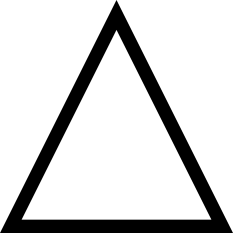 (Triangle), Bythus and the first emanated pair or Duad,
Nous (Mind) and its syzygy Aletheia (Truth). Then the  (Square), the dual Duad, Tetractys or Quaternary, two males ‖, the Logos (Word) and Anthrôpos (Man), two females, their syzygies, = Zoê (Life) and Ekklesia (the Church or Assembly), Seven in all. The Triangle the Potentiality of Spirit, the Square the Potentiality of Matter; the Vertical Straight Line the Potency of Spirit, and the Horizontal the Potency of Matter. Next comes the Pentagram
 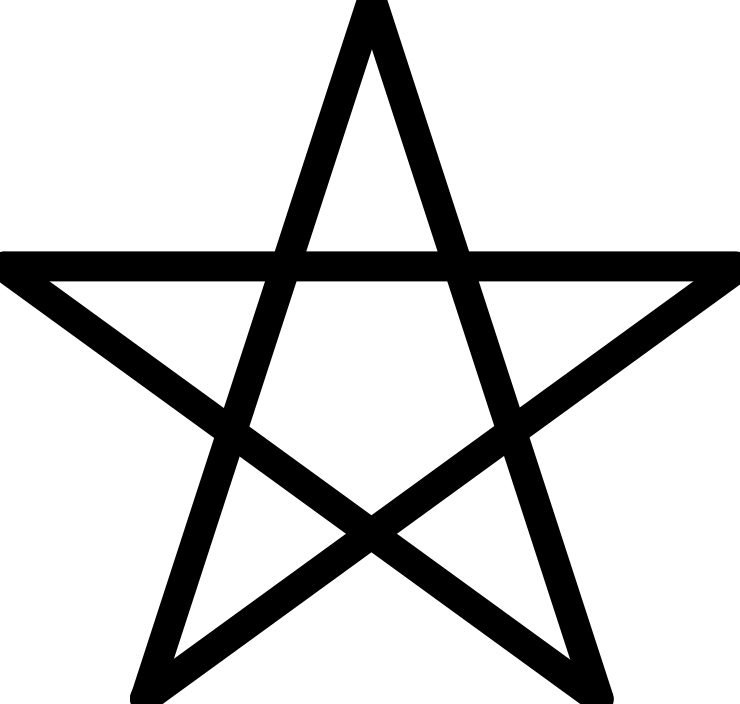 , the Pentad, the mysterious symbol of the Manasáputras or Sons of Wisdom, which together with their syzygies make 10, or the Decad; and last of all, the Hexalpha or interlaced Triangles
 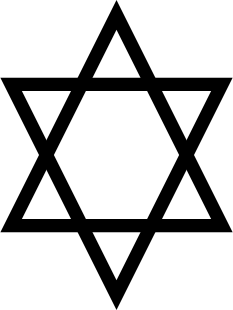 , the Hexad, which with their syzygies make 12, or the Dodecad. Such are the Contents of the Pleroma or Completion, the Ideas in the Divine Mind, 28 in all, for Bythus or the Father is not reckoned, as it is the Root of all. The two small circles within the Pleroma are the syzygy Christos-Pneuma (Christ and the Holy Spirit); these are after-emanations, and, as such, from one aspect, typify the descent of Spirit to inform and evolve Matter, which essentially proceeds from the same source; and from another, the descent or incarnation of the Kumâras or the Higher Egos of Humanity.
The Circle of the Pleroma is bounded by a circumference emanated from Bythus (the Point), this is called the Horus (Boundary), Staurus (Stock, Stake, or Cross) and Metæcheus (Participator); it shuts off the Pleroma (or Completion) from the Hysterêma (the Inferiority or Incompletion), the larger from the smaller Circle, the Unmanifested from the Manifested. Within the Circle of the Hysterêma is the Square of primordial Matter, or Chaos, emanated by Sophia, called the Ektrôma (or Abortion). Above this is a Triangle, primordial Spirit, called the Common Fruit of the Pleroma, or Jesus, for to all below the Pleroma it appears as a unity. Notice how the Triangle and Square of the Hysterêma are a reflection of the Triangle and Square of the Pleroma. Finally, the plane of the paper, enclosing and penetrating all, is Sigê (Silence) (1).
Some General Hints towards an Explanation of the Figures
In all the figures except Fig. 8 the great Hermetic axiom, "As above, so below" is triumphantly shown forth, as also the idea of the Syzygy, pair or opposite. Let us begin with Fig. 8, remembering that the Point produces the Line; the Line the Superficies; and the Superficies the Solid.
In this figure we have a symbol of Fire or Spirit. The vertical line, in the centre of the figure, is the subtlest Fire; this gradually falls into the shape of triangles, their vertical angles growing less and less acute, as their bases expand and at the same time rise to higher planes. Six planes or bases in all, and six triangles, with the point the seventh. The seventh figure generated from the point is the right-angled triangle, the most perfect. The more acute the angle the subtler the Fire, until it finally reaches the right angle, the balance or turning-point of all angles.
Now let us take the central point of the whole figure and join it with the extremities of the bases of the triangles; we shall then find that with the point again we have a second series of Seven, viz., the point, two acute-angled, one right-angled, two obtuse-angled triangles, and the horizontal diameter of the Figure. These are the Rupa Planes, the first septenary being the seven fiery Logoi, the second septenary the seven Globes on the four lower planes of the great septenate, &c., &c. Notice again the series of quadrilaterals formed by the intersection of the bases and sides of the triangles, 2, 4, 6, 8, and 10, the perfect number. Therefore starting from our perpendicular, or Spirit, we arrive by a series of angles through every variety of acuteness to the right-angled triangle, and pass from it through every variety of obtuseness to the horizontal diameter, Matter.
This great fact may be more plainly seen in Figs. 11–18, where the same series is traced in rectangular quadrilaterals, of which the balance or turning-point is the Square. Of course it must be remembered that only the perfect types are given, the intermediate types being infinite. For instance, to get from Fig. 11 to Fig. 12 an infinity of points are required; from Fig. 12 to Fig. 13 an infinity of lines; from
(1) It is hardly necessary to point out the wonderful concordance of this system with that of the Secret Doctrine. The mysteries of the Higher and Lower Ego are presented, perhaps, almost too clearly.
Fig. 13 to Fig. 14 an infinity of intermediate figures, &c., seven infinities and seven eternities in all.
In these figures also it should be noticed that the Vertical has expanded and again decreased into the Horizontal, but in doing so has changed its direction, in other words the wheel has turned. In one of the following papers it is hoped to show the generation of the Svastica and its connection with these figures.
Having now obtained our most perfect triangular figure, viz., the right-angled Triangle, let us proceed to trace the operations of a pair of these. In the series of figures 1–8, we notice the triangle of Spirit with its apex upward and the triangle of Matter with its apex downward. Let those who wish to understand the two Circles surrounding these triangles and gradually involving into one another until finally they became one (Fig. 7), remember the Caduceus, and think over what is said in the Secret Doctrine (vol. pp. 550 et seqq.), about the "lemniscate" and also about the development of a germ-cell (vol. ii, pp. 117 et seqq.).
These Triangles produce Squares by their intersection, and we get the following series of Points generated, 1, 4, 9, 16, 25, 36 and 49, which is 12, 22, 32, 42, 52, 62, 72.
Thus are the Forty nine Fires generated.
At the fourth stage the primal type of the spindle ( ) is repeated, but as a duality; in the two succeeding figures this duality is repeated but on a smaller and smaller scale until in Fig. 8, it disappears entirely.
Let us now combine our previous figures and we obtain Fig. 9. All is generated from the Point (the First Logos). Thus from it we have six descending triangles six spheres of matter, which together with the point make seven. So also with the fainter triangles and circles of spirit which ascend. And yet the two points of departure are essentially one in nature. The horizontal diameter is neither dark nor light, neither spirit nor matter, as is also the greatest circumscribing circle.
Fig. 10 is an amplification of Fig. 7. It is the Pyramid unfolded, and the "Four-faced Brahm", the "four Maharahjas," etc., and all the quaternaries; it is also the expansion of the Tetractys. Notice the two series of three Squares each and the Point in the centre, seven in all. Notice also that the Square of Twelve Fires is bounded by Triangles of Ten. The representation of the Pythagorean Tetractys was a triangle containing ten Yods.
Our figure being a perfect type, if the comers are folded to the central point, the Fires, or syzygies, coincide, and this process can be repeated until the whole figure disappears in the Point. But in nature the type is imperfect, and the Fires are at unequal distances, so that in folding over the four corners, the Solid Pyramid is formed, its spiritual axis and its material basal diameters varying with the proportion of spirit and matter in any manifestation.
Fig. 7 will give us all our pairs, and initiate us into the mystery of Reflection. Thus we have 2 ones, 2 twos, 2 threes, 2 fours, 2 fives, 2 sixes, but only one seven. Here then we have all the mysterious gnostic numbers; from 1 to 7, then 8, or the Ogdoad, 10 or the Decad, and 12 or the Dodecad.
Much more, indeed, might be written; but, perhaps, enough has already been said to direct the attention of students to the mystery of the Forty-nine Fires, and give them a key to the comprehension of the hitherto hopeless obscurity of the Gnostic writers in the eyes of the moderns.
Lucifer June 1890
Pistis-Sophia.
[It is thought that it will greatly aid the reader and a key be given to students of Esoteric Philosophy by anticipating the following passage:
[247]. . . . And when Andrew had said these words, the Spirit of the Saviour was moved in him, and he cried out and said: "How long shall I bear with you, how long shall I suffer you! Do ye still not know and are ye ignorant? Knew ye not, and do ye not understand, that ye are all Angels, and all Archangels, and Gods and Lords, and all Rulers, and all the great Invisibles [248], and all those who pertain to the Midst and to the Region of the Light, and all the great Projections of the Right, and all their Glory. That ye are from all, of your selves and in your selves in turn, from one Mass, and one Matter and one Essence. And that ye are all from one Mixture; and by the command of the First Mystery, the Mixture is a necessity, until all the great Projections of Light and all their Glory have cleansed it. And they have been cleansing it not of themselves, but of necessity, according to the dispensation of one and the same Ineffable. Neither have they at all undergone sufferings, nor changes in the Regions, nor have they stript them selves at all, nor poured themselves (1) into various bodies, nor have they been in any tribulation.]
Commentary.
(1) Metangizein—to pour from one vessel into another: metangismos was the technical term for metempsychosis or reincarnation among the Pythagoreans. C. W . King, however, translates this passage: "nor transformed themselves into various figures"; but sômata are animal bodies and nothing else, and metangizein and metangismos are technical words, used only in connexion with the Pythagorean metempsychosis, and frequently employed in Pistis-Sophia by Schwartze to denote reincarnation. It is, therefore, difficult to understand how the author of The Gnostics and their Remains missed the correct translation.
Augustine (Haer. 58), copying from Philaster, gives the name of Metangis-monitae to a certain sect of Heretics who, he avers, asserted that the Son was in the Father, as one vessel (angeion) in another. There is, however, no evidence to support this statement.
"AFTER these things, moreover, I looked down into the World of Men, and found Mary who is called my Mother after the body of Matter (Hyle); I spoke to her, moreover, in the form of Gabriel, (1) and when she had turned herself into the Height (sc. Pleroma) towards me, I implanted in her the first Power which I received from Barbêlô, (2) the Body which I
wore in the Height. And instead of a Soul, I implanted in her the Power [14], which I received from the Great Sabbaoth, the Good, (3) who is in the Region of the Right. (4) And the twelve Powers of the Twelve Saviours (5) of the Treasure of Light, which I received from the twelve Deacons (Ministers), who are in the Midst, (6) I brought into the Sphere of the Rulers, and the Decans (7) of the Rulers and their Ministers thought them the souls of the Rulers : and the Ministers conducted them. 1 bound them in the body of your mothers. And when your time was full, they brought you forth into the World, no Soul of the Rulers being in you. And ye have received your portion of the Power which the last Supporter breathed into the Mixture (Kerosmos, see Table I.), which blended with all the Invisibles, and Rulers, and Æons; once only was it blended with the W'orld of Destruction, which is the Mixture : this (Power) I brought out from Myself, (sc. the Four-and-Twentieth Mystery) from the beginning, and infused it into the First Precept; and the First Precept infused a portion thereof into the Great Light; and the Great Light infused a portion of that which it received, into the Five Supporters; and the last Supporter received that portion and infused it into the Mixture. (8) [15] Such is the manner of all things which are in this Mixture, as I have told you.
Commentary.
(1) In the system of Justinus (Philosophumena, v, 26), the first triad is described as consisting of two male principles and one feminine. The first male is called the Good and is attributed with universal foreknowledge: the second, the Elohim, is the father (collective) of all the creation or generation, without foreknowledge and blind. The third, the feminine principle, is also without foreknowledge, two-minded or undecided, bi-corporate or of two bodies, being figured as a virgin above and a viper below (astronomically the Virgo-Scorpio of the ancient Zodiacs), and her name is Eden or Israel. And mutual desire arose in the Elohim and Eden, and from this union were born twenty-four Angels, twelve called Paternal and twelve Maternal. Among the twelve Paternal is Gabriel. The twelve are, of course, the twelve signs of the Zodiac, &c., according to the key used. In the Talmud and the Kabala, Eden is called "The Garden of Delight", and held by the Church Fathers to figure Yoni after the commission of the first sin. The Gnostics, on the contrary, always explain the term in its most spiritual and metaphysical sense, treating of its cosmogonical and theogonical signification and ignoring its material and physiological explanation.
In the Adversum Celsum (vi, 30), Origen with much verbiage and contempt treats of the "accursed diagram" of the Ophites, which his Gnostic opponent Celsus had referred to. In it, Gabriel is the fourth of the "seven ruling Daimons", for we read: "Moreover, Celsus asserted that the 'fourth had the form of an eagle'; the diagram representing him as Gabriel the eagle-like." In ancient Astrology, Gabriel was said to rule over the sign Taurus and the Moon.
Now, the Egyptians, according to Plutarch (De Isid et Osir.) assigned to the moon a male and a female nature (phusin arsenothelun). During the Lunus-Luna festival, at the Vernal Equinox, when the sun was in the sign Taurus, the men sacrificed to Lunus and the women to Luna, each sex assuming the dress of the other. The Bull (Taurus), moreover, among all the ancients was the symbol of generation,
and in the symbolism of the Mithraic Mysteries, the Initiate plunges a sword or scimitar into the throat of a prostrate Bull. Compare this with the Voice of the Silence (pp, 11 and 12): "Before that path is entered, thou must destroy thy lunar body, cleanse thy mind-body and make clean thy heart. . . . .
"Before the 'Mystic Power' can make of thee a God, Lanoo, thou must have gained the faculty to stay thy lunar form at will."
When we collate all this with what is told us in the Secret Doctrine of the Pitris and their work in the formation of the lower man, and of the bi-sexual or androgynous nature of the early races, we shall understand why the Angel Gabriel the Daimon of the Moon, and the ruler of the sign Taurus, appeared to Mary at her conception; the Annunciation will resolve itself into far simpler terms than the accepted solution, and we shall have learnt something of the mysteries of the astral body.
(2) In explaining this term, it will be interesting to see first of all what the other Gnostic systems say of Barbelo and then to examine the statements in Pistis-Sophia.
We learn from Irenzeus, Contra Haereses, that the Innominable Father was manifested to this "never-aging Æon in a virginal form" by the emanation of four beings, whose name expressed thought and life; and that she, at the sight thereof, conceived and gave birth to three like beings.
Compare this with:—
"(Then) the three (triangle) fall into the Four (quarternary). The radiant essence becomes Seven inside, Seven outside. The Luminous Egg (Hiranyagharba), which in itself is Three (the triple hypostases of Brahmâ, or Vishnu, the three 'Avasthas'), curdles and spreads in milk-white curds throughout the depths of Mother, the Root that grows in the Ocean of Life." (S. D. vol. i, 66).
According to Epiphanius, one of the Ophite schools taught that Barbelo was an emanation of the Father, and the Mother of Ialdabaoth (or according to some of Sabaoth), which is to say that Barbelo was identical with Sophia Achamoth, or Pistis-Sophia. She dwelt in the Eighth Heaven above: while her son insolently possessed himself of the Seventh and caused his mother much lamentation. This idea is the common property of all the Gnostic systems, the terms varying, the idea remaining constant. She is further said to constantly appear to the Archons, or Rulers, in a beautiful form, so that she may collect again her scattered power, stolen from her by the Demiurge, his Gods, Angels, and Daimons.
According to Irenzeus again, the ascent of souls terminated in the upper Region "where is Barbelo the Mother of the Living (or Lives)."
Pistis-Sophia informs us that Barbelo is one of the Triad of the Invisibles, Agrammachamareg, Barbelo and Bdellê, in the Region of the Left (See Table I.), where is the Thirteenth Æon (pag. 359). She is twice called the Power (dynamis) of the Invisible God; she is also the Mother of Pistis-Sophia and twenty-three other Emanations (pagg, 49, 361). The Region of the Left is apparently called the Hyle (Matter) of Barbelo (pag. 128).
Again, from Epiphanius, Advcrsus Haereses (26, n, 3), we learn that one of the names of the Valentinians was Barbélitæ, and we are inclined to think with M. E. Amélineau in his Essai stir le Gnosticisme Egyptien (Paris, 1887), that it was the name of the highest degree of their Initiation, in which the Adept became a perfect Pneumatic, or Illuminatus, a son of Immortality. The Hebrew derivation would give the meaning, Son or Daughter of God. We know, on the other hand, that with the Gnostics and especially the Docetae (Illusionists), who held that Jesus, the man, was entirely distinct from Christos, the Principle, and denied the facts of the miraculous conception, incarnation, death, and resurrection—the mother of Jesus, the man, was considered as low, as the mother of Christos, the Principle, was held in veneration by them. The latter was the "Holy Ghost" and regarded as female
by their schools. When we consider, however, that esoterically there are seven aspects of the Sophia (the seven planes of wisdom), it will be easy to see that both the Church Fathers, unintentionally, and the Gnostics, intentionally, only give one out of the seven aspects.
(3) In Pistis-Sophia there are three Sabaoths, that is to say three aspects of the power or principle hidden in this name. (1) The Great Sabaoth the Good, the "father" of the "soul" of Jesus (pagg. 14, 193): (2) The Little Sabaoth, the Good, called in the Kosmos Zeus (Jupiter) (pag. 371), one of the Planetary Rulers: and (3) Sabaoth Adamas, Ruler over six of the twelve Archons (pag. 360), and also in the Lower World, one of the Archons which have the punishment of Souls, whose "Receiver" or subordinate, presents the Cup of Oblivion to reincarnating souls.
In some of the schools, it was taught that he who wished to be "Perfect" must ascend through the realms of the Rulers, and finally place his foot on the head of Sabaoth; and thus attain the Eighth Heaven where dwelt Barbelo. Sabaoth was said to have woman's hair, and was figured by some as an ass, by others as a swine. Here we should call to mind the red ass of Typhon in the Egyptian Mysteries; the descent of Bacchus to Hades on an ass in the "Frogs" of Aristophanes (a burlesque on the Eleusinian Mysteries); the "Golden Ass" of Apuleius, and last but not least the entrance of "Jesus" into "Jerusalem" (the mundane Jerusalem, in other words, physical existence, see Lucifcr vi, 235) on an "ass." In every case these terms are from the Mysteries and none but the "Perfect" knew their secret meaning. To the multitude they have ever remained "abracadabra" and will remain so for all but the most determined students.
Origen (Adv. Cels, vi, 31) gives the formulae of prayers recited by the Defunct, or Pneumatic, to the Planetary Rulers. These were probably part of the secrets of their outer initiation, and used by the Bishop of Auch to show that he knew their secrets even better than Celsus himself. The passage referring to Sabaoth runs as follows: "They next come to Sabaoth, to whom they think the following should be addressed: 'O Governor of the fifth realm, powerful Sabaoth, defender of the law of thy creation, which is liberated by grace, through the help of a more powerful Pentad, admit me, seeing the faultless symbol of thy art, preserved by a stamp of an image, a body liberated by a Pentad. Let grace be with me O Father, let grace be with me'."
(4) Perhaps it will not be without interest if, in explanation of this term, we translate a few lines from the Quinque Libri adversus Haereses (Migne, η. 5, col. 500, 501) of Irenaeus, who was, perhaps, the bitterest of all the opponents of the Gnosis. The "holy" Father shall teach us the Knowledge he strove so vigorously to crush out of existence.
In speaking of the Italian school of the Valentinians, Irenaeus writes:— "They declare that the Demiurge, having fashioned the Cosmos, made the Choïc (Material) Man also, but not from this dry Earth, but from the invisible Essence, from the fluid and unsettled portion of the Hyle, and that he breathed into him the Psychic (or astral Man). And this is the Man which is born according to the image and likeness (sc. the Chhaya), the Hylic being according to the image, resembling but not of the same Essence with the God (the Pitris), while the Psychic Man was in the likeness: whence also his Essence, being from a spiritual emanation, is called a spirit of Life. It was afterwards they say that the Coat of Skin clothed him, which they declare is the body of flesh perceived by the senses. . . . . . so that they derive the Soul from the Demiurge, the Body from the Earth (Choos), and the Fleshly Covering from the Hyle; but the Spiritual Man (Anthrôpos) from the Mother of Achamoth (i.e., from Sophia-Above or Within, the Mother of Sophia-Without, or Pistis-Sophia). "Of these three, they say that the Hylic, which
they also call the Left, must of necessity perish, in as much as it has in it no breath of incorruptibility; but the Psychic, which they designate the Right, being in the middle of the Spiritual and Hylic, goes in whatsoever direction it may incline itself; whereas the Spiritual (Manas) has been sent forth, in order that, by being united with the Psychic here (i.e., emanating Kama-Manas), it might take Form and be instructed together with it (the Psychic or Kama-Rupa) by sharing in its existence or by conversion with it [anastrophê]."
In the Pistis-Sophia the plane immediately below or inferior to the Treasure of Light is divided into three main Lokas or Sub-planes, the Right, the Left and the Middle.
The duty of the Rulers of the Right is the forming, fashioning or building of all lower Spheres or Planes of existence, by bringing down the Light out of its Treasury and causing it to return thither again, thus in another sense, accomplishing the salvation of such souls as are fit to ascend to a higher plane. The Rulers of the Midst have the Guardianship of Human Souls. The Left called also the Region of Righteousness, is the Loka or condition towards which all penitent souls tend, for it is here that the conflict between the principles of Light and Hyle, (i.e., differentiation) first commences. From the words in italics in the preceding paragraph, we can see the type of Brahmâ, Vishnu and Shiva, the Hindu Trimurti or Trinity, revealing itself; the ideas of Creation, Preservation, and Destruction or Regeneration being very clearly shown forth.
In the System of Valentinus (Lucifer, vi. 234), we read of "the power of the psychic or soulish essence which is called 'Right'". Sabaoth also who dwells in the Right is an aspect of the Demiurge and the Creator of Souls.
Before proceeding further, it is necessary to give a provisionary table of the Planes and Lokas according to the Pistis-Sophia.
Table I.
TRIAD |
The Mystery of the Ineffable | ARUPA |
||||
TETRAD |
Pneumatic or Spiritual | Treasure of Light or Pleroma | Lumen or Light | RUPA |
||
| Psychic | Right Midst Left (The Loka of the thirteenth Æon) |
Kerasmos or Mixture (sc. of Lumen and Hyle) | ||||
| Hylic or Sidereal | The Twelve Æons Fate (Heimarmenê) Sphere |
Hyle or Subtle Matter | ||||
| Choic or Material | Firmament World (Kosmos) of men |
Kosmos of Choos (Gross Matter) | ||||
| Underworld |  |
Orcus Chaos Outer Darkness (Caligo External) |
||||
| Planes | Names | Substances (Prakritis) | ||||
Vide S. D. I., 200.
(5) The Twelve Saviours are part of the contents of the Treasure of Light and are identical with the Dodecad of the Valentinian Pleroma (Lucifer, vi, 231–237). The twelve Deacons are of course a manifestation of the primordial type of the Dodecad of the Pleroma on a Loka of another plane.
(6) In the Valentinian System the Mesǒtês, or Middle Region, is above the highest Heaven but below the Pleroma. It is especially the the place of the Psychics,
as the Pleroma is of the Pneumatics. This is the proper place of Sophia-Achamoth, the Sophia-Without or Pistis-Sophia, who desiring the Light, falls from the Ogdoad into the Heptad, the highest Loka or Sub-plane of which is ruled by the Demiurge, the Self-willed One of the Pistis-Sophia. When she gains the Pleroma, the Demiurge will be exalted to the Middle Region. In other words when the Lower-Manas shall have become one with the Higher, those Kamic elements which follow the higher and impress themselves permanently in it, will be purified.
(7) Over the Sphere (see Table I) iec, [the Overseer (episkopos or bishop) of the Light, also called the First Man (primus homo) who is one of the 6 great Rulers of the Right], sets 5 great Rulers, or Archons, formed of the Light-powers of the Right; these are the Planetary Rulers, Saturn, Mars, Mercury, Venus and Jupiter. Below it are placed 360 other powers, or Decans; below them again, in the Region of the Air and corresponding in number, are 360 other Archons with 5 Rulers again over them. The lower 365 refuse to believe in the mysteries of Light and entice souls to sin. This apparent duality is a common characteristic of the Gnosis. Everything in nature is bad or good according to the nature and motive of man; at each moment of life, every man can choose the Left or Right.
These numbers 360 and 365 occur in the systems of Bardesanes and Basilides and in the Æonology of other schools; sometimes they form part of the contents of the Pleroma.
Matter in treating of the Gnostic schools of Egypt (Tom. ii, 34), tells us that the Tutelar Genii of each day were invoked against the nefast power of Typhon, the Egyptian Ahriman. These composed the third scries of the gods of the Egyptian Pantheon.
"These gods" he says, "are as little known by name, as the 360 Intelligences which made up the Abraxas of Basilides. The ancients classed them under the generic term Dæmons. These Dæmons, were grouped in classes round the Cosmic Deities, as they were called; that is to say, the gods which governed the visible world; they were its agents (Cosmocratores), just as their chiefs were those of the Super-celestial gods. Commissioned as they were to maintain the communication between the two worlds, they presided at the descent of souls from the higher regions to the inferior zone, and communicated to them during the present existence of trial and expiation, the gifts of divine life. They divided among themselves the 36 parts of the human body, and after their earthly career was finished, guided the souls in their return to the Supreme Being."
(8) Although it is impossible at present to give a complete and detailed table of the almost interminable synonyms of the terms, used in the scheme of the Pistis-Sophia, we are compelled, at the risk of being thought tedious, to give some explanation of the strange nomenclature which meets us at every step.
Below the Last Mystery in the Upper World which we are inclined to make correspond with the Treasure or Pleroma, come the Great Light of the Impression (or Mark) of Light, divided into 5 Impressions of Light; the First Precept (or Statute), divided into 7 Mysteries; the Great Light of Lights; the 5 Great Supporters (or Helpers), which conduct the Powers of Light into the lower regions, or planes; and last of all the Region of the Inheritance of Light, where redeemed souls will dwell.
Here we have 7 elements or principles and it is curious to remark how the 5 Impressions (Charagmai; in some systems Characteres), or ideas, are repeated as the 5 Supporters, and the Great Light of the Impression of Light as the Great Light of Lights.
Other Supporters (parastatai) are mentioned as belonging to the Middle Region, 15 in number, whose names are quoted from a Coptic papyrus in the Bodleian, in
the work of M. E. Amélineau already mentioned (p. 252). This papyrus contains three treatises apparently of the same school as the Pistis-Sophia, entitled "The Mystery of the Letters of the Alphahet", "The Book of the Gnosis of the Divine Invisible", and "The Book of the Great Logos according to the Mystery.",
These repeated Fives and combinations of Five are according to the type of the Pentad, as shown in the Chart of the Valentinian Pleroma (Lucifer, vi, 237). Five is the number of man; for of the perfect Septenary, the Triad, Atma-Buddhi-Manas, is to average humanity a unity.
"Rejoice, therefore, in that the time is come that I should put on my Vesture (1).
"Lo! I have put on my vesture and all power has been given me by the First Mystery. Yet a little while and I will tell you every Mystery and every Completion; henceforth from this hour I will conceal naught from you, but in Perfectness will I perfect you in all Completion, and all Perfectioning and every Mystery [16], which indeed are the End of all Ends, and the Completion of all Completions, and the Wisdom (gnosis) of all Wisdoms, which are in my Vesture. Hearken! I will tell you all things which have befallen me.
"It came to pass, when the sun had risen in the places of the East, a great flood of light descended, in which was my Vesture, which I placed in the Four-and-Twentieth Mystery. And I found the Mystery on my Vesture, written in Five Words, which pertain to the Height. ZAMA ZAMA ÔZZA RACHAMA ÔZAI (2). And this is the interpretation thereof: 'The Mystery which is without in the World, because of which the Universe was made, is all Evolution and all Progress; it projected all emanations and all things therein. Because of it every Mystery exists and the Regions thereof. Come to us (3), for we are thy fellow members. We are all one with thee. We are one and the same, and thou art one and the same. That is the First Mystery [17], which was from the beginning in the Ineffable before it came forth therefrom; and its Name is all of us.
"Now, therefore, we all live together for thee at the last Limit (4), which also is the last Mystery from the Interiors. That also is a part of us. Now, therefore, we have sent thee thy Vesture, which indeed is thine from the beginning, which thou didst place in the last Limit, which also is the last Mystery from the Interiors, until its time should be fulfilled according to the command of the First Mystery. Lo! its time being now completed, I will give it thee. Come to us! For we (5) all stand by thee to clothe thee with the First Mystery, and all its glory by command of the same, because that the First Mystery, coming into manifestation, gave us two Vestures to clothe thee, besides the one, which we have sent thee, since thou art worthy of them and art prior to us and came into being before us. For this cause, therefore, the First Mystery sent for thee through us the Mystery of all its Glory, two Vestures. The first thereof is the whole glory of all the Names of the Mysteries and all the Projections of the
Orders of the Spaces of the Ineffable. [18] And the second Vesture therein is the whole Glory of the Name of all the Mysteries and all the Projections, which are in the Orders of the two Spaces of the First Mystery. And in this Vesture, which we have now sent thee, is the Glory of the name of the Mystery, the Revealer, which is the First Precept, and the Mystery of the five Marks, and the Mystery of the great Legate of the Ineffable, which Mystery is the Great Light; and also the Mystery of the five Leaders, who are also the five Supporters. There is also in that Vesture the Glory of the Name of the Mystery of all the Orders of the Projections of the Treasure of Light, and also their Saviours, and also the Orders of (their) Orders, which are the seven Amens and the seven Voices, and also the five Trees, and also the three Amens, and also the Saviour of the Twins, which are the Child of the Child, and also the Mystery of the nine Keepers of the Three Gates of the Treasure of Light. There is also therein all the Glory of the Name, which is on the Right, and of those who are in the Midst; Moreover there is therein all the Glory of the Name of the great Invisible [19], who is the great Forefather, and also the Mystery of the three Triple Powers (6), and also the Mystery of the whole Region of them, and also the Mystery of all their Invisibles and of all that turn (7) in the Thirteenth of the Æons, and the Name of the twelve Æons, and of all their Archons, Archangels, Angels and all that turn therein; and every Mystery of the Name of all that turn in the Fate, and all in the Heavens, and in the Sphere, and also of their Firmaments and of all that are in them, and of all their Regions. (8)
"'Behold, therefore, we have sent thee this Vesture, which no one has known from the First Precept downwards, because the radiance of its Light had been hidden therein, nor did the Spheres and all the Regions downward form the First Precept (know it). Make haste, therefore, clothe thyself with this Vesture. Come to us; for ever, until the time appointed by the Ineffable was fulfilled, we have been in need of thee, to clothe thee with the two Vestures by the command of the First Mystery. Lo, then, that time is fulfilled. Come, therefore, to us quickly that we may put them on thee, until thou fulfillest every Ministry of the Perfections of the First Mystery, appointed by the Ineffable. Come to us quickly, we will put them upon thee according to the command of the First Mystery; for the time that yet remains is very short. Thou art coming to us and wilt leave the World. Come, therefore; quickly shalt thou receive all thy glory, the glory of the First Mystery.'"
Commentary.
(1) It is curious and interesting to learn what occult ideas the Gnostics had of these Bodies or Vestures; for instance, in speaking of the Docetae, a generic name including those schools which maintained that the Body of the Adept was only an appearance or, in other words, a Mayavi-rupa, the author of the Philosophumena (viii, 10) informs us that they explained the mystery-drama of the Jesus as follows:
"He went and washed in the Jordan (the mystic 'River' which stopped the Exodus of the Israelites from Egypt 'which is the body' [v, 7]), and in doing so received the Type and Impression, in the water, of the body born from the Virgin, in order that when the Ruler (Archon) condemned his own (sc. the Ruler's) image (plasma, i.e. the body) to death, viz., to the Cross (stauros; vide 'Lucifer', vi, 232 et seqq.), this Soul of his (Jesus') being nourished in the body, might not after putting off the body, and nailing it to the tree and by its means triumphing over the Principalities and Authorities, he found naked, but might put on the body, which had been impressed in the water when he was baptized, instead of the fleshly body."
The deep occult significance of this passage scarcely needs any pointing out to the student, the whole mystery of "Birth" and "Baptism" is contained therein. Those alone who have bathed in the Cosmic stream will fully comprehend.
(2) Compare the Secret Doctrine, vol. ii, 580: "The five words (Panchadasa) of Brahmâ have become with the Gnostics the 'Five Words' written upon the akâsic (shining) garment of Jesus at his glorification: the words ZAMA ZAMA ΩZZA PAXAMA ΩZAI, translated by the Orientalists, 'the robe, the glorious robe of my strength'. These words were, in their turn, the anagrammatic blind of the five mystic powers represented on the robe of the 'resurrected' Initiate after his last trial of three days' trance; the five becoming seven only after his death, when the Adept became the full Christos the full Krishna-Vishnu, i.e., merged in Nirvana."
(3) Compare the Secret Doctrine (vol. i, Stanzas v and vi, and pages 130, 131), where the Great Day "Be with us" is described as : "that day when man, freeing himself from the trammels of ignorance, and recognizing fully the non-separateness of the Ego within his personality—erroneously regarded as his own—from the Universal Ego (Anima Supra-Mundi), merges thereby into the One Essence to become not only one 'with us' (the manifested universal lives which are ONE Life), but that very life itself."
In the Egyptian mysteries we also find the Day "Come to us" mentioned, and explained as "the day, when Osiris said to the Sun 'Come'" ("Book of the Dead", xvii, 34,42). For a full explanation, read also "Secret Doctrine" , pp. 134, 135.
(4) This corresponds to the Horos or Stauros of the Valentinian System. The Pistis-Sophia, however, is far richer in its esotericism, and there are many Limits or Laya centres (see Secret Doctrine passim), corresponding to each plane and sub-plane, even as there are several Pleromas. Compare also (ibid.) what is said about the Ring "Pass not", and the Dhyani-pasa or Rope of the Gods".
(5) Notice the change of number.
(6) Two mystery names of the three Triple Powers are mentioned (pag. 361), viz., Ipsantachounchaïnchoucheôch and Chaīnchôôôch; a Power emanates from the former upon Mars and from the latter upon Mercury. In the same context, we are told that a Power from the Great Invisible resides in Saturn and from Pistis-Sophia, daughter of Barbelo, in Venus.
(7) Or dwell: sc. the "Wheels" (cf. S. D.).
(8) For the Regions, etc., see Table I.
N.B.—With regard to the figures published in the last paper, it should be clearly understood that there is no up nor down, no top nor bottom, in reality. It has, however, been suggested that Fig. 8 would be preferable if reversed, so that the Point should be at the top.
Lucifer July 1890
Pistis-Sophia.
"IT came to pass, therefore, when I saw the Mystery of all these Words in my Vesture, that, in that very hour, I clothed myself therewith. And I became the brightest possible Light, and soared towards the Height, and came to the Gate of the Firmament. And all the Gates of the Firmament were shaken, one above the other, in turn, and all were thrown open together. And all the Rulers, Authorities, and Angels therein were disturbed together, on account of my great Light. And gazing on the Vesture of Light, with which I was clothed, they saw the Mystery, above which were their names, and feared exceedingly; [21] and all their Chains, with which they were bound, were loosed; and each one ceased in his Order; and all, bowing themselves before me, worshipped me, saying: 'How has the Lord of the Universe changed us without our knowing'? And they all sang Hymns together in the Interior of Interiors. Yet they did not see myself, but only saw the Light.
"And having left that Region, I ascended into the First Sphere, shining
with the greatest possible Light, forty and nine* times exceeding the splendour, with which I shone in the Firmament.
"And when I had come to the Gate of the First Sphere, its Gates were shaken and opened together of their own accord. So I entered into the Houses of the Sphere, and all its Rulers and all that turn therein, saw the great Light. And gazing on my Vesture, they saw the Mystery of their own Name therein, and were the more confused—[and did even as they of the Firmament].†
"[22] And having left that Region, I came to the Gate of the Second Sphere, which is the Fate.‡ [And its Gates were opened, and its Rulers and they which turn therein, did even as they before them, my Light being forty and nine times greater than in the Sphere.]
"[23] Thence, ascending to the great Æons of the Rulers, I came to their Veils and Gates, clad in the most resplendent Light. These also were thrown into confusion, one above the other, in turn. And I entered to the Æons, clad in the greatest possible Light, forty and nine times greater than that, with which I shone in the House of the Fate. And all their Angels, Æons, Archangels, Rulers, Gods, Lords, Authorities, Tyrants, Powers, Sparks, Light-givers, Unpaired, Invisibles, Forefathers, and Triple Powers,§ saw me, being the most radiant, limitless Light. And they were thrown into confusion, one above the other, in turn. And great fear fell upon them, when they saw my great Light. [24] And their great confusion and fear reached to the Region of the Great, Invisible Forefather (1) also, and of the three great Triple-Powers. And because of the great fear of their confusion, the Great Forefather himself, and the three Triple-Powers, ceased not to run hither and thither, in their Regions, because of the great fear in which they were, and, at the same time, they threw into confusion all their Æons, and all their Spheres and Orderings, fearing and being greatly troubled, because of my great Light, far different from the Light I had when living (lit. turning) on the Earth of Men, when the shining Vesture came upon me. For (the Earth) could not bear the Light, such as it is in its reality, else would the World be resolved and all, who dwell therein, together. But, in the Twelve Æons, my Light was greater than in the World among you, eight thousand and seven hundred times (2).
"It came to pass, when all who turn in the Twelve Æons, saw the great Light, that they were confused, one above the other, in turn, and ran hither and thither in the Æons; and all the Æons, and Heavens, and their whole Ordering, were shaken, because of the great fear, which was in them [25] because they knew not the mystery, which was done (3).
* Typical of the "forty-nine fires" in the Occult doctrines. See the figures in Lucifer, No. 33, for May.
† The passages in square brackets are the summarizing of long repetitions.
‡ See Table I. in Lucifer, No. 34, for June.
§ Compare Lucifer, No. 32, p. 109.
"And Adamas, the Great Tyrant (4), and all the Tyrants, which are in all the Æons, began to fight vainly againt the Light. And they knew not, with what they fought, because they saw no one but only the most exceeding Light. But when they began to fight against the Light, they all lost courage, one with the other, in turn, and falling down in the Æons, became dead like the dwellers in the Earth, who are bereft of all breath. And I took a third part from the Power of all of them, lest they should prevail in their evil doings; and lest—if perchance the men who are in the World, should invoke them in their Mysteries, which the transgressing angels brought down from above, for these magical rites are from those angels—(such evil practices) should be accomplished. And I changed both the Fate and Sphere, which are their Lords, and made them turned for six months towards the left, and for six months aspecting the right, accomplishing their influences [26] for, by the command of the First Precept and of the First Mystery (5), ieu (6), the Watcher (or Overseer) of the Light, had placed them, facing the left, for all time, accomplishing their Influences and Actions."
And when he had said these things to his disciples, he added: "He that has ears to hear let him hear".
Now when Mary (7) had heard these words, which the Saviour said, having gazed into the sky with amazement,* for the space of one hour, she said: "Master, give commandment to me to speak openly". And Jesus answered with compassion, and said to her: "Speak openly, Mary, thou blessed one, whom I will perfect in all Mysteries, which pertain to the Height, thou, whose Heart is set on the Kingdom of the Heavens, more than the Hearts of all thy Brethren".
Then said Mary to the Saviour: [27] "Thou sayest the words, 'He that has ears to hear, let him hear', in order that we may understand thy conversation. Hear, therefore, my Master, I will speak the words openly, which thou saidest, to wit: 'I have taken away a third part in the Power of the Rulers of all the Æons, and have changed the Fate and Sphere, for thou didst deprive them of their power, and of their Ordainers of the Hour,† and Diviners, and those who show the men of the World all future things, so that they should not be able from this hour to foretell what should come to pass'. Concerning these words, my Master, the Power, which was in Esaias, the Prophet, spake as follows, and set it forth in a spiritual Parable, at the time, when he spake concerning the vision of Egypt: [28] 'Where, then, O Egypt, where are thy Diviners and Ordainers of the Hour; where those whom they summon from the earth, and those whom they call from themselves? Let them, then, show thee the deeds, which the Lord Sabaoth will accomplish!' Thus, then, before
* Or into the Air (Aëra) with inspiration. See Commentary (4) on Adamas, "the Middle Region of the Air".
† Horary Astrologers.
thou camest, was the Power of the Prophet Esaias prophesying for thee, that thou shouldest take away the Power of the Rulers of the Æons, and shouldest change their Sphere and Fate, that they should not know anything thenceforth, from that hour. Of this very thing he said: 'Ye shall not, therefore, know what the Lord Sabaoth shall do': that is, no Ruler shall know the things, which thou wilt do henceforth, from this hour; which Rulers indeed are Egypt, (8) since they are the ineffectual Hyle, of which (the Power) in Esaias at that time prophesied, saying: 'Ye shall not, therefore, know henceforth, from this hour, what the Lord Sabaoth will do (to wit) concerning the power of Light, which thou didst take from Sabaoth, the Good, who is in the Region of the Right, which (Power) is in thy hylic body to-day.* For this cause, therefore, O Jesus, my Master, thou didst say to us: He that has ears to hear, let him hear!' For thou wouldest known whose Heart is earnestly set on the Kingdom of the Heavens."
And when Mary had ceased he said: "Well done, Mary, since thou art blessed before all women [29] who are on the Earth, for thou shalt be the Completion (Pleroma) of all Completions, and Limit of all Limits."
Now when Mary heard the Saviour say these words, she rejoiced greatly, and came to Jesus, and bowed herself before him, and adored his feet, saying: "Master, hear me, and I will ask thee this word, for thou hast not yet spoken with us concerning the Regions into which thou didst go."
And Jesus answered and said unto Mary: "Speak openly, and fear not; all things, which thou seekest, I will reveal to thee". And she said: "Master, will all those, who know the Mystery of the Magic of the Rulers of all the Æons, and of those of the Fate and of the Sphere, as the Transgressing Angels taught them (if they invoke them in their Mysteries, which are evil Magic Rites for the hindering of good deeds), will they accomplish their ends now at the present time, or not?"
And Jesus answered, and said to Mary: "They will not accomplish them, like as they accomplished them from the beginning, because I have taken the third part of their Power. But they will be in error (9) in the eyes of those, who know the Mysteries of the Magic of the Thirteenth Æon. (For the latter) will accomplish them finely, and exactly, [30] because I have not taken away their Power in that Region, according to the command of the First Mystery."
And Mary said: "Master, surely the Ordainers of the Hour, and Diviners, will not show to men what will come to pass, henceforth, from this time?" And Jesus answered, and said unto her: "If the Ordainers of the Hour chance upon the Fate, and the Sphere, turned towards the left, according to their first emanation, their words come to pass, and they will say what ought to be done; but if they meet with the Fate, or Sphere, turned towards the right, they will not obtain any truth, since I
* See Lucifer, No, 34, p. 316. pag. 14.
have changed their Influences, their Four and Three Angles, and their Eight Configurations (10); for these had remained turned to the left from the beginning. But now I have turned them six months to the left and six right. Whosoever, therefore, shall chance upon their Number, since the time when I changed them, so that for six months they aspect their left hand Parts, and for six their right hand Paths, [31]—he shall know their Influences whosoever shall observe them in this way, exactly, and shall announce all things, which they shall do. Likewise, also, the Diviners, if they invoke the Name of the Rulers, so that they light upon them when looking towards the left. All things, concerning they shall ask their Decans, shall be told them exactly. But if the Diviners invoke their Names, looking towards the right, they will not hear them, as aspecting a different Configuration from their first position, in which ieu placed them, for some of their Names are turned to the left, and some to the right. If, then, they thus invoke them, they will receive no truth, but they (the Decans) will throw them into confusion, and threaten them with threatening, because they know not that they are turned to the right."
[32] Now when Jesus had finished speaking, Philip sat and wrote all which he said (11).
And Philip having asked, and received, permission to speak, said unto Jesus: "Master, on account of what Mystery, has thou changed them, and didst thou this unto them for the Salvation of the World, or not?"
And Jesus answered: [33] "I have changed their Path for the Salvation of all souls. Amên, Amên, I say unto you, had I not changed their Path, they would have destroyed the host of Souls; the Rulers also of the Æons, and of the Fate, and Sphere, and all their Regions, and Heavens, and Æons, would have spent much time, without being resolved (or set free); moreover also, the Souls would have continued a long time without this Region (the Kosmos), and the Number of perfected Souls, which will be recorded in the Inheritance of the Height by the Mystery, and will be in the Treasure of Light, would have been delayed in its completion. For this cause, therefore, I changed their Path, that they might be disturbed, and, in their confusion, lose the power, which is in the Hyle of their World, which they make into Souls, in order that both themselves, and the whole of their Power, might be quickly purified, and conveyed to (or evolved into) those, who are to be saved, and that those who are not to be saved, might be quickly resolved."
And Mary said unto Jesus: [34] "Master, how is it that the Souls would have delayed outside this (the Æons, &c.,) quickly?"
And Jesus answered, and said to Mary: "Before I had revealed (my) Message to all the Rulers of the Æons, and of the Fate, and Sphere, they had been all bound by their own Chains, Spheres, and Seals, in the way, in which ieu', the Overseer of the Light, bound them from the beginning:
each of them was remaining in his own Order, and each walked in his own Course. And when the time of the Number of Melchisedec, the great Receiver of Light (12), had arrived [35], he kept coming into the midst of the Æons, the Rulers bound in the Sphere, and Fate, and took away their pure Light, for he took it from them, by throwing them into confusion. And he urged on their Partisan (Spoudastén), who is over them, to turn their Circles quickly, and took away their Power, both the Breath of their Mouth, and Tears of their Eyes, and also the Sweat of their Bodies. And Melchisedec, the Receiver of Light, purified those that he might carry their Light into the Ministers (Leitourgoi) of all the Rulers (of the Æons) collected the Hyle of the rest of them, and the Ministers of all the Rulers of the Fate, and of the Sphere, which are below the Æons, received it, that they might make thence the Soul of men, and cattle, and reptiles, and beasts, and birds, and send it into the world of men. The Receivers of the Sun, and of the Moon, also,—when they had observed the Heavens, so that they might see the Figures of the Paths of the Æons, and the Figures of the Fate, and the Sphere, and that he (Melchisedec) had taken away the Power of their Light from them (the Æons),—also prepared themselves to scatter it (the Light), until they should give it to the Receivers of Melchisedec. [36] (So) they carried the pure Light and their (the Æons') hylic Evacuation (faecem) into the Sphere, which is below the Æons (13), that they might make thence the Soul of men, reptiles, cattle, beasts, and birds, according to the Circle of the Rulers of that Sphere, and according to all the Figures of their revolution, and cast them into the World of Men, and that the Souls might be made in that Region, according to the manner, which I have already told you. These things, therefore, they were accomplishing constantly, before their Power began to lessen, and weaken, in them and they became languid, and powerless. But when they became powerless, so that their Light began to cease, and their Kingdom to be resolved, and the Universe to quickly continue (or complete) its evolution (eveheretur); then, when they knew this by the circumstances, and the Number of his Reckoning (Pséphou) was accomplished, Melchisedec, the Receiver, began to come again, that he might enter into the midst of all the Rulers of the Æons, and of the Fate and Sphere, and disturbed them in order to requicken their Circles. [37] Forthwith, they are compressed, that they may cast out their Power from themselves, from the Breath of their Mouth, from the Tears of their Eyes, and from the Sweat of their Bodies, and Melchisedec, the Receiver of Light, purified them (ea? the Bodies!) perserveringly, and bore their Light into the Treasure of Light; and all the Rulers of the Æons, and the Rulers of the Fate and Sphere, surrounded the Hyle of their Evacuation (or error), that they might devour it, and not allow it to go so that Souls might be made in the World. They, therefore, devoured their Hyle, in order that they might not become powerless, and languid, and their Power cease in them and their Kingdom be dissolved;
but that they might linger, so as to delay the completion of the Number of perfected Souls, which will be in the Treasure of Light. Such things, then, they continued doing for two Circles."
([38–42] Pagg. 23-26 are repeated with some slight variations, the most interesting being: "For this cause, therefore, I said unto you: "I have shortened their Times, because of my Elect' (Cf. Matth. xxiv, 22; Markxiii, 20). Otherwise, no Soul could have been saved. But I have shortened their Times and Periods, because of the perfect number of Souls, which will receive the Mystery, which indeed are the Elect; for had I not done so, no hylic Soul could have been saved, but they would have perished in the Fire, which is in the Flesh of the Rulers") (14.)
Commentary.
(1) The Great Invisible Forefather stands at the head of the Hierarchies of the Left, the Region of Righteousness, and of the Thirteenth Æon. The great Power (or Dynamis) of this Invisible Deity is Barbelo, and next to it come the three Triple-Powers (cf. pagg. 19, 23, 41, and 183.) As we proceed, it will be seen how the Type of the Pleroma is impressed upon all the Planes and Lokas. In other words, as the States of Consciousness change, the Appearances of things change with them, while the Things in themselves, or Types, remain the same. See the Chart of the Valentinian Pleroma (Lucifcr, No. 33, p. 237).
(2) Eight thousand and seven hundred times: octies millies et scptics centies (S). Setting aside the poor latinity of septies centies, it is difficult to relate this number with the previous "forty and nine times." The translation is evidently at fault, for we find in the notes "centies (. . . decies millies P.)." This emendation, however, only seems to tnake matters worse. The translation in Migne is "huit fois mille fois et sept fois cent fois", and, as usual, no comment or elucidation is offered. The probable solution of the difficulty is that, whatever the correct translation may be, it is either a vague expression meaning "many thousand times", just as in Latin the number of the Sacred Cycle, 600, became a loose term for any large number, or that it is a deliberate "blind" .
(3) Truly Avidya, or Ignorance (Nescience rather), is the root of all Nidanas, or the Concatenation of Cause and Effect (see S. D. sub voce.)
(4) Adamas. On pag. 360, we read that six of the Twelve Æons are ruled by Sabaoth Adamas, and six by Iabraoth. These Twelve Æons, in order to extend their power, persist in the Mystery of Intercourse. In this, however, they are opposed by ieu the Father of the Father of Jesus, and thus Iabraoth and his Rulers are converted to the Mysteries of Light. ieu, therefore, exalts them to a higher Region and brings them into a pure Air, into the Light of the Sun, amid the Region of the Midst, and of the Invisible Deity. Sabaoth Adamas and his Rulers, however, will not abstain from the Mystery of Intercourse; ieu, accordingly, confines them in the Sphere (of Fate?), in number 1800 (360 x 5) and above them 360 other Rulers, and above these again 5 great Rulers. Using the astronomical key, ieu is the Spiritual Sun, the father of the Physical Sun, which again is the father of the "inter-mercurial planet". See Secret Doctrine II, 28, and Part I Transactions of the Blavatsky Lodge, p. 40.
The above description is taken from the fourth book or division of the Pistis-
Sophia, which, R. A. Lipsius thinks, "has probably got by accident into the place where we now read it in the manuscript. It presents a simpler and older form of Gnostic doctrine, and was the work perhaps of a different author." However that may be, and as our effort is to understand the ideas of the Pistis-Sophia, it will be sufficient to remark that the above description is given by Jesus to his disciples when he had brought them, in their Initiation, "into the Middle Region of the Air, in the Paths of the Way of the Midst, which is below the Sphere", and that, by analogy, it helps greatly the understanding of the "Conversion of the Rulers" which follows. A hint to the explanation of the word " Tyrant" is given on pag. 76, where it speaks of "All the Tyrant Deities, which had not yet given up the purity of their Light." Compare also pagg. 25, 137, and 154, and also Lucifer, No. 34, p. 318, note (3).
In the Gnosis of the Ophites, the term "Adamas" is of frequent occurrence, and in Philosophumena x, 9, we read that; "The Naaseni (a School of the Ophites) call Anthropos (the Man), the First Principle of the Universe (Archen Universorum), and also the Son of Man, and divide it into three. For in it, they say, is an Intelligent, a Psychic and a Choïc (Physical) Principle. And they call it Adamas, and think that the knowledge, which has it (Adamas) for its object, is the beginning of our being able to know Deity." From the above it is evident there are three Adamantes, of which our Adamas is the lowest.
In connection with these "Tyrant Deities, which had not yet given up the purity of their Light" and from which Jesus took a "third part of their Power", and in explanation of what follows in the text, students should compare Stanza vi, sloka 5, of the Secret Doctrine (vol. i, pp. 191 et seqq.), "At the fourth (Round, or revolution of life and being around 'the seven smaller wheels'), the sons are told to create their images. One-third refuses. Two (thirds) obey."
(5) The First Mystery. Jesus, who proceeds from the First Mystery (his Father), bears also himself the name of the First Mystery. The Hierarchy of the Emanations in the Treasure of Light, according to the first three books, consists of the Ineffable, called also the Deity of Truth, and the Inward of the Inward, and also of the Limbs (or Words) on the one hand, and on the other of the Mysteries of the Ineffable. At the head of all Mysteries stands the Mystery of the Ineffable or the First Mystery, called also the Only (Unicum) Word (or Logos) of the Ineffable. From this emanates the Only Mystery of the First Mystery, and thence Three, Five, and Twelve other Mysteries.
(6) Ieu is called the Father of the Father of Jesus, the Father of Jesus being the Great Sabaoth, the Good (see Lucifer, No. 34, p. 318, note 3). The Region of Ieu is the Right, and the titles of this Principle are the Overseer of the Light, the First Man, the Legate of the First Statute (Cf. loc. cit. p. 320, note 8), and the Guardian of the Veil. See also note 3 supra. Seeing also that, in the fourth book, the Ineffable, to which Jesus addresses all invocations, is called the Father of all Fatherhood, we have three Fathers of Jesus, viz., the Ineffable, Ieu, and the Great Sabaoth. For a further comprehension of these three "Fathers" and three "Lives", read Isis Unveiled, vol. ii, pp. 227 et seqq.
(7) Mary, called also Mariham and Maria Magdalena (pag. 182), must not be confounded with Mary, the corporeal Mother of Jesus. This Mary is by far the most intuitive (pneumatic), and the most prominent interlocutor of all the disciples.
From the Philosophumena, v. 7, we learn that the School of the Naaseni claimed to have received their teachings from Mariamne, to whom "James, the brother of the Lord" had originally imparted them. Origen also (Adv. Celsum, v. 62) speaks of a Gnostic school, which derived its teachings from Mariamne.
Those who are curious to analyse the controversies on the three Marys, viz., Mary Magdalene, Mary the sister of Martha, and "la femme pécheresse", as to whether they were three different personages or one and the same individual,
should refer to the list of authorities in "Migne" vol. xxiv, col. 541 and 542. Esoterically, however, Mary the Mother, Mary the sister of Martha and Mary Magdalene correspond to Buddhi, Manas, and the lower Manas.
(8) Egypt. This passage is somewhat obscure, especially the last sentence, "Quae eadem sunt Ægyptus" (S.), which grammatically must refer to its antecedent, "the things which thou wilt do". If, however, it is so construed, despair will seize upon our readers. We have, therefore, restored the idea of the Gnostic writer by a study of passages in the Philosophumena, of which the following is an example:— "This, said he, is what was written: 'I have said, ye are all Gods, and children of the Highest, if ye shall hasten lo flee out of Egypt, and crossing the Red Sea come into the Wilderness', that is, from the Intercourse (mixis) below, to that of Jerusalem Above; 'but if ye again return to Egypt', that is, to the Intercourse below, 'ye die like men' (Ps. 82, 6). For he said, all the inferior generation is mortal, whereas all that is generated above is immortal. For of Water* alone and Spirit, the Spiritual (Man) is generated, and not the Carnal. The Lower (Man), on the contrary, is Carnal: this is, said he, what was written: 'What is born of the Flesh is Flesh, and what is born of the Spirit is Spirit'. This is, according to them, the Spiritual generation. This, he said, is the Great Jordan, which, flowing down, and hindering the Exodus of the Children of Israel from Egypt (that is from the lower Intercourse; for Egypt is the body, according to them), was turned back, and made to flow upward by Jesus" (v. § Naaseni).
(9) But they will be in error: "Sed facient culpam in his . . ." (S.): "Mais ils feront la faute en ceux . . . ." (Migne), a mere echo of Schwartze, as usual! The passage before us is of the greatest possible interest, as showing the attitude of the Schools of Initiation to the Astrology of the Profane, and as containing the hint that the "Influence of the Stars" had to do with the Physical or Hylic Man alone, whereas, those who knew the mysteries of the Thirteenth Æon, i.e., the Psychics (see Table I), were superior to such Influences.
(10) Their Four and Three Angles. These are terms of the occult system of Astrology, founded on the type of the Triad and Quaternary, and correspond to the three higher and four lower principles, making seven in all. In exoteric astrology they stand for the usual Trine and Square, the Eight Configurations being □, △, ⚹, ∠, ☍, ☌,  , ⚺.
, ⚺.
(11) Philip. "Epiphanius mentions (26, 8) as books made use of by the Gnostics (the Ophites) the small and great Questionings of Mary, and (26, 13) a Gospel of Philip. Renan has recently (Marc Aurèle, p. 120, sqq.) endeavoured to identify these Questionings of Mary with the book Pistis-Sophia. . . . That moreover which Epiphanius tells us of the contents of this Gospel of Philip agrees right well with the whole tone and range of thought in the Pistis-Sophia" (Lipsius in Smith and Wace, Dict. of Christ. Biog., vol. iv, p. 413). The passage, however, quoted by Epiphanius, is not to be found in Pistis-Sophia, nor is the substance of the Questionings of the same nature as the Interlocution of Mary, in our text; therefore we must conclude, either that the pages missing from the Coptic MS. may contain the passage referred to, or, what is far more probable, that there existed different Commentaries on the original Oral Traditions.
(12) Melchisedec. In Philosophumena vii, 36, we find mention of the "Melchise-deciani", who, the author says, owed the foundation of their School to Theodotus, a banker. The main feature of their teaching was that the Christos descended on the man, Jesus, at his Baptism, but that Melchisedec was a heavenly power, higher than the Christos. That which the Christos was to do for men, Melchisedec did for Angels. This Melchisedec was without Father, or Mother, or descent, whose
* Sc. the Water of Space.
beginning and end were incomprehensible. See also Philaster (Haer. 52), Pseudo-Tertullian (24), Epiphanius (55), and Eusebius (Hist. Ecc. v, 28), as quoted by Salmon (Smith and W ace, vol. iii, 888.)
From the Pistis-Sophia (pagg. 292, 327-9, 337, 365), we leam that the three chie Deities of the Right, are Ieu, Zorokothora Melchisedec, and the Great Sabaoth, the Good. The office of Melchisedec, and of his Receivers, is to deprive the Rulers of their Light-Powers, and carry the Light back into the Treasure. For the occult significance of "Melchisedec" compare Secret Doctrine, I, 208 and 265, on the "Great Sacrifice" and "Silent Watcher".
(13) Schwartze's translation is here almost hopeless, while Petermann's note makes the obscurity denser. Migne coolly omits it entirely, and Köstlin, in his digest (Baur und Zeller's Theologischc Jahrbücher, 1854, pp. 1-104 and 187-196), makes the Receivers of the Sun and Moon responsible for another set of Souls.
(14) Flesh of the Rulers. That is to say, that the kama-manasic Entity would perish in the lower kosmic forces.
Lucifer August 1890
Pistis-Sophia.
"AFTER this, I came into the Height, to the Veils of the Thirteenth Æon.* And its Veils were drawn together of their own accord, and opened for me. And having entered the Thirteenth of the Æon, I found Pistis-Sophia (1) below the Thirteenth Æon, alone, none of them turning near her. But she was sitting in that Region grieving mourning, because they had not brought her to the Thirteenth Æon, her proper Region in the Height. She was grieving also because of the vexations, which the Self-willed One caused her, which is one of those Three Triple-Powers,† [43] whose Mystery I will tell you, if I shall come to speak of their Emanation.‡
"And when Pistis-Sophia saw me, changed into the most brilliant Light, she was in great perturbation; and gazing into the Light of my Vesture, she saw the Mystery of her own Name (2) therein, and the whole Splendour of her Mystery, in as much as she had been in the Beginning in the Region of the Height, in the Thirteenth Æon. So she began to sing to the Light, which is in the Height, which she saw in the Veil of the Treasure of Light. And it came to pass that, when she continued singing to the Light, which is in the Height, that all the Rulers looked on, being in the presence of the Two Great Triple-Powers and of her Invisible, paired with her, and of the Two-and-Twenty Invisible Projections,§ since Pistis-Sophia and her Syzygy, and the Two-and-Twenty other Projections made up the Four-and-Twenty Projections which the Great Invisible Forefather,‖ and the Two Great Triple-Powers emanated."
And when Jesus had said these things to his Disciples, Mary came forward and said: "Master, I have heard thee say that Pistis-Sophia also was among the Four-and-Twenty Projections. How then was she not in their Region? For thou hast said: [44] 'I found her below the Thirteenth Æon'."
And Jesus answered, and said unto his Disciples: "When Pistis-Sophia was in the Thirteenth of the Æons, in the Region of all her Sisters, the
* See Table I. Lucifer VI, 34, p. 319.
† See Lucifer, VI, 32, p. 109, note 6; and 34, p. 323, note 6.
‡ Or, " And I shall tell you the Emanation of these, I will tell you a Mystery, how they were made."
§ Notice the reflection of these as the Four-and-Twenty Hylic Projections, pag. 45, infra.
‖ See Lucifer, VI, 35, p. 398, note 1.
Invisibles, which are themselves the Four-and-Twenty Projections of the Great Invisible—by the command of the First Mystery, she looked into the Height and saw the Light of the Veil of the Treasure of Light. And she desired to go into that Region, but could not come into it. (Nevertheless) she ceased doing the Mystery of the Thirteenth Æon, and began to sing to the Light of the Height, which she saw in the Light of the Veil of the Treasure of Light. And when she began to sing, the Rulers, which are in the Twelve Æons, to wit, all those which are in the lower part, held her in detestation, because she ceased in their Mysteries, and wished to go into the Height, to be above them. And the Great Triple Power, the Self-willed One, which is the third Triple-Power, and turns itself in the Thirteenth Æon, the disobedient one, which refused to project the whole Purity of its Power, and to present a pure Light, at the time when the Rulers gave their Purity, [45] wishing to be Lord over all the Thirteenth Æon, and the Æons below it—this Great Self-willed Triple-Power followed the Twelve Æons in their rage and hate, and projected from itself a great Power with the appearance of a Lion,* and emitted also from its Hyle another multitude of Hylic Projections, very violent, and sent them into the Lower Regions, to the Parts of Chaos, that they might lay in wait for Pistis-Sophia there, and take away her Power, for that owing to her desire to go to the Height, she was held in detestation by the Rulers, which stand, or remain, in their Mystery, which they do, and also by all the Guardians who are at the Gate of the Æons.
"After this, by the Statute of the First Statute,† the Great Self-willed Triple Power kept persecuting Pistis-Sophia in the Thirteenth Æon, that she might gaze upon the Lower Parts, and so see its Power of Light in that Region, which has the appearance of a Lion, and desire it, and come into that Region, so that they might take away her Light. So it came to pass that, after this, she looked from above, and saw the Power of Light in the Lower Parts, and knew not that it pertained to the Triple-Power, the Self-willed One, but imagined that it was from the Light, which she saw in the Beginning in the Height, which is from the Veil of the Treasure of Light; and she thought within herself: 'I will come into that Region without my Syzygy,‡ to take the Light, which the Æons of Light§ have procreated for me, that I may come to the Light of Lights, which is in the Height of Heights.'
"Thus pondering, she went forth from her own Region of the
* See Commentary, "Ildabaoth", infra.
† See Lucifer, VI, 34, p. 320, note 8.
Compare this with the Valentinian System (Lucifer vi, 33, p. 232), where Sophia generates "without a Syzygy", and also with the Commentary on Ildabaoth infra, where Ildabaoth generates without a female, just as Sophia generated without a male. Demon tst Deus inversus.
§ Called also the "High Æons" (pag. 56), which are opposed to the "Æons of the Rulers."
Thirteenth Æon, and entered* into the Twelve Æons. And the Rulers of the Æons kept pursuing her, and were enraged against her, for that she thought to enter into the Greatness. And issuing from the Twelve Æons, she came into the Regions of Chaos, and drew near to the Power of Light with the appearance of a Lion, in order that it might devour her. [47] And all the Hylic Projections of the Self-willed One surrounded her. And the great Power of Light with the appearance of a Lion devoured the Powers of Light in Sophia; and (also) purified (or expelled) her Light and Hyle and devoured them. (Thus then) they cast her forth into Chaos. And in Chaos was the Ruler with the appearance of a Lion, of which the one-half is Flame, and the other half Mist, which is Ialdabaoth (3), of which I have spoken to you many times. Now when this was done Sophia was most exceedingly weakened. And the Power of Light with the appearance of a Lion endeavoured further to remove utterly the remaining Powers of Light in Sophia as well. And all the Hylic Powers of the Self-willed One surrounded her at the same time, and cast her down. But she, crying out exceedingly, called to the Light of Lights, which she saw in the Beginning, trusting in it, and recited this Repentance! as follows:—
"Preserve me, O Light, for evil thoughts have come upon me. I have gazed, O Light, into the Lower Parts. I have seen the Light in that Region, [48] thinking that I should come thither to take that Light. And having issued forth, I am turned about in the Mist‡ of the Lower Chaos. Nor have I been able to soar forth, to come into my own Region, because that I am cast down in all the Projections of the Self-willed One, and the Power with the appearance of a Lion has taken away my Light. I have cried for help, but my voice has not ascended in the Mist. And I have looked into the Height, that the Light, in which I have trusted, might aid me. And when I had looked into the Height, I saw all the Rulers of the many Æons. And gazing on me, they rejoice over me, although I do them no ill. But they hated me without a cause. And the Projections of the Self-willed One, which were afflicting me unjustly, when they saw the Rulers of the Æons rejoicing over me, understood that they would not bring me any help, and had confidence. And the Light, which I had not received from them, they took from me. Now, therefore, O Light of Truth,§ thou knowest that I did these things in my Foolishness,‖ thinking that the Light with the appearance of a Lion pertained to thee. The sin which I have committed is clear before thee. Let me no more be
* Ascended (S.) [!?].
† Metanoia: compare Lucifer vi. 33 p. 233, and notes 1 and 2, where the Stauros is said to be incapable of change, or without repentance (ametanoêtôs). Compare also Dict. of Christ, Biog. Vol. i, p. 38, art. "Adam".
‡ The "Outer Darkness" of Table I., Caligo Externa.
§ The Treasure of Light is called the Region of Truth.
‖ Compare Lucifer vi, 33, p. 235, "Now foolishness . . . . . is the power of the Demiurge".
in want, for I have trusted in thy Light, even from the Beginning. Suffer me no more, O Lord, Light of Powers, to lack my Light. For it is because of thy inducement and Light, that I am thus cast down. And shame has covered me. [49] And because of thy Light, I am a stranger to my Brethren,* the Invisibles, and also to the Great Projections of Barbelo.† These things have happened to me, O Light, because I have envied thy Dwelling. And the wrath of the Self-willed One, which did not listen to thy command, to cast its own Power out of its Projection, has come upon me, because I was in its Æon, not doing its Mystery. And all the Rulers of the Æons were making sport at me. And I am in that Region, lamenting, seeking thy Light, which I saw in the Height. And all the Guardians of the Gate of the Æons, which hold to their (the Æons') Mystery, kept seeking me and mocking at me. But I kept gazing into the Height, upwards, to thee, O Light, and trusted in thee. Now, therefore, O Light of Lights, Thou art cast down‡ in the Mist of Chaos. If, therefore, thou wilt come to preserve me, great is thy mercy; hear me in truth, and preserve me. Free me from the Hyle of this Mist, that I may not be immersed therein, that I may be freed from the Projections of the Self-willed Deity, which cast me down, and from their evils; let not this Mist devour me, nor this Power with the appearance of a Lion. Let it not devour the whole of my Power entirely, nor let this Chaos hide it. [50] Hear me, O Light, for thy mercy is good, and look upon me, according to the abundance of the mercy of thy Light. Turn not now thy face from me, for I am exceedingly tormented. Haste thee, hear me, and preserve my Power. Preserve me because of the Rulers, which hate me; for thou knowest my affliction, and my torment, and my broken Power, which they have taken away from me. They who have set me in all these evils, are in thy presence. Deal with them according to thy will. My Power looks forth from the midst of Chaos and Darkness. I have waited for my Syzygy, that it might come and fight for me, and it came not. And I had waited that it might come and give me strength, and I found it not. And when I sought for Light, they gave me Mist: and when I sought for my Power, they gave me Hyle. Now, therefore, Light of Lights, the Projections of the Self-willed One have brought Mist and Hyle upon me. Let snares be set for them, and let them be ensnared. Recompense them, and let them stumble,§ that they may not come into the Region of their own Self-willed One. Let them remain in Darkness, so that they may not see the Light. Let them behold Chaos for all time, and look not into the Height. Bring upon them their punishment, and let thy judgment seize upon them. [51] Let them not come into their own Region, to their Self-willed Deity henceforth from this
* In pag. 44, they are called Sisters.
† See Lucifer vi, 34, p. 317, note 2.
‡ Affligere, "Thou art cast down" (S.); affligor, "I am cast down" (P.).
§ Or, "may they give offence."
hour. For their Deity is impious, and thought that it had done these evils itself, not knowing that had I had not been humbled by thy Statute, it would not have prevailed against me; but when thou hadst humbled me, it pursued me the more and its Projections added grief to my humiliation, and took away the Power of my Light, and began again to be hostile to me and afflicted me exceedingly to take away all my Light. On account of these things, therefore, in which they have set me, let them not ascend into the Thirteenth Æon, the Region of Righteousness. And let them not be counted in the Lot of those, who purify themselves and their Light, nor of those who will repent quickly, that they may quickly receive the Mystery in the Light. Now, therefore, O Light, that which is in thee, is with me; I sing thy name in glory. May my Hymn please thee, even as the excellent Mystery, which pertains to the Gates of Light,* which they, who have repented, will tell of, and will purify its Light. Now, therefore, let all Hyle (pl.) rejoice. [52] Seek ye all the Light. The Power of your Soul shall live, for the Light has heard the Hyle (pl.), nor will it leave any, without purging them. Let all Souls and Hyle (pl.), the Æons and Hyle (pl.) of all therein, praise the Lord, for the Deity will free their Soul from all Hyle, and they shall prepare a City in the Light. And all Souls, which it shall free, shall dwell in that City, that they may have a Lot therein. And the Souls of them, who shall undertake the Mystery, shall be in that Region. And they, who have undertaken the Mystery in his Name, shall be in the City."
"And when Jesus had spoken these words, he said: "He that hath ears to hear, let him hear." And Mary coming forward again, said: "Master, my Dweller in the Light† hath ears, and I hear in my Power of Light, and thy Spirit, which is with me, is sober (or free from passion) for me. [53] Hear, therefore, I will speak concerning the Repentance, which Pistis-Sophia made, and all that befell her, which thy Power of Light prophesied concerning her, at that time, through the Prophet David, in the sixty-ninth Psalm, 'Save me, O God, for the waters are come in unto my soul.' [54,, 55] This is the solution of the Mystery of the Repentance of Pistis-Sophia. [56, 57] [And Jesus commended M ary for her interpretation, and narrates the Second Repentance of Sophia.] [58] And Peter starting forward, cried out:] "Master, we will not suffer this woman to thus take our place from us, and allow none of us to speak." And Jesus answered and said to his Disciples: Let him, in whom the Power of his Spirit is inebullition, to understand what I say, come forward to speak. (Speak), then, Peter: I see thy Power in thee, understanding the solution of the Mystery of the Repentance, which Pistis-Sophia uttered". [And Peter gave the interpretation thereof by reciting the seventy-first Psalm of
* Compare supra, pagg. 45 and 49, the "Gate of the Æons." There are Nine Guardian of the Three Gates of the Treasure of Light.
† Buddhi.
David, (v.v. 1–13), 'O God, my God, I have trusted in thee; let me not be afflicted with shame for ever.' [59,60] And Jesus commended Peter and said:] "Amên, Amên, I say unto you, I will perfect you in all Completion, from the Mysteries of the Exterior to the Mysteres of the Interior, and I will fill you with the Spirit: for they shall call you Pneunatics,* perfected in all Completion. Amên, Amên, I say unto you, I will give you all the Mysteries of all the Regions of my Father,† and of all the Regions of the First Mystery, that what you receive on Earth, may be taken to the Light of the Height, and what ye reject on Earth, may be rejected in Heavens."
[61, 62] [Jesus then declares the Third Repentance of Sophia, which is explained by Martha, who is of a "perceptive Spirit", from the seventieth Psalm. And Jesus commended Martha, and said:] "Moreover Pistis-Sophia proceeded to utter her Fourth Repentance, before the Power with the appearance of a Lion, and all the Hylic Projections, which the Self-willed One sent into Chaos, compressed her again. [63] She recited, therefore, this Repentance as follows: 'O Light, in whom I have trusted, hear my Repentance, and let my voice bome into thy Dwelling-place. Turn not they Image of Light from me, but regard me for they are oppressing me. Haste thee, preserve me, at the time, when I shall cry to thee, for my time vanishes as vapour, and I am become as Hyle. They have taken away my Light, and my Power is dried up. I have forgotten my Mystery, which I performed in the Beginning. Because of the uproar of the fear and power of the Self-willed One, my Power has failed me. I am become as like a separated Dæmon (idios daimôn) dwelling in Hyle, in which there is no Light, and I am become like the Counterfeit of the Spirit, (5) which is in the Hylic Body, in which there is no Power of Light; and I am become like as a Decan alone in the Air. (6) The Projections of the Self-willed One compressed me mightily. And my syzagy said to itself: "Instead of the Light, which was in her, they have filled her with Chaos". I have devoured the Sweat of my own Hyle, and the Anguish of the Tears of the Hyle of my Eyes (7), that they, who afflict me, might not take what remains. [64] All these things, O Light, have been done to me by thy Statute and Order; and it is thy Statute that I am therein. Thy Statute brought me to the Lower Region, and I am come thither, like as a Power of Chaos. And my Power has waxed cold in me. But thou, O Lord, thou art Light for ever, and thou dost visit the afflicted at all times. Now, therefore, O Light, arise, seek my Power and Soul. Thy Statute is accomplished, which thou didst decree for me in my afflictions. My Time is such that thou mayest seek my Power and Soul. This is the Time, which thou didst decree for seeking me, in that thy Preservers‡ have sought
• See Table I, Lucifer, vi, 34, p. 319.
† See Lucifer, vi, 33, p. 399, note 6, for the three Fathers of Jesus, and for the First Mystery, note 5, ibid.
‡ They who fulfill thy decrees.
the Power in my Soul, because my Number is perfected, and that they may keep its Hyle also. Then, indeed, shall all the Rulers of the Hylic Æons fear the Mystery of thy Light, so that others shall put on the Purity of their own Light, because the Lord shall seek the Power of your* Soul. He has revealed his own Mystery, because he is about to regard the Repentance of those, who turn in the Lower Regions, nor has he disregarded their Repentance. This, then, is that Mystery, which is made the Type of the Race, which has to be generated, and the Race, which has to be generated, will hymn to the Height, because the Light has gazed upon it, from the Height of its Light: [65] it will gaze into every Hyle, that it may hear the groaning of the bound, and free the Power of the Souls, whose Power they have bound, and place its Name in the Soul, and its Mystery in the Power."
[66] And John came forward and having adored the Breast† of Jesus, asked and received permission to speak; and explained the Repentance by the one hundred and first Psalm.
Commentary.
(1) Pistis-Sophia. The reader should carefully study the recital of the "Fall" of Sophia, as told in Philosophumena (Lucifer vi. 33, p. 231, et seqq.), and compare it with the allegorical drama of the text which follows. It will be noticed, in the note on page 231, that the first and last of the female Æons of the Dodecad, are respectively Pistis and Sophia. The Soul was the one subject, and the knowledge of the Soul the one object of all the ancient Mysteries. In the "Fall" of Pistis-Sophia, and her rescue by her Syzygy, Jesus, we see the ever-enacted drama of the suffering and ignorant Personality, which can only be saved by the immortal Individuality, or rather by its own yearning towards it. In reading this portion of the Pistis-Sophia, the mysterious Duality of the Manas should always be remembered, and this key applied to every line.
As Wisdom was the end of the Gnosis, so the pivot of the whole Gnostic teaching was the so-called "Sophia-Mythus." For whether we interpret the allegory from the macro- or from the micro-cosmic standpoint, it is always the evolution of Mind, that the Initiates of old have sought to teach us. The emanation and evolution of Mahat in cosmogenesis, and of Manas in anthropogenesis, was ever study of the One Science. The dwelling of Sophia was in the Midst, between the Upper and Lower Worlds, in the Ogdoad. Below was the Hebdomad or Seven Spheres, governed by seven Hierarchies of Rulers. Truly hath "Wisdom built for herself a House, and rested it on Seven Pillars" (Proverbs, ix, 1.); and again: "She is on the lofty Heights; she stands in the midst of the Paths, for she taketh her seat by the Gates of the Powerful Ones (the Rulers), she tarrieth at the Entrances " (Ibid. viii, 2), Moreover, Sophia was the Mediatrix between the Upper and Lower Region, and at the same time projected the Types or Ideas of the Pleroma into the Universe. Now, why should Sophia, who was originally of a Pneumatic or Spiritual Essence, be in the Middle Space, an exile from her true Dwelling? Such was the great mystery which the Gnosis endeavoured to solve. Seeing again that this "Fall of the Soul" from its original purity involved it in suffering
* Notice the sudden bringing home to the hearers of the teaching; this sudden change of person occurs several times, and is one of the most powerful means for forcing the comprehension of the ideas of the Gnosis on the reader.
† The other disciples adored the feet of Jesus.
and misery, the object that the Gnostic teachers had ever before them, was identical with the problem of "Sorrow," which Gautama Sakyamuni set himself to resolve. Moreover, the solution of the two systems was identical in that they traced the Cause of Sorrow to Ignorance, and to remove this, pointed out the Path to Self-Knowledge. The Mind was to instruct the Mind: "self-analysing reflection" was to be the Way. The Material Mind (Kama-Manas) was to be purified, and so become one with the Spiritual Mind (Buddhi-Manas). In the nomenclature of the Gnosis, this was expressed by the Redemption of Sophia by the Christos, who delivered her from her ignorance (agnoia) and sufferings. It is not then surprising that we should find Sophia, whether regarded as a unity, or as a duality, or again as cosmic mind, possessed of many names. Among these may be mentioned the Mother, or All-Mother, Mother of the Living or Shining Mother; The Power Above; The Holy Spirit (all from the macrocosmic standpoint); and again She of the Left-hand, as opposed to Christos, He of the Right-hand; The Man-woman; Prouneikos or the Lustful-one; Matrix; Paradise; Eden; Achamoth; the Virgin; Barbelo; Daughter of Light; Merciful Mother; Consort of the Masculine One; Revelant of the Perfect Mysteries; Perfect Mercy; Revelant of the Mysteries of the whole Magnitude; Hidden Mother; She who knows the Mysteries of the Elect; The Holy Dove, which has given birth to the two Twins; Ennoia; Ruler; and The Lost or Wandering Sheep, Helena. In the Valentinian System, Sophia gives birth to the Christos "with a Shadow." The above terms are taken from Smith and Wace's Dictionary of Christian Biography, art., "Sophia," where we read: In the Syriac text of the Acts published by Dr. Wright (Apocryphal Acts of Apostles, pp. 238-245) we find the beautiful Hymn of the Soul, which has been sent down from her heavenly home to fetch the pearl guarded by the serpent, but has forgotten here below her heavenly mission till she is reminded of it by a letter from 'the father, the mother and the brother,' performs her task, receives back again her glorious dress, and returns to her old home."
(2) Name. The Name, which is no name, but a Sound, or rather Motion. The mystery of the Logos, Verbum and Vâch has ever been concealed in the mystery Names. These Names, in whatever tongue, or among whatever people, all represent permutations of the "Ineffable Name."
In this connection, the following passage from the Pistis-Sophia (pagg. 378, 379) is of great interest. Jesus, in explaining the Mystery of the Light of his Father, the Baptisms of Smoke and of the Spirit of the Holy Light, and the Spiritual Anointing, to his Disciples continues: "Nothing, then, is more excellent than these Mysteries, into which ye inquire, unless it be the Mystery of the Seven Voices, and their Nine-and-forty Powers and Numberings (psephôn), nor is any name more excellent than all of them, the Name, in which are all Names, and all Lights and all Powers. He, therefore, who shall depart out of the Body of Hyle* knowing that Name, no Smoke,† nor Authority, nor Ruler of the Sphere of Fate, nor Angel, nor Archangel, nor Power, shall be able to prevent that Soul; nay, if on quitting the World, a man shall speak that Name to the Fire, it shall be extinguished, and the Mist shall withdraw. And if he shall speak it to the Dæmons and the Receivers of the Outer Mist (Darkness), and to its Rulers, Authorities, and Powers, all shall perish, so that their Flame is consumed, and they cry out, 'Thou are hallowed, the sanctified one, thou blessed one, of all them who are holy.' And if they shall speak that Name to the Receivers of Evil Condemnations, and their Authorities and all their powers, and also to Barbelo and the Invisible Deity, and the Three Triple-Powers, forthwith all will collapse in those regions, so that they
* Not necessarily at death only, but during Samadhi, or mystic trance.
† i.e. no theological delusion.
shall be compelled to dissolve and perish, and cry out: 'O Light of every Light, which is in the infinite Lights, remember us also, and cleanse us.'"
With regard to this passage, it is remarked in the Secret Doctrine (II, 570): "It is easy to see what this Light and Name are: the Light of Initiation and the name of the "Fire-Self," which is no name, no action, but a Spiritual, ever-living Power, higher even than the "Invisible God," as this Power is Itself.
Compare also the Secret Doctrine, sub. voc., Oeaohoo, I, 68, 71, 72, 93 (Oi-Ha-Hoo); Mantrika-Sakti, I, 293; Kwan-Yin, I, 136; Kuan-Yin-Tien, I, 137, 138; Logos, II, 25; Hermes, II, 541, 542; Mystic names and attributes, 1,352; Aditi-Vâch, I, 431; Vâch, Savitri, the mother of the gods and of all living, II, 128; Vâch, Devasena, II, 199; and The melodious cow, II, 418. I
(3) Ildabadth or Ialdabadth is identical with the Fetahil of the Codex Nazaraeus, the Demiurge of the Valentinian system (Lucifer, vi, 33), the Proarchos of the Barbelitse (Irenaeus, I, xxix, 4), the Great Archôn of Basilides and the Elohim of Justinus, &c. Ildabaoth (the Child of Chaos) was the son of Sophia (Achamôth) in Gnostic Cosmogenesis, in other words, the Chief of the Creative Forces and the representative of one of the classes of Pitris. If we regard the Sophia-Above (Lucifer, vi, 33, pp. 231, et seqq.) as the Akâsa, and the Sophia-Below (Achamôth) as its lower or material planes, we shall be able to understand why Ildabaoth, the material creator, was identified with Jehovah and Saturn, and so follow out the following allegory from Irenaeus (I, xxiii-xxviii). Ildabaoth the child of the Mother, Sophia, generates a son of himself, without the assistance of any mother, and his son a son in his turn, and he another, and so on until there are six sons generated, one from another. Now these immediately commenced to strive with their father for the mastery; and he in despair and rage gazed into the "purgations of matter" below; and through them begot another son, Ophiomorphos, the serpent-formed, the spirit of all that is basest in matter. Then being puffed up with pride, he stretched himself over his highest sphere, and proclaimed aloud: "I am Father and God, and there is none above me." On this, his mother cried out: "Lie not, Ildabaoth, for the Father of All, the First Anthrôpos (man), is above thee, and so is Anthropôs, the Son of Anthrôpos. "And Ildabaoth to prevent his sons attending to the voice, proposed that they should fashion a man. So the six of them made a gigantic man, who lay on the earth and writhed like a worm (the man of the first rounds and races). And they brought him to his father Ildabaoth, who breathed into him the "Breath of Life", and thus emptied himself of his creative power. And Sophia aided the design, so that she might regain the Light-powers of Ildabaoth. Forthwith the man, having the divine spark, aspired to the Heavenly Man, from whom it came. At this Ildabaoth grew jealous, and generated Eve (Lilith) to deprive Adam of his Light-powers. And the six "Stellars", empassioned of her beauty, begot sons through her. Thereupon Sophia sent the serpent (intelligence) to make Adam and Eve transgress the precepts of Ildabaoth, who in rage, cast them down out of Paradise into the World, together with the serpent (fourth round and fourth race). At the same time, she deprived them of their Light-power, that it might not come under the "curse" as well. And the serpent reduced the world-powers under its sway, and generated six sons, who continually oppose the human race, through which their father (the serpent) was cast down. Now Adam and Eve in the beginning, had pure spiritual bodies, which gradually became grosser and grosser. Their spirit too became languid, for they had naught but the breath of the lower world, which Ildabaoth had breathed into them. In the end, however, Sophia gave them back their Light-power and they awoke to the knowledge that they were naked.
This suggestive allegory, wherein the creature became higher than the creator, can only be understood by remembering the identity of essence of that which is
evolved, with that from which it is evolved. Compare: "I have clothed myself in thee, and thou art my Vahan to the Day 'Be with us', when thou shalt rebecome myself and others, thyself and me" (Secret Doctrine, I, Stanza vii, Sloka 7). In this cycle of emanation that which is above becomes that which is below, so that we find in Pistis-Sophia that Ildabaoth is finally spoken of as residing in the Great Chaos which is the Outer Mist", where, with his Forty-nine Dæmons, he tortures wicked souls (pag. 382). Moreover, the resemblance between Ildabaoth and Sabaoth Adamas (Lucifer, vi, 35, p. 398, note 4) is so close, that they are evidently to be regarded as aspects of the same power; the peculiar richness of the terminology of the Pistis-Sophia renders such correspondences a necessity.
In the Chart of the Ophites of which Origen speaks in his Contra Celsum, there are two septenates of Planetary Rulers, a superior and inferior Hebdomad. Ildabaoth is the first of the Superior Group, and Michael-Ophiomorphos at the head of the inferior. Now this Michael is called the "Lion-like", and is the son of Ildabaoth who is also represented as lion-headed. In the formula of prayers for the "Defunct", the Soul, after having crossed the Rampart of Wickedness (phragmon kakias), the dominion of Ophiomorphos, or our terrestrial plane, arrives at the Gates of Ildabaoth and utters the following adulatory address, which in truth seems little applicable to the nature of Ildabaoth. "O thou, who art born to rule with boldness, Ialdabadth, first and seventh, O ruler, subsistent Logos of a pure mind, perfect work for Son and Father, bringing to thee the token of Life (marked) with the stamp of the type, I open the gate, which thou hast closed to thy Æon, the world, and pass by thy authority again in freedom. May grace be with me; Yea, may it be, father."
(4) Each of the Thirteen Repentances of Sophia is explained by a portion of Scripture, which though bearing a family likeness to the authorized texts, still differs essentially in spirit and frequently in terms. As, however, the reproduction of these Psalms would be too long a labour, we can only refer the student to them, hoping that the comparison of the orthodox text with the Elegies of Sophia will give him a clue to the right understanding of the mystery hymns, known and misunderstood as the Psalms of David. Moreover, seeing that the elegies, prayers, hymns, songs or repentances of Pistis-Sophia are mostly reiterated repetitions, some of them will be omitted and others shortened.
(5) The Counterfeit of the Spirit (Antimimon pncumatos) is one of the principles in the formation of the Soul, in which fabrication, each of the five Planetary Rulers has his share. This work is completed by administering to the Soul the Drought of Forgetfulness, or Lethe-potion, which is brewed from the Sperm of Evil, and incites men to all material lusts; this is the evil genius of man, a sort of spiritual substance surrounding the Soul.
(6) Decan alone in the Air. Compare pag. 107, "I am like as Hyle, which is sunken; they have driven me hither and thither, like as a Dæmon in the Air." The Middle Region of the Air is spoken of as in the Paths of the Way of the Midst, which is below the Sphere. For the term Decan, see Lucifer, vi, 34, p. 320, note 7.
(7) The Tears . . . of my Eyes. M. E. Amélineau in his Essai sur le Gnosticisme Egyptien, p. 303, in tracing this idea through Egyptian imagery, writes as follows. "Among the invocations addressed to the sun, or rather in the enumeration of his various transformations, we read the following: 'He who creates the water, which issues from his interior, the image of the body of Remi, the weeper'. 'Tears play an important part in the Egyptian religion', says M. Naville, in explaining this text, 'and especially in that which concerns creation'. He then quotes several examples taken from unpublished texts from the tomb of Rameses IV, which we borrow from him. In one of these the God is prayed to as the 'weeper' and
asked to give life to the 'king': O weeper, thou powerful one, high in the realms of Aukert, give life to the King'. . . . He also receives this invocation: 'O thou, he who forms himself by his tears, who hears himself his own words, who reanimates his soul, reanimate the soul of the King'. Finally in a famous text known as the text of the four races, men are thus addressed: 'Ye are a tear of my eye in your name of Retu, that is to say in your name of men'. . . . This doctrine is still more clearly affirmed in a magic papyrus translated by Dr. Birch, where the tears of different Gods are represented as the matter from which issue flowers, incense, bees, water, salt, &c. 'When Horus weeps', says the papyrus, 'the water which falls from his eyes, grows into plants, which produce a sweet perfume. When Su and Tefnut weep greatly, and water falls from their eyes, it changes into plants which produce incense. . . . When the sun weeps a second time, and lets water fall from his eyes, it changes into bees, which work. . . . When the sun Ra becomes feeble, the perspiration falls from his limbs, and changes into a liquid. . . . his blood changes to salt. When the sun becomes feeble, he sweats, water falls from his mouth and changes into plants'."
Compare also the "Sweat-born" of the Secret Doctrine.
Lucifer September 1890
Pistis-Sophia.
[67] It came to pass, therefore, when John had finished speaking these words to Jesus, that he said unto him: "Well said, John, the Virgin, thou who shalt reign in the Kingdom of Light". And Jesus continued and said: "Thus then it came to pass. And the Projections of the Self-willed One were afflicting Pistis-Sophia in Chaos and wished to take away the whole of her Light, and her Statute had not yet been accomplished for conveying her forth (completing her evolution) in Chaos, and the order had not yet come to me from the first Mystery, to aid her in Chaos. Whereupon she cried aloud, repeating her fifth Repentance,* and saying: 'Light of my Salvation, I hymn to thee in the Region of the Height and also in Chaos. Let my Hymn come into thy presence. [68] I am become like as the Rulers of Chaos, which have come into the Lower Darkness. I am become like a hylic Body, which has no one to help it in the Height. I am become also as the Hyle (pi.) cast forth into Chaos, from which they have taken away their Power, which have not been preserved by thee, but have perished by thy Statute. Now, therefore, they have placed me in the lower Mist, in the Darkness and dead Hyle (pi.), endowed with no Power. Thou hast imposed thy Statute on me and on all things, which thou hast decreed, and thy Spirit has fled from me and left me. Moreover, also, by thy Statute, the Projections of my Æon† did not come to my aid; nay, they held me in detestation, and kept themselves from me. Yet am I not utterly ruined, though my Light is diminished in me. And I have cried on high to the Light, with the whole (strength of the) Light that is in me, and I have stretched forth my hands to thee. Now, therefore, O Light, surely thou wilt not accomplish
* The Soul, in passing theough the different stages and planes of evolution, reaches a middle point of balance in each, where the choice between the below and the above is given: doubt thus arises and it is said to "repent".
† Æons and Projections represent various stages and degrees of emanation.
thy Statute in Chaos? Nor will Redeemers come according to thy Statute, and arise in the Mist, to learn of thee? Surely they will not tell the Mystery of thy Name in Chaos? Surely they will not tell thy Name in the Hyle of Chaos, in which thou wilt not explain it? But I hymn to thee, O Light, and my Repentance shall come and take hold of thee in the Height. [69] Let thy Light come upon me, for they have taken my Light from me, and I am in afflictions because of the Light, from the time when they projected me. And when I had gazed into the Height towards the Light, and below at the Power of Light, which is in Chaos, I arose and came into the lower (Region). Thy Statute came upon me, and the terrors, which thou didst decree, threw me into confusion and surrounded me continuously. Like as waters they seized hold of me together, throughout all my time. And by thy Statute,* they did not suffer the Projection, my co-partner, to aid me, nor my Syzygy to preserve me from my distress'."
And when Jesus had finished, Philip sprang to his feet, and laid down the Book, which he had in his hand. For it is he who writes all things, which Jesus had said and done. Philip, therefore, advanced and said unto him: [70] "My Master, surely I am not the only one whom thou hast charged to bear the care of the World, and write all that we shall say and do, and hast not allowed me to come forward, and give the interpretation of the Mystery of the Repentance of Pistis-Sophia?" And when Jesus had heard Philip, he said unto him: "Hearken, Philip, that I may speak to thee, in that to thee, and Thomas, and Matthew (1) has been given by the First Mystery the duty of writing all things, which I shall say and do, and which ye shall see. But so far the number of the words which thou hast to write, is not completed. When, then, it shall have been accomplished, thou shalt come forward to reveal that which thou shalt desire. But now ye three shall write all things, which I shall say, and do and see, that I may bear witness of the Kingdom of the Heavens". Then said Jesus to his Disciples: He that hath an ear to hear, let him hear!" [71] And Mary arose again, and came into the midst, and stood by Philip, and said to Jesus: "My Master, hearken, that I may speak in freedom. Thou hast said: 'He that hath an ear to hear, let him hear'. Concerning that which thou didst say to Philip: 'To thee, and to Thomas and Matthew, to you three has been given by the First Mystery the duty of writing all things concerning the Kingdom of Light, that ye may testify concerning them'.† Hearken, therefore, that I may reveal the solution of the Word, which thy Power of Light prophesied of old through Moses: 'With two or three witnesses everything shall stand'. The three witnesses are Philip, and Thomas, and Matthew."
And when Jesus had heard this, he said: "Well said, Mary. This is
* All is according to law.
† Notice the uncertainty of the pronouns in the sentences in italics and compare Lucifer, VI, 36, p. 495, note and pag. 74 infra.
the solution of the Word. Now, therefore, do thou, Philip, come forward, to reveal the interpretation of the Mystery of the fifth Repentance of Pistis-Sophia. And afterwards, take thy seat and write all things, which I shall say, until the Number of thy Part (sc. the division of the book), which thou shalt write in the Words of the Kingdom of Light shall be accomplished. After this, thou shalt come forward and say what thy Spirit understands. [72] But now reveal the interpretation of this Repentance." [And Philip explained the Repentance of Sophia by reciting the eighty-eighth Psalm: "O Lord, God of my salvation, I cry to thee, day and night", [73] and after being commended by Jesus, he sat down and continued writing.]
And Jesus continued in his discourse, and said to his Disciples: "Then did Pistis-Sophia cry on high to the Light. It remitted her sin, in that she had quitted her own region and was come into the Mist. Thus, then, she recited her sixth Repentance: [74] 'I have trusted in thee, O Light, even though turning in the lower Chaos. Let every Power, which is in me, have confidence in the Light, though I am in the lower Chaos. Let them also have confidence in him, when they come into the Region of the Height, for he shall see and redeem us, and he has the great Mystery of Salvation (2). And he will keep all Powers from Chaos, because of my transgression, in that I have left my Region and am come into Chaos [75] [And Andrew explained this Repentance by the one hundred and thirtieth Psalm; "In the Depths, I have cried unto thee, O Lord ".] And Jesus said unto him: "Well said, Andrew, thou blessed one. This is the interpretation of the Repentance. Amên, Amên, I say unto you, I will perfect you in all the Mysteries of Light, and in all the Gnosis, from the Interior of Interiors, to the Exterior of Exteriors; from the Ineffable to the Mist of Mists; and from the Light of Lights, to the * of Hyle; from all Gods to Daemons; from all Lords to Decans; from all Authorities to Ministers; from the Creation of Men, to that of Beasts, and Cattle, and Reptiles; in that they shall call you Perfect, complete in every perfection (pleróma). [76] Amên, Amên, I say unto you, in that Region, where I shall be in the Kingdom of my Father, there shall ye be also with me. And when the Perfect number shall be completed, so that the Mixture (Kerasmos)† may be resolved, I will give order for them to bring all the Tyrant Deities, which have not yet given up the Purity of their own Light, and I will give order to the Fire of Wisdom (ignis sapiens),‡ which is crossed by the Perfect, to consume those Tyrants, until they shall have yielded the last Purity of their Light."
[And Mary explained what Jesus had said by reciting a verse from the eighty-second Psalm, "God shall sit in the congregation of the gods to judge the gods."§]
* A word is ommitted in the text.
† See Table 1., Lucifer, VI., 34, p. 319.
‡ Buddhi.
§ "God" the higher Triad, shall judge the "gods", the lower Quaternary.
[77] And Jesus commended Mary, and continued: "It came to pass when Pistis-Sophia had finished reciting her sixth Repentance concerning the remission of her Transgression, that she turned again to the Height, to see whether they would lead her upwards in Chaos. But not yet have they heard her, by command of the First Mystery. Therefore, does she again turn to the Height to see whether they had accepted her Repentance, and sees all the Rulers of the Twelve Æons mocking at her and rejoicing because her Repentance had not yet been accepted. Therefore she raised her face upwards towards the Height and recited her seventh Repentance: "O Light, I have raised my Power upwards to thee. They, which have taken away my Power, shall remain in the Mist: they shall not profit by it themselves, but it shall be taken from them. [78] O Light, show me thy Paths, and I shall be preserved in them: and show me the Region of thy going, that I may be set free in Chaos. As to my Transgression, which I have committed from the Beginning through Ignorance, lay it not to my charge, but preserve me by that same great Mystery of thine which remits sins, on account of thy great goodness, O Light, for good and righteous is the Light. Therefore will it show me my way, that I may be preserved in my Transgressions. And from the hylic Projections of the self-willed One will it take my Powers which have been weakened through fear of them, according to its own Statute, and will teach my Powers its own means of knowledge. For every Science of the Light is saving, and there are Mysteries for everyone who seeks the Region of the Inheritance thereof, and its Mysteries, on account of the Mystery of thy Name, O Light. To each one, who has confidence in it, the Light will give the Mystery he shall desire. His soul shall be in the Regions of Light, and his Power shall inherit the Treasure of Light. [79] Look upon me, O Light and save me, for they have taken away my name in Chaos."
[80–82] [And Thomas came forward, and explained the Repentance by reciting the twenty-fifth Psalm: "O Lord, I have lifted up my soul to thee, O God."]
And Jesus continued: "It came to pass when Pistis-Sophia had recited her seventh Repentance in Chaos, and the command had not yet come to me from the First Mystery, [83] to free her and lead her upwards in Chaos, that I of my own accord, in compassion, without any command,* brought her to a slightly less confined Region in Chaos And when the hylic Projections of the Self-willed One perceived this, they ceased to afflict her for a little, thinking that she would be raised up entirely in Chaos. Now when this was done, Pistis-Sophia did not know that it was I who was bringing her help, and she did not know me at all but she continued singing to the Light of the Treasure, and thought that it was it that was aiding her. Moreover she continued singing to it, thinking that it was the Light of Truth, and that it was because she had confidence in the Light,
Compare pag. 99 infra.
ascribed to the Truth of the Treasure, that she would be taken to a higher place, and her Repentance accepted. But the Statute of the First Mystery had not yet been completed, that her Repentance should be received. [84] But when the Projections of the Self-willed One understood that Pistis-Sophia was not (entirely) exalted in Chaos, they returned again together, and began to afflict her exceedingly. Therefore, in that they had ceased to afflict her, and had again returned and excessively oppressed her, she recited her eighth Repentance, saying: 'I have set my heart on thee, O Light, leave me not in Chaos. Because of the Mystery of thy Name, O Light, show me the way, and give me thy Mystery. Thou shalt free from this Power with the appearance of a Lion, with which they have lain in wait for me, for thou art my Saviour, and I will give the Purity of my Light into thy hands. Thou art freeing me, O Light, with thy knowledge.'
"And it came to pass that, when the Power with the appearance of a Lion understood that Pistis-Sophia had not been entirely exalted in Chaos, [85] that it caine again with all the other hylic Projections of the Self-willed One,* and oppressed Pistis-Sophia anew. Thereupon, she cried out in the same Repentance, saying: 'Because of thy Statute, O Light, the Light, which is in me, is thrown into confusion, and so also is my Power and Mind (nous). The Number of my Time is in Chaos.† And all the Powers in me are tossed about. I am impotent in the presence of all the Rulers of the Æons, which hate me, and of the Four-and-Twenty Projections‡, in whose Region I was. And my Brother, my Syzygy, feared to give me aid, because of the things in which they have set me. And all the Rulers of the Height considered me as Hyle, in which is no Light. I am become as hylic Power, which has fallen down from the Rulers, and they have said, "She is turned into Chaos". And after this, pitiless Powers have surrounded me, wishing to take away the whole of my Light. But I have trusted in thee O Light, and said, "Thou art my Saviour". [86] Let Chaos cover the Projections of the Self-willed One'."
[And Matthew came forward, and explained this Repentance, by reciting the thirty-first Psalm, "On thee, O Lord, have I set my heart§." [87, 88].]
[89] And when Jesus had heard these words, he said: "Well said, Matthew. Amên I say unto you, when the Perfect Number‖ shall be accomplished, and the Universe complete its evolution, I shall sit in the Treasure of Light, and ye also shall sit on Twelve Powers of Light, until we shall have have restored all the Orders of the Twelve Saviours into the Region of the Inheritances of each one of them". And when he had thus
* The Powers of the lower Quaternary.
† The time of my evolution in matter.
‡ There are four-and-twenty Projections above and four-and-twenty below, which together with Sophia, who is now above, now below, or with their synthesis, make up the Fouty-nine Fires.
§ Desire.
‖ Compare pag. 33 et seqq. and note 12 Lucifer vi, 35, pp. 397 and 400
spoken, he said: "Know ye what I say?" And Mary came forward and said: Master, thou didst speak to us formerly about this very thing in a Parable; 'Ye endured trials with me: I will found a Kingdom (3) with you, like as the Father founded one with me, for ye shall eat and drink at my Table in my Kingdom, and ye shall sit on twelve Thrones to judge the Twelve Tribes of Israel." (5) He said unto her: "Well said, Mary."
And Jesus continued : It came to pass that when the Projections of the Self-willed One continued to oppress Pistis-Sophia in Chaos, she recited her ninth Repentance, saying: "Smite, O Light, them which have taken away my Power, and take from them the Power, which they have taken from me, for I am thy Power and thy Light. [90] Let their Power be as the dust, and let Ieu* thy messenger, smite them: and if they shall endeavour to come to the Height, let Mist cover them. Let them smite upon them so that they be turned into Chaos, and let Ieu, thy messenger, pursue them to slay them with the lower Mist. Now, therefore, O Light, take its Purity from the Power with the appearance of a Lion, without its knowing it (6). Thou shalt free me from them which have taken my Power and Light from me. For they have stood against me, [91] speaking a lie, saying that I knew the Mystery of the Light in the Height, in which I trusted. And they constrained me, saying: 'Tell us the Mysteries of the Light in the Height', which indeed I knew not. They have afflicted me with all these evils, and have deprived my Power of its Light. Save me, O Light. I know that thou wilt free me, because I was doing thy Will, the Will of thee, from whom I was in my Æon. I was working thy Will, like as the Invisibles, which are in my Region, and like as my Syzygy. Free from the Power with the appearance of a Lion, for I alone of the Invisibles am in this Region.† [92] Now, therefore, O Light, let not the Projections of the Self-willed One rejoice over me. For they were addressing me flatteringly with soft words,‡ demanding from me the Mysteries of the Light, which I know not. Now, therefore, save me that I may rejoice, for I long for the Thirteenth Æon, the Region of Righteousness. [93] And I will say throughout all time, more and more shall shine the Light of Ieu, thy messenger and my tongue shall hymn to thee in knowledge of thee, the whole time, in the Thirteenth Æon."
[And James interpreted this Repentance by reciting the thirty-fifth Psalm, "Judge them, O Lord, which oppress me with wrong; fight against them that fight against me" [94–97].]
[98] And when James had thus spoken, Jesus said: "Well said, James, well done. This is the interpretation of the ninth Repentance of Pistis-Sophia. Amên, Amên I say unto you, ye shall enter into the Kingdom of
* See Lucifer VI, 35, p. 399 note 6.
† The Lower Manas which is a ray from the Higher.
‡ The "words" of the Powers of the lower principles are the allurements and seductions of matter.
the Heavens, before all Invisibles, and all Gods, and all Rulers, which are in the Thirteenth Æon, and in the Twelfth Æon; and not only ye but everyone who shall have performed my Mysteries". And when he had thus spoken, he said unto them: "Know ye how I speak with you?" And Mary sprang forward again and said: "Yea, master, this is what thou didst say to us once on a time, that the last shall be first and the first last. The first, then, which were procreated before us, are the Invisibles, since they were before the Human Race, they, and the Gods, and Rulers. And the men who will undertake the Mysteries, shall enter before them into the Kingdom of the Heavens."
And Jesus commended Mary, and continued: "It came to pass when Pistis-Sophia had proffered her ninth Repentance, that the Power with the appearance of a Lion oppressed her again, wishing to take away her whole Light, and she again cried out to the Light, saying: [99] 'O Light, in whom I have trusted from the Beginning, for whose sake I have undergone these great griefs, help me'. And this time they accepted her Repentance. The First Mystery heard her and sent me by its command.* I came to help her: I lead her upwards in Chaos, because she repented, and because, trusting in the Light, she undertook these great griefs and great dangers, and was deceived by the Self-willed Deity, nor was she deceived by anything else, save through the Power of Light, in which she trusted. Therefore was I sent by command of the First Mystery to help her secretly. Nor was I yet come into the Region of the Æons at all, but I came through the midst of all of them, no Powers knowing it, neither those which pertain to the Interior of Interiors, nor those which pertain to the Exterior of Exteriors, but only the First Mystery alone. It came to pass, when I was come into Chaos to help her, that she saw me, inasmuch as I was of an intelligent nature (noëros, i.e., manasic), and shone exceedingly, and was compassionate towards her, for I was not self-willed like as the Power with the appearance of a Lion, which took away the Power of Light in Sophia, and oppressed her to take away the whole of it. Therefore did she see me endowed with greater Light than the Power with the appearance of a Lion, ten thousand times, and being compassionate to her, and she understood that I was from the Height of Heights, in whose Light she had trusted from the Beginning. Therefore Pistis-Sophia had confidence, and spake her tenth Repentance, saying: 'Thou hast heard O Light. Woe is me for my Dwelling-place is far off: and my Power is in Regions, which are not mine.'"
[And Peter explained the Repentance by the one hundred and twentieth Psalm [101] "I have cried unto thee, O Lord, when I was afflicted."]
Commentary.
(1) For the " Gospel of Philip ", see Lucifer vi, 35, p. 400, Note 11. The Greek,
* Compare pag. 83 supra.
Latin and Syriac fragments which remain of writings called the Gospel of Thomas give but little idea of what the original Gospel or Gospels according to Thomas must have been to have been held in such respect by the followers of various schools of Gnosticism and even by some Church Fathers. The fragments are also called "Acts of the Lord's Boyhood", and are replete with the foolish and childish incidents which are so frequent in the "Gospel of the Infancy". These fables, however, were in such favour among Catholic readers, that the gospel was dressed up to suit orthodox taste by cutting out all heretical passages. Still, the Gnostic tendency of the fraginents is shown by their strong Docetism, that is to say the theory that the appearance of the Christos as man was an illusion. That there was a philosophical gospel of Thomas is very evident by the nature of the citations from it, and by the many references to it, but that this gospel was the book that the Thomas of our text was commissioned to write, must for ever remain a mystery, unless some fresh evidence is forthcoming.1
There is a Gospel of Matthew called the "Book of the Infancy of Mary and of the Saviour Christ", which purports to be a translation from the Hebrew by St. Jerome, and is probably the original on which the later "Gospel of the Nativity of Mary" was based. But such edited and re-edited fragments are certainly no more the authentic "Gospel according to Matthew" than is the text of the Synoptic of that name, and as certainly can never be placed in that philosophical category to which genuine Gnostic writings must always be ascribed.
(2) Great Mystery of Salvation. This great Mystery is the Mystery of the Ineffable (Atma), or First Mystery, the Supreine Wisdom (Buddhi), from which all emanations proceed. It emanates from the Ineffable and is like unto it, being at the same time the Supreme Principle of the Forgiveness of Sins. See Table I.
(3) Kingdom of Heaven. Out of the many quotations which might be given to show what occult ideas the Gnostics held concerning this "Kingdom", and how different was their view from the poverty-stricken orthodox conception of our own degenerate times, perhaps the following from the Gospel of the Egyptians will not be the least interesting. In answer to the question, when will this kingdom come, it was answered: "When out of Two has been made One, and the Outward has become as the Inward, and the Male with the Female neither Male nor Female". Whence two interpretations of the many which could be given, start immediately forward: (a) The union of the Lower with the Higher Manas, of the Personality with the Individuality; and (b) The return to the androgynous state as will be the case in future Races. Thus this Kingdom may be attained by individuals now and by mankind in Races to come.
(4) Thrones. "They who are called in Theology 'the Thrones', and are the 'Seat of God', must be the first incarnated men on Earth; and it becomes comprehensible, if we think of the endless series of past Manvantaras, to find that the last had to come first (Cf. pag. 98 infra), and the first last. We find, in short, that the higher angels had broken, countless æons before, through the 'Seven Circles', and thus robbed them of their Sacred Fire (Cf. pag. 76 supra); which means in plain words, that they had assimilated during their past incarnations, in lower as well as in higher worlds, all the wisdom therefrom—the reflection of Mahat in its various degrees of intensity." Secret Doctrine, ii, 80.
(5) Israel. The meaning of this term will be made clear from the following, taken from the systems of the Naaseni (Ophites) and of Justinus as found in the Philosophumena.
The Exodus of the Children of Israel from Egypt (i.e. the body) was hindered by the waters of the Great Jordan (the type of spiritual birth or generation), which were turned backward and made to flow upward by Jesus (v. 7). See Lucifer vi, 35, p. 400, note 8.
Again the Sons of Israel crossed the Red Sea and came into the Desert (i.e., by parturition were born into the world), where are the gods of destruction and the god of salvation. The former are they which inflict the necessity of changeable birth on those who are born into the world. These are the Serpents of the Desert, and it was in order that the Sons of Israel might escape the bites of these Powers that Moses showed them the True and Perfect Serpent (v. †6).
In the system of Justinus the first triad consists of The Good Principle, the Elohim and Eden or Israel, the latter being considered as feminine and figured as a Virgin above and a Viper below; she is the Spouse of the Elohim. The passage of Isaiah (1, 3): "Hear, O Heaven, and give ear, O Earth, for the Lord has spoken. . . . But Israel does not know me . . . .", is explained by saying that Heaven is the Spirit of the Elohim in man, Earth the Soul which is in man with the Spirit, Israel is Egypt (i.e. matter). (v, 26). Cf. also Lucifer vi, 34, p. 316, note 1. It is abundantly evident from the above that the Tribes of Israel are the men of this world of matter.
(6) In the passage of Jesus to the Height, the Powers of the different Regions exclaim one after the other, as he passes from plane to plane: "How has the Lord of the Universe changed us without our knowing" (pag. 21). They are further (pag. 25) described as being in fear "because they knew not the Mystery which was done". Sophia again (pag. 78) tells us that she has sinned "through ignorance". From the comparison of such passages we are led to conclude that the triumphant ascension of Jesus, as the perfected Initiate, and the dramatic narrative of the repentant Sophia, are but two aspects of one and the same thing regarded, firstly from the point of view of the Individuality, and secondly from that of the Personality.
Lucifer October 1890
Pistis-Sophia.
AND Jesus commended Peter, and continued: "It came to pass, when the Power with the appearance of a Lion saw me approaching Pistis-Sophia, clad with the greatest possible Light, that it was the more enraged, and cast forth from itself a fresh multitude of exceedingly violent Projections. Whereupon Pistis-Sophia spake her eleventh Repentance, saying: 'Why does the Power of the Mighty one boast itself in evils. It bethought itself to take away the Light which is in me, for all time, and like a sword cutting me they have taken away my Power. [102] I have chosen to descend into Chaos rather than to remain in the Region of the Thirteenth Æon, the Region of Righteousness. And they desired to take me by guile to devour my whole Light. Therefore shall the Light take the whole of their Light,* and all their Hyle shall be destroyed, and it shall take away their Light, and suffer them not to be in the Thirteenth Æon, their dwelling-place, nor their Name in the Region of those who shall live, and the Four and-twenty Projections shall see these things which have been done to thee, O Power with the appearance of a Lion, that they may fear and not be disobedient, but give the Purity of their Light, and they shall see them in order that they may rejoice and say: "Lo! a Projection, which has not given the Purity of its Light, that it might be saved, but boasts concerning it in the great Light of its own Power, because it did not project in the Power which is in it, and said, 'I will take away the Light of Pistis-Sophia', which (Light) they will take from it.""
[And Salome explained the Repentance by reciting the fifty-second Psalm: "Why does the mighty boast of his own wickedness?" [103, 104]
And Jesus commended Salome and continued: "It came to pass after these things that I approached nearer to Chaos, endowed with the greatest possible Light; to take away the Light of that Power with the appearance of a Lion. And as I was the greatest possible Light, it feared and cried on high to its Self-willed Deity, that it might help it.† And the Self-willed Deity looked forth from the Thirteenth Æon, and looked down into Chaos, in great wrath, [105] desiring to aid its Power with the appearance of a Lion. Whereupon the Projection with the appearance of a Lion, itself, and all its Projections, turned to Pistis-Sophia, desiring to take
* Karmic retribution.
† Just as Sophia cried to the Light.
away all her Light. And when they began to afflict Sophia, she cried on high to the Height, to me, to help her. And when she looked into the Height, she saw the Self-willed One in very great wrath, and in fear recited her twelfth Repentance, an account of the Self-willed One and its Projections, as follows: 'May Mist come upon the Self-willed One, and may the Ruler of the Outer Mist remain at its right hand. [106] May the Receiver, the Purifier of Lights,* purify all lights which are in the Self-willed One and may he take them from them (the Projections). May their Names be removed from the Thirteenth Æon. Let them bring upon the Power with the appearance of a Lion, the sin which it has projected in the presence of the Light, in order that the iniquity (lawlessness) of the Hyle which it projected, may not be blotted out. Its sin shall always be in the presence of the Light forever. Nor shall they let the Projections see, in order that their Name may be removed in every Region, because they have not spared me. [107] They have chosen to descend into Chaos. There shall they be, nor shall they be brought on high from this hour. They have refused the habitation of the Region of Righteousness, nor will they† bring them into it henceforth from this hour. It hath clothed itself with Mist like as with a garment, and hath entered into it like as water, and entered into all its Powers like as oil. Let it be wrapped with Mist like as with a garment, and let it gird itself with Mist as with a girdle of skin for all time.‡ I am as Hyle which is fallen (1), they have driven me hither and thither like as a Dæmon in the Air.§ My Power has been lost because I had no Mystery there and my Hyle has been bound on account of my Light, which they have taken away. Help me according to thy mercy.'"
[108] [And Andrew explained this Repentance by reciting the one hundred and ninth Psalm, (vv. 1-27): "O God, keep not silence of my praise". [109, 110]]
And Jesus continued: "It came to pass again after this, that Pistis-Sophia cried on high to me in her thirteenth Repentance, saying: 'O Light of Lights, I have transgressed in the Twelve Æons, and come below them. Therefore have I recited twelve Repentances, one for each Æon. Now, therefore, O Light, remit my transgression, for it is very great. Hear me hymning to thee, O Light of Lights, hear me reciting the Repentance of the Thirteenth Æon, the Region from which I have descended, in order that the thirteenth Repentance of the Thirteenth Æon may be fulfilled. [111] Because of such transgressions have I descended. Now, therefore, Light of Lights, hear me hymning to thee in the Thirteenth Æon my Region, from which I descended. Preserve me, O Light, in thy Great Mystery. Remit my transgression in thy remission, and give me Bap-
* Melchisedec; see Lucifer VI, 35, pp. 399, 400, notes 6 and 12.
† That is the " Receivers of Light".
‡ Compare the "Pitris evolving their Shadows" in The Secret Doctrine.
§ See Lucifer, VI. 36, p. 498, note 6.
tism, remit my sins and purify me from my transgression. And my transgression is the Power with the Appearance of a Lion, which shall not escape thee for ever, for I have descended because of it, and I alone of the Invisibles, in whose Region I am, have transgressed. I have descended into Chaos. I transgressed before thee, in order that thy Statute might be fulfilled.'"
[112] [And Martha explained this Repentance by reciting the fifty-first Psalm (vv. 1-4): "Have mercy upon me, O God, according to thy great mercy."]
And Jesus continued: "It came to pass, when Pistis-Sophia had said these words, that the time was fulfilled for them to lead her upwards in Chaos and of myself, without the First Mystery, I produced a Power of Light* from myself and sent it into Chaos, to bring Pistis-Sophia up from the deep Regions of Chaos into a higher Region, until the command should come from the First Mystery, to lead her upwards entirely in Cliaos. So my Power of Light brought Pistis-Sophia up to the higher Regions of Chaos. And when the Projections of the Self-willed One perceived it, they pursued her into the Height, wishing to bring her again into the lower Regions of Chaos. And my Power of Light, which I sent into Chaos to Sophia, was shining exceedingly. [113] Whereupon she sang a hymn and cried on high to me, saying: 'Save me O Light of the Height, for it is thou, to whom I sing. Thou has brought me to the higher Regions of Chaos. Let dark Mist come upon them, for they have taken council without thy Statute.'"
[114] And when Jesus had spoken these words to his Disciples, Salome came forward and said: "My Master, my Power constrains me to tell the interpretation of the words, which Pistis-Sophia spoke. Thy Power prophesied of old through Solomon (2), saying: 'O Lord, I will manifest myself to thee, for thou art my God. Leave me no longer, O Lord, for thou art my hope. Thou hast given me my right † freely for nought, and I am preserved by thee. Let them fall that pursue me, and let them not see me. Let the Cloud of Mist and the Vapour of Air cover their eyes. Let Mist be upon them, and let them not see the day, that they may not take hold of me. Let their counsel be impotent: let their own deliberation come upon them. They have designed a plan, let them be without one. The mighty have conquered them; and the evils which they have prepared, are fallen below them. My hope is in the Lord and I will not fear, for thou art my God and my Saviour'."
[115] And Jesus commended Salome and continued: "It came to pass, when Pistis-Sophia had finished speaking these words in Chaos, that I made the Power of Light, which I sent her, to help her, become a Crown of Light for her head, in order that from henceforth the Projections of the Self-willed One might not overcome her. And when the Crown of Light was upon her head, all the Hyle (pl.) in her were moved, and all were
* Cf. pagg. 42, 43.
† "thy judgment " (P.).
purified in her. They perished and were in Chaos, while the Projections of the Self-willed One gazed upon them and rejoiced. And the pure parts of unmixed Light in Sophia added their Power of Light to my Power of Light, with which her head was crowned. It came to pass, when my Power surrounded the pure Light, which was in Sophia, and her pure Light mingled with the Crown of Power, that brilliant flame, that thereupon, so that the Projections of the Self-willed One might not take it from her, the Power of the pure Light in Sophia began to sing. And hymning to my Power of Light, which is the Crown on her head, it sang a hymn saying: * The Light is a Crown to my head, nor shall I ever be without it, so that the Projections of the Self-willed One may take it from me. Though all Hyle (pl.) may be moved, [116] yet shall I not be moved, and though all my Hyle (pl.) perish, so that they remain in Chaos and the Projections of the Self-willed One see them, yet shall I not perish, for the Light is with me, and I shall be also with the Light.'"
And Mary, the mother of Jesus, came forward, and said: "My son, according to the World, my God and my Saviour, according to the Height, bid me utter the interpretation of these words which Pistis-Sophia said". And Jesus answered and said: "Thou also, Mary, who didst receive the Form, which is in Barbelo* according to Hyle, and didst receive the Likeness, which is in the Virgin of Light, according to the Height, thou and the other Mary, the blessed one,-truly was Mist made because of thee, and also there came forth from thee the Body of Hyle, in which I am, which I have purified and set in order. Now, therefore, I bid thee utter the interpretation of the words which Sophia spake."
And Mary, the mother of Jesus, answered and said: "My Master, thy Power of Light prophesied of old through Solomon concerning these words, in his nineteenth Song, and said: 'The Lord is above my head, as it were a Crown, nor shall I be without him. [117] They have woven for me a Crown of Truth. And he has made thy branches to flourish in me, for he desired not a withered crown, and one that flourished not, but thou livest above my head and dost flourish. Thy fruits are full and perfect, they are full of thy salvation.'"
And when Jesus had heard the words which his Mother Mary spake, he said unto her: "Well said, well done, Amên, Amên, I say unto you, they shall bless thee from one end of the Earth to the other, for the Pledge (parathêkê) of the First Mystery hath dwelled with thee, and by that Pledge all the inhabitants of the Earth, and of the Height, shall be preserved, and that Pledge of thine is the Beginning and the End."
And Jesus continued: "It came to pass that as soon as Pistis-Sophia had finished her Thirteenth Repentance, that the Statute was fulfilled, the Statute of all the afflictions with which they had disgracefully oppressed Pistis-Sophia for the fulfilment of the First Mystery, which is from the
* Compare Lucifer, vi, 34, p. 317, note 2.
Beginning, and that the time was come for them to set her free in Chaos and bring her on high out of all Darkness. For her Repentance was accepted by the First Mystery, and that Mystery itself sent me a great Power of Light from the Height [118] that I might aid Pistis-Sophia, and bring her upward in her Chaos. And having gazed into the Height of the Æon, I saw the Power of Light which the First Mystery sent me, that I might aid SOPHIA in Chaos. It came to pass when I saw it proceeding out of the Æons and coming to me (for I was above Chaos) that another Power of the Power of Light went forth from me also to help Pistis-Sophia. And the Power of Light which came forth from the Height, from the First Mystery, descended on the Power of Light which went forth from me and the two meeting together became a great Stream of Light."
And Mary, starting forward again, said: "Thy Power of Light prophesied of old in the eighty-fifth Psalm (vv. 10, 11): 'Mercy and Truth are met together, Righteousness and Peace have kissed each other. Truth hath flourished out of the Earth, and Righteousness hath looked down from Heaven. Mercy then is the Power of Light which came forth from the First Mystery, the Mystery which heard Pistis-Sophia, and pitied her in all her afflictions. [119] Truth also is the Power which went forth from thee, in that thou didst set free Truth to go and help her in Chaos. Righteousness again is the Power, which went forth from the First Mystery, and directed Pistis-Sophia; and Peace is the Power which went forth from thee, in that it will proceed against the Projections of the Self-willed One, to take away their Lights from them which they have taken away from Pistis-Sophia, which means that thou wilt assemble them in Sophia, that thou mayest make them at peace with her Power. Truth also is the Power which went forth from thee when thou wert dwelling in the lower Regions of Chaos. For this cause did thy Power say through David: 'Truth hath flourished out of the Earth', because thou art in the lower Regions of Chaos. 'Righteousness also hath looked down from Heaven', this indeed is the very Power which came forth from the Height, from the First Mystery and entered into Sophia."
And when Jesus had commended Mary, Mary the Mother, also came forward and said: [120] Concerning this word, thy Power once prophesied when thou wert a child, before the Spirit (Pneuma) came to thee, when thou wert working in the vineyard with Joseph. Coming from the Height, the Spirit entered into my house, like unto thee; and I knew it not, but thought that it was thou. And the Spirit said to me: 'Where is Jesus, my brother? I will go to meet him'. And when it said this, I was in doubt and thought it was a phantom, tempting me. And I took it and bound it to the foot of the bed, which was in my house, while I went to you in the field, to thee and Joseph, and found you in the vineyard, where Joseph was giving thee the vine-poles. And it came to pass that, when thou hadst heard me narrating this to Joseph, understanding the word thou didst rejoice and saidest: 'Where is he that I may see him? Nay rather,
I will await him in this place.' And when Joseph heard thee saying this, he was distressed [121], and coming together we entered into the house and found the Spirit tied to the bed. And we gazed upon thee and it, and found it like to thee. And that which was bound to the bed was loosed; and embracing thee it kissed thee, and thou didst kiss it, and ye became one. This then is the word and its interpretation. Mercy is the Spirit which came from the Height, from the First Mystery, which came to the Race of Men, and sent its Spirit to remit the Sins of the whole World, that they might receive the Mystery and inherit the Kingdom of Light. Truth also is the Power which dwelt in me, when I had come forth from Barbelo, and which became a hylic Body, and preached in the Region of Truth. Righteousness is thy Spirit, which brought the Mysteries from the Height to give them to the Race of Men. Peace also is the Power which dwelled in thy hylic Body, according to the World, which baptizes the Race of Men, until it should make them strangers to sin, and at peace with thy Spirit and with the Projections of Light. Truth again is thy hylic Body which germinated from me according to the Earth of Men, and heralded the Region of Truth."
[122] And when Jesus had commended his mother, the other Mary came forward and said: "Mercy is the Spirit which came upon thee in order that thou shouldst receive Baptism from John. Mercy is the Spirit of Divinity which came upon thee, in pity for the Race of Men; it descended and met the Power of Sabaôth, the Good,* which is in thee, (the Power) which preached the Region of Truth. [123] Peace also is the Power which is in thee, of Sabaôth, the Good, which baptises and remits sins to the Race of Men and makes them at peace with the Sons of Light."
And Mary, the Mother, came forward and said: "'Mercy and Truth have met each other.' I am Mary thy mother, and Elizabeth, the mother of John, is she whom I met. Mercy then is the Power of Sabaôth which is in thee. That which came forth from my mouth is thou: thou didst pity the whole Race of Men. Truth also is the Power in Elizabeth, which is John, who came and preached the Way of Truth which is thou, which he preached before thee. 'Mercy and Truth have met each other.' This is thou, my Master, when thou didst meet John on the day when thou wert to undergo Baptism. Moreover, thou and John, are Righteousness and Peace, which kissed each other. 'Truth hath flourished out of the Earth, and Righteousness hath looked down from Heaven', which is the time when thou didst minister to thyself. Thou wert the form of Gabriel,† thou didst look down upon me out of Heaven; thou didst speak with me; thou didst germinate from me. This is Truth, which indeed is the Power of Sabaôth, the Good, which is in thy hylic Body. This is the 'Truth which flourished out of the Earth'." And when Jesus had heard these words which Mary, his Mother spake, he said unto her: "Well said, well
* See Lucifer, vi, 34, p. 318, note 3..
† Ibid. note 1.
done. This is the interpretation of all the words, concerning which my Power of Light prophesied of old through David the Prophet.
[A lacuna occurs in the M.S., and the following most interesting passage unfortunately stands without introduction or conclusion.]
*******
[125] These are the Names which I will give from the Infinite downwards. Write them with a Sign that the Sons of God may show them forth from this Region. This is the Name of the Immortal Α Α Α Ω Ω Ω, and this is the Name of the Voice, which is the Cause of the Motion of the Perfect Man, Ι Ι Ι. And these are the interpretations of the Names of the Mysteries. The first is Α Α Α, and its interpretation is Φ Φ Φ. The second is Μ Μ Μ, or Ω Ω Ω, and its interpretation is Α Α Α. The third is Ψ Ψ Ψ, and its interpretation is Ο Ο Ο. The fourth is Φ Φ Φ, and its interpretation is Ν Ν Ν. The fifth is Δ Δ Δ, and its interpretation is Α Α Α. The interpretation of the second* is Α Α Α Α, Α Α Α Α, Α Α Α Α. The interpretation of the whole Name . . . . (3).
*******
Commentary.
(1) Compare pagg. 102 and 107; "I have chosen to descend into Chaos", "They have chosen to descend into Chaos". If these different terms are referred to their correct "principles" in man, no confusion will arise. The Self-willed one is the root of the Kama principle, or principle of desire, and its projections are of the same nature as the mysterious Tanhas of the Buddhist philosophy. The reflection of Manas, "alone of the Invisibles", gravitates to Kama and so becomes the Lower Manas. Truly our "transgressions" are this "Power with the appearance of a Lion".
(2) Odes of Solomon. In Pistis-Sophia there are five fragments, known to the orthodox as the Pseudo-Salomonic Odes. They were the first portions of our text translated from the Coptic, a version being attempted by Woide, and published by Münter in 1812: Champollion wrote an article in Millin's Magasin Encyclopédique (1815, ii, 251) on the opuscule of Woide: and Matter notices them in his Histoire (ii, 348). As, however, no valid argument is brought forward to justify the contemptuous prefix "pseudo", we are content to believe that they were just as canonical in their time as many another scripture which has since been put on the "codex expurgatorius", to suit the whims and prejudices of beneficed ignorance.
(3) A few notes from the system of Marcus (Philosophumena vi, 39 seq. and Irenæus, Contra Haereses I, 14) on the letters and numbers of the Greek alphabet will, perhaps, throw some light on the obscurity of the text. The school of this famous teacher is said to have distributed the letters among the members of Anthrôpos, the celestial man, (called in the Kabbala Adam Kadmon, the type of the Macrocosm) as follows:—
| Letters. | Members. | Numbers. | ||||||
| Α–Ω | ... | ... | Head | ... | ... | ... | ... | 1–800 |
| Β–Ψ | ... | ... | Neck | ... | ... | ... | ... | 2–700 |
| Γ–Χ | ... | ... | Shoulders and Arms | ... | ... | 3–600 | ||
| Δ–Φ | ... | ... | Breast | ... | ... | ... | ... | 4–500 |
* i.e., the sixth, for Buddhi is either the sixth or the second principle, or mystery.
| Ε–Υ | ... | ... | Diaphragm | ... | ... | ... | ... | 5–400 |
| Ζ–Τ | ... | ... | Abdomen | ... | ... | ... | ... | 7–300 |
| Η–Σ | ... | ... | Pudenda | ... | ... | ... | ... | 8–200 |
| Θ–Ρ | ... | ... | Thighs | ... | ... | ... | ... | 9–100 |
| Ι–Π | ... | ... | Knees | ... | ... | ... | ... | 10–80 |
| Κ–Ο | ... | ... | Tibiae | ... | ... | ... | ... | 20–70 |
| Λ–Ξ | ... | ... | Ankles | ... | ... | ... | ... | 30–60 |
| Μ–Ν | ... | ... | Feet | ... | ... | ... | ... | 40–50* |
The product or synthesis of the Twelve Members is the Son, Christos or Jesus, the Thirteenth. Six are above and six are below and the thirteenth, or balance, in the centre. Pistis-Sophia is in the Thirteenth Æon, and Jesus in his passage to the Height turned six of the Æons to the Right and six to the Left.
The seven vowels are the seven Heavens; Α is the first, Ω is the last, and Ι is the fourth or Mid-Heaven. See the diagram in the Secret Doctrine vol. i, 200.
The 24 letters are divided into Nine Mutes which pertain to the Father and Truth, so-called because they are ineffable and incapable of being sounded or spoken: Eight Semi-vowels or half-sounds, pertaining to the Logos and Life, because they are midway between the Mutes and Vowels and receive the Emanation from above and the Reversion from below; and Seven Vowels or Sounds, pertaining to Man and the Assembly, for the Sound of the Voice gave all things Form.† In which classification the trichotomy into the arupa or formless planes, rupa or planes of form and the intermediate division, which is neither rupa nor arupa, is plainly discernible.
In order that the reader inay not confuse the above nomenclature of the Æonology of the Marcians with that of the Valentinians, as given in Lucifer vi, 33, we insert the scheme of the primordial dual Tetractydes of Marcus, which is as follows:—
| First | Tetractys. | |
Arrhétos | or | Ineffable | containing | 7 | elements | |
= | 24 |
| Sigê | " | Silence | " | 5 | " | ||||||
| Pater | " | Father | " | 5 | " | ||||||
| Aletheia | " | Truth | " | 7 | " | ||||||
| Second | Tetractys. | |
Logos | " | Word | " | 7 | " | |
= | 24 |
| Zoê | " | Life | " | 7 | " | ||||||
| Anthrôpos | " | Man | " | 5 | " | ||||||
| Ekklesia | " | Assembly | " | 7 | " | ||||||
| Which together with the Christos | = | 49 | |||||||||
To return to the letters, the nine mutes are :—
| Hard. | Soft. | Aspirate. | |||
| Labials ... | ... | ... | Π | Β | Φ |
| Gutturals | ... | ... | Κ | Γ | Χ |
| Dentals ... | ... | ... | Τ | Δ | Θ |
and the eight Semi-vowels Λ Ρ, Μ Ν, Σ Ζ, Ξ Ψ, so that the three classes of mutes, Semi-vowels and Vowels fall naturally into the type of 3, 4, and 7.
We shall now be able to throw some light on the text, keeping in mind the diagram of the Secret Doctrine already referred to. Α Α Α, Ω Ω Ω, Ι Ι Ι, are the unmanifested arupa planes, æons or emanations, and also the nine mutes of Marcus.
* N.B.—The signs for the numbers 6, 90, and 900 are not found in the known Greek alphabet.
† See the description of the "Eidophone" in the "Theosophical and Mystic Publications" of this month under the Theosophist.
This triple triplicity, in another aspect, becomes the famous Ι Α Ω of such frequency on the Gnostic gems, and in its permutation Α Ι Ω represents Spirit (Α) linked to Matter (Ω) by Mind (Ι). These three are probably the Mysteries of the Ineffable and the Seven which follow are the Mysteries of the First Mystery, though later on we read of Seven Mysteries of the Ineffable. "The first is Α Α Α, and its interpretation is Φ Φ Φ": turning the letters into figures and neglecting the noughts and reduplication, we resolve it into "the interpretation of 1 is 5," or in other words the revealer, or manifester, of the first and greatest mystery, corresponding to atma, is the fifth principle, or immortal Ego of man. "The second which is Μ Μ Μ, or Ω Ω Ω, and its interpretation is Α Α Α." Now Ω or ω often found on the gems in straight lines, thus W, which is the reverse of M or  the usual sign for Water or "Matter" in symbology. By referring to the Table of the members of the Celestial Man of Marcus, it will be seen that Μ is the opposite pole to Α, as is also, when the letters are "unfolded". If this folding of the letters is taken to represent one spiral of evolution, in the next spiral Μ and Ν would be on the same plane as Α and Ω and we should have four letters abreast, or on one plane. Μ and Ν would then be interchangeable and their interpretation would be Α. "The Third is Ψ Ψ Ψ, and its interpretation is Ο Ο Ο. The fourth is Φ Φ Φ, and its interpretation is Ν Ν Ν." Now Ψ = 700 and Ο = 70, Φ= 500 and Ν = 50; therefore, as 10 is the "radix" of numbers, 70 interprets 700 and 50, 500, as every higher plane interprets the lower. "The fifth is Δ Δ Δ, and its interpretation is Α Α Α." In other words the interpretation of 4 is 1, just as that of Ω or 8 is also 1, for whether we count by threes or sevens, the fourth and the eighth will always be the first of the next class, plane, degree, emanation, or whatever we choose to call it. The next mystery, approaching the end of the cycle of evolution, differentiates the original triple triad into a triple quaternary, and having thus added to its experience returns into the silence of the Great Name. When the key of the seven planes and principles has been understood, it will be easy to place the seven on the lower four planes of a higher septenary, as in the diagram in the S. D., and then we shall see how the type of the three highest arupa planes is reflected in the seven planes of the lower four.
The
Second Book
of
Pistis Sophia
Lucifer November 1890
Pistis-Sophia.
SECOND PART OF PISTIS SOPHIA. (1).
*******
[126] And John also came forward and said: "Master, bid me also tell the interpretation of the words, which thy Power of Light prophesied of old by David". And Jesus answered and said to John: "To thee also, John, do I give order to tell the interpretation of the words, which my Power of Light prophesied through David: 'Mercy and Truth have met each other; Righteousness and Peace have kissed each other; Truth hath flourished out of the Earth, and Righteousness hath looked down from Heaven'." And John answered and said: "This is the word which thou didst say to us once on a time: 'I came forth from the Height and came into Sabaoth, the Good, and embraced the Power of Light which is in it'. Now, therefore, Mercy and Truth have met each other. Thou art Mercy, which they sent from the Regions of the Height from thy Father, the First Mystery, Looking-within, which sent thee to have compassion on the whole World. [127] Truth also is the Power of Sabaoth, the Good, which clove to thee, the Power which projects itself to the Left. Thou art the First Mystery, Looking-without; and the little Sabaoth, the Good,* received it,† and projected it into the Hyle and Barbelo, and preached‡ the Region of Truth in all the Regions of those which pertains to the Left. That Hyle of Babelo, therefore, serves thee as a Body to-day. 'Righteousness and Peace have kissed each other'. Righteousness is thou, who didst bring all Mysteries from thy Father, the First Mystery, Looking-within, and thou didst baptize the Power of Sabaoth, the Good, and didst come into the Region of the Rulers, and gavest them the Mysteries of the Height, and they became righteous and good. Peace also is the Power of Sabaoth, which indeed is thy Soul, which entered within into the Hyle of Barbelo, and the Rulers, all the Intelligences of the Æon of Jabraoth made them (? themselves) at peace with the Mystery of Light. 'Truth hath flourished out of the Earth'. This is the Power of Sabaoth, the Good, which came forth from the Region of the Right, and came into the Region of those, which pertain to the Left; it came into the Hyle of
* Compare Lucifer vi, 34, p. 318, note 3.
† Sc. The Power of Sabaoth, the Good.
‡ This is the speaking forth or emanation of the Word.
§ See Lucifer, vi, 35, p. 398, note 4.
Barbelo and preached to them the Mysteries of the Region of Truth. 'Righteousness hath looked down from Heaven'. Thou art the First Mystery, Looking-without; thou hast come from the Spaces of the Height and the Mysteries of the Kingdom of Light, and thou hast come upon the Vesture of Light,* which thou didst receive from Barbelo, which (Vesture) is Jesus, our Saviour, on which thou didst descend as a Dove" (2). And it came to pass, when John had uttered these words, that the First Mystery, Looking-without, said unto him: "Well said, John, beloved Brother".
And the First Mystery continued: "It came to pass then, that the Power came forth from the Height, which (Power) I am, since the Father had commissioned me to preserve Pistis-Sophia in Chaos. I, therefore, and the second Power, which went forth from me, and also the Soul, which I received from Sabaoth, the good, came (together) the one bringing the other in turn, and became a single flood of Light, showing itself as the brightest possible Light. I summoned Gabriel from above, from the Æons, and also Michael, by the Command of my Father, the First Mystery Looking-within; I gave them the Stream of Light and made them descend into Chaos, [129] to help Pistis-Sophia, and carry off the Powers of Light, which the projections of the Self-willed One took away from her, and taking them from them, give them to Pistis-Sophia. And when they led the Stream of Light from above into Chaos, it shone exceedingly in the whole of Chaos, and was extended in all its Regions. And when the Projections of the Self-willed One saw the great Light of that Stream (of Light), they fell into fear one after the other, and the Stream of Light drew forth from them all the Powers of Light, which they took from Pistis-Sophia; nor did the Projections of the Self-willed One dare to seize the Stream of that Light in the Chaos of Darkness; nor did they seize it by the art of the Self-willed One, which rules over the Projections. And Gabriel and Michael brought the Stream of Light into the Body of Hyle of Pistis-Sophia and infused into her all the Lights of that (Power), which they had taken from her; and her whole Body of Hyle received the Light. Moreover, all the Powers in her received the Light, they received their own Light and ceased to lack it: for they received their own Light, which they† took from them, because they‡ gave the Light to them from me. And Michael and Gabriel, which ministered to me, brought the Stream of Light into Chaos, to give them the Mysteries of Light: [130] to them was entrusted the Stream of Light; that which I gave to them, I brought into Chaos. And Michael and Gabriel took no Light for themselves from the Lights of Pistis-Sophia, which they took from the Projections of the Self-willed One. And Pistis-Sophia became Light entirely, and the Powers of Light also in her, which the Projections
* See Lucifer vi, 32, p. 3, note 3, and vi, 34, p. 321.
† Sc. the Projections.
‡Sc. Gabriel and Michael.
of the Self-willed One had not taken away, became blithe again and were filled with Light; and the Lights which they cast into Pistis-Sophia, vivified her Body of Hyle, in which is no Light, but which will perish, or perishes; and they set in order all her Powers, which were to be freed, and gave them a Power of Light. They became again like as they were from the Beginning. They were also raised up in their perception of the Light, and all the Powers of the Light of Sophia knew themselves in turn through my Stream of Light, and were preserved by its Light. And when the Stream of Light had taken away the Lights from the Projections of the Self-willed One, which they took from Pistis-Sophia, [131] it brought them unto her, and turning ascended in Chaos."
When, then, the First Mystery had thus related to his Disciples what had happened to Pistis-Sophia in Chaos, he said unto them: "Know ye how I speak unto you?" And Peter came forward and said: "Master, concerning the interpretation of the words which thou hast spoken, thy Power of Light prophesied of old through Solomon in his odes. 'The stream came forth and became a great and wide river. It engulphed them all, and when it poured over the temple, they could not hold it in their enclosures and structures, nor could the arts of those who held them (sc. the people), take hold upon it. It was conducted over the whole earth, and seized upon them all. They that dwell on the dry sand, drank of it. Their thirst was assuaged and vanished when they had received the draught from on high. Blessed are the ministers of that draught, to whom has been entrusted the water of the lord. They turned away their dry lips. They who had remained free, plucked up courage: they strengthened their souls, infusing breath into them, lest they should die; they raised up their fallen limbs they gave strength to their own boldness and gave light to their own eyes, for all of them knew that they were in the lord, and were saved by the water of life for ever.' Hearken, therefore, Master, I will utter the word in boldness as thy Power prophesied through Solomon. [132] 'The flood came forth and became a great and wide river'; that is the Flood of Light spread out in Chaos, in all the Regions of the Projections of the Self-willed one; and again, 'it engulphed them all, it poured them over the temple'; that is, it drew all the Powers of Light from the Projections of the Self-willed One, which they had taken from Pistis-Sophia, and cast them into Pistis-Sophia again. 'The enclosures and structures could not contain it'; that is the Projections of the Self-willed One could not hold the Stream of Light in the fenced places of the Darkness of Chaos: and again, 'they conducted it over all the earth, and it filled all things'; that is, when Gabriel and Michael had poured it over the Body of Pistis-Sophia, it brought to her all the Lights, which the Projections of the Self-willed One had taken from her, and her Body of Hyle became Light. 'They which dwell in the dry sand drank of it'; that is, all things in Pistis-Sophia which had before been robbed of their Light, received their Light again: and the word 'their
thirst was assuaged and vanished'; [133] that is, her Powers ceased to lack their Light. 'They gave them a draught from on high'; that is, they gave them Light from the Stream of Light, which went forth from me, the First Mystery: and also 'blessed are the ministers of that draught'; which is the word thou didst speak, 'Michael and Gabriel performing their ministry, brought the Flood of Light into Chaos and also conducted it upwards. They will give the Mysteries of the Light of the Height to those to whom the Flood of Light has been entrusted'. Again, 'they have turned away their dry lips'; and that is, Gabriel and Michael have not taken for themselves any of the Lights of Pistis-Sophia, which they have wrested from the Projections of the Self-willed One, but they have poured them into Pistis-Sophia. 'Those who were free, received strength in me'; that is, all the other powers of Pistis-Sophia, which the Projections of the Self-willed One took not away, were exceedingly endowed with strength and filled with Light by their own Co-partner of Light. [134] And again, 'they have vivified the Souls, infusing their breath, lest they should die'; that is, when they had infused the Light into Pistis-Sophia, they vivified her body of Hyle, which they had previously robbed of its Lights, the body which was to have perished. And again, 'they set up the limbs, which were fallen, or so that they should not collapse'; which is, when they had induced into her her Lights, they set in order all her Powers, which were to have been destroyed. And again, 'they gave strength to their boldness'; that is, they received back again their Light, and became as they were formerly. 'They gave Light to their eyes'; which is, they received perception in the Light and knew the Stream of Light, which pertains to the Height. And again, 'all of them knew that they were in the Lord'; that is, all the Powers of Pistis-Sophia knew themselves in turn through the Stream of Light. 'They were preserved by the water of life for ever'; which is, they (the Powers) were preserved through the Stream of the whole Light. And again, 'the Stream of Light drew them all, and drew them over the temple'; that is, when the Stream of Light had received all the Lights of Pistis-Sophia, [135] and when it had torn them from the Projections of the Self-willed One, it infused them into Pistis-Sophia, and turning quitted Chaos and ascended into the Perfection, for thou art the temple.* This is the interpretation of all the words which thy Power of Light spake through the Ode of Solomon." And when the First Mystery heard the words which Peter spake, he said unto him: "Well said, Peter; this is the interpretation of the words which were said."
And the First Mystery continued in his conversation and said: "It came to pass, therefore, as I had not yet led Pistis-Sophia upwards out of Chaos, because they had not yet given me command from my Father, the First Mystery, Looking-within, that thereupon, when the Projections of the
* And, therefore, Jesus and every man, in one of his principles, is Pistis-Sophia. Pistis-Sophia is the repentant "personality".
Self-willed One knew that my Power of Light was taking away from them the Powers which they took away from Pistis-Sophia, and that it had infused them into Pistis-Sophia, and when they saw her clothed with Light, as she was from the Beginning, they were enraged with Pistis-Sophia, and cried on high to their Self-willed One to come and help them, that they might again take away the Powers in Sophia. And the Self-willed One in the Thirteenth Æon, sent from the Height another great Power of Light, descending into Chaos, like to a Flying Arrow, to help its Projections, [136] in order that they might take away the Lights of Sophia again. And when that Power of Light had descended, the Projections of the Self-willed One, which are in Chaos, compressed Pistis-Sophia and gained confidence exceedingly, and pursued her again with great terror and disturbance: so some of them compressed her, one of them changed itself into the shape of a Great Serpent, another into that of a Basilisk, with seven heads, and another into that of a Dragon; and also the First Power of the Self-willed One with the appearance of a Lion, and also all the rest of its Projections, in great number, kept re-inforcing one another, and afflicted Pistis-Sophia, and again brought her into the lower Regions of Chaos, and again threw her into great confusion. And it came to pass that when they did this, she fled from before them* and came into the higher Regions of Chaos: but the Projections of the Self-willed One pursued after her and threw her into great confusion. It came to pass after this that there looked down out of the Twelve Æons, Adamas, the Tyrant† which also was wrath with Pistis-Sophia, because she wished to come to the Light of Lights, [137] which is above all of them. And thereupon Adamas saw the Projections of the Self-willed One afflicting Pistis-Sophia, to take away all the Lights in her. And it came to pass that when the Power of Adamas‡ had descended into Chaos to all the Projections of the Self-willed One; it came to pass when that dæmonial Power (daimonion) had descended into Chaos, that it overthrew Pistis-Sophia; and the Power with the appearance of a Lion, and the Serpent, Basilisk and Dragon shapes, and also all the rest of the numerous Projections of the Self-willed One, surrounded Pistis-Sophia together, wishing to take away her Powers again, and afflicted her exceedingly and threatened her. Thereupon she cried again to the Light, and sung, saying: 'O Light, thou didst help me. Let thy Light come to me, for thou art he who takest me to himself, and I come to thee, O Light: for thou art he who dost preserve me from the Projections of the Self-willed One and of Adamas, the Tyrant, and thou shall free me from all their hard threats'. And when Pistis-Sophia had said this, [138] then again by the command of my Father, the First Mystery, Looking-within, I sent Gabriel and Michael
* Previously she had made no effort to escape them.
† See Lucifer vi, 35, p. 398, note 4.
‡ Previously called the Power of the Self-willed One.
and the greatest of the Streams of Light, to help Pistis-Sophia, and I commanded Gabriel and Michael, to bear Pistis-Sophia in their hands, so that her feet should not touch the lower Mist, and I ordered them, to guide her in the Regions of Chaos, in which they were to lead her upward. It come to pass, therefore, that when these Angels and the Stream of Light, were descending towards Chaos, and all the Projections of the Self-willed Deity and the Projections of Adamas saw the Stream of Light sending out its limitless Light, that they feared and let go Pistis-Sophia, and the great Stream of Light surrounded her on every side, on the left and right and on all sides, and restored the Crown of Light to her head. It came to pass, therefore, that when the Stream of Light had surrounded Pistis-Sophia, that she had confidence exceedingly, (nor did it cease to surround her on every side); nor did she fear the Projections of the Self-willed One, which are in Chaos; nor the other new Power of the Self-willed One, which it sent down into Chaos, like as a Flying Arrow; [139] nor yet because of the Power of the dæmonial Power, or of Adamas, which came forth from the Æons. And also by the command of myself the First Mystery, Looking-without, the Stream of Light which surrounded Pistis-Sophia on all sides, shone with exceeding brilliance, and Sophia remained in the midst of the Light, and the Projections of the Self-willed One could not again change their appearance, nor could they stand because of the shock of the great Light of the Stream, which crowned her head. And of all the Projections of the Self-willed One, a great multitude, fell on her right hand, since she was the greatest possible Light, and another host on her left, nor could they approach Pistis-Sophia at all for the great Light, but they all fell one above the other in turn. They came leading one another in turn, but could not do any evil to Pistis-Sophia, because she trusted in the Light. And through the command of my Father, the First Mystery, Looking-within, I also descended into Chaos, being the greatest possible Light, [140] and directed my attack against the Power with the appearance of a Lion, which was a very great Light, and took away the whole of the Light in it, and suppressed all the Projections of the Self-Willed One, so that they should not come into their own region, to wit, the Thirteenth Æon, from that time forth. And I took away the Power which was in all the Projections of the Self-willed One, and all fell in Chaos, powerless, and I led Pistis-Sophia forth, turning on the right hand of Gabriel and Michael; and the great Stream of Light went against them, and Pistis-Sophia gazed upon her enemies, for I took away their Power of Light from them, and led Pistis-Sophia forth out of Chaos, treading underfoot the Projection of the Self-willed One with the appearance of a Lion, and those with the shapes of a Serpent, Basilisk with Seven Heads, and Dragon. I made Pistis-Sophia to remain standing upon the Projection of the Self-willed One with the appearance of a Basilisk with Seven Heads (3), which is stronger than them all in his evil doings; and I, the First Mystery, stood upon it, and took away all the Powers in
it, and destroyed all its Hyle, so that no seed from it should arise from this time forth". [141, 142] [And James came forward and recited the ninety-first Psalm.] "This is, my Master, the interpretation of the words which thou hast spoken. Hearken, therefore, I will tell thee in boldness. 'He that dwelleth under the protection of the high one, shall be under the shadow of the god of heaven'; that is, when Sophia took confidence in the Light, she was under the Light of the Stream of Light, which issued in the Height from thee: and again, 'I will say unto the lord, thou art he who taketh me to himself, and my place of refuge is my god, I have put my confidence in him'; which is the very word which Pistis-Sophia sang, [143] 'thou art he who taketh me to himself, and I come to thee'.* 'My god, I trust in thee, thou shalt preserve me from the snare of the hunters and from their hard speech'; which is the same as Pistis-Sophia said; 'O Light, I trust in thee, for thou shalt free me from the Projections of the Self-willed One, and of Adamas, the Tyrant; thou also shalt free me from all their hard threats': and again, 'he shall make a shade for thy breast, and thou shalt have confidence under his wings', that is, Pistis-Sophia is in the Light of the Stream of Light, which came forth from thee, and persevered in her confidence in the Light, which is on her left hand and on her right, which are the Wings of the Stream of Light.† 'Truth shall surround thee, like a buckler', that is the Light of the Stream of Light, which surrounds Pistis-Sophia on every side, like a buckler: and again, 'he shall not fear the terror of night', which is, Pistis-Sophia did not fear the terrors and disturbances, into which they had thrown her in Chaos, which is 'night'. [144] 'He shall not fear the arrow flying by day'; that is, Pistis-Sophia did not fear the Power which the Self-willed One sent from the extreme Height, which came into Chaos like as a Flying Arrow. Therefore did thy Power of Light say: 'thou shalt not fear the arrow flying by day', because that Power came forth from the Thirteenth Æon, which indeed is the Lord of the Twelve Æons, and the Light for all the Æons. This is why there is mention of the 'day'. 'He shall not fear the thing walking in mist'; that is, Pistis-Sophia did not fear the Projection with the appearance of a Serpent, which caused terror to Pistis-Sophia in Chaos, which is the 'Mist'. 'He shall not fear the destruction and dæmonial Power at mid-day'; that is, Pistis-Sophia did not fear the dæmonial Projections of Adamas, the Tyrant, which cast down Pistis-Sophia in great destruction, which came forth from Adamas, from the Twelfth Æon. [145] Therefore, was it said, 'He shall not fear the dæmonial destruction at mid-day'. 'Mid-day', because it came forth from the Twelfth Æon, which is the mid-day. And also it issued from Chaos which is 'Night', and Night issued from the Twelfth Æon, which is between the two. Thus was it spoken, because the Twelve Æons are in
* Compare pagg. 17-19. Come to us."
† The Dove.
the midst between the Thirteenth Æon and Chaos. 'A thousand shall fall at its left hand and ten thousand at its right, and they shall not come nigh it'; that is, when the Projections of the Self-willed One, in exceeding number, could not stand before the great Light of the Stream of Light, a multitude of them fell at the left hand of Pistis-Sophia, and a multitude at her right, nor could they approach her, to mould her. 'But thou shalt gaze upon them, and see the recompense of sinners, for thou, O Lord, art my hope'; that is, Pistis-Sophia gazed upon her enemies, which are the Projections of the Self-willed One, which all fell one above the other. [146] Not only did she behold them in this (distress), but thou also again, my Master, O First Mystery, didst take away the power of Light, which is in the Power with the appearance of a Lion, and also thou didst take away the Power of all the Projections of the Self-willed One, and also in that Chaos thou didst prevent them from coming to their proper Region, henceforth, from this hour. But not only did she behold them collapsed, one on the other, in turn, but also saw the penalty with which they were recompensed. Just as the Projections of the Self-willed One thought to take away the Light of Sophia from her, so didst thou recompense and repay them, and took away the Power of Light, which is in them, in place of the Lights of Sophia, who trusted in the Light of the Height. As thy Power of Light spake through David; 'thou hast made the height a place of refuge for thee: no ill shall approach thee and no plague come nigh thy dwelling', which is, when Pistis-Sophia trusted in the Light and was being oppressed, she hymned to it; [147] and the Projections of the Self-willed One did her no evil, nor could they mould her, nor approach her at all. And again, 'he gave commandment to his messengers concerning thee, that they should keep thee in all thy ways, and bear thee in their hands lest at any time thou shouldst dash thy foot against a stone'; that is, thou didst charge Gabriel and Michael to guide Sophia in all the Regions of Chaos, until they should lead her on high, and to bear her in their hands, so that her feet should not touch the lower Mist, and those which pertain to that Region might seize upon her. 'Thou shalt tread upon the serpent and basilisk, and upon the lion and dragon; because he trusted in me, I will preserve him, I will overshadow him, because he has known my name'; which is, when Pistis-Sophia directed her path upwards in Chaos, she passed over the Projections of the Self-willed One, over those which have the appearance of a Serpent, and of a Basilisk with Seven Heads, and over the Power with the appearance of a Lion, and that with the appearance of a Dragon, because by having confidence in the Light, she was saved from them all. This, my Master is the interpretation of the words which thou hast spoken." And it came to pass, when the First Mystery had heard these words, that he said; "Well said, James, thou blessed one."
Commentary.
(1) It should be remarked that the Coptic text which is known as the Pistis-Sophia, has no general title, and begins without an inscription. There are four divisions, sections or books, the three last bearing titles. The first and second treat mostly of the drama of Pistis-Sophia, the second bearing the title in the text. The two last each bear the inscription "A Portion of the Prayers (? teuchôn) of the Saviour"; the third continues the narrative of the instruction given to the disciples during the eleven years after the "Resurrection", and the fourth differs so much from the others that some of the critics suppose it to be the work of another author, and consider that it contains a "simpler and older form of gnostic doctrine".
(2) Dove. See Lucifer vi, 32, p. 109, note 3. In the system of Marcus (Philos. vi, 47), the Dove is said to correspond to Α and Ω, for the explanation of which see Lucifer vii, 38, p. 145, note 3. In the system of Cerinthus (Philos. vii, 33), we read: "Cerinthus, who was practised in the training of the Egyptians, said that the world was not made by the first God, but by a certain power which was separated from the authority which was over the universe, and it knew not the deity which was over all. He laid down, moreover, that Jesus was not born of a Virgin, but that a son was born to Joseph and Mary like all other men, but that he was more righteous and wise (than the rest). And after his baptism, the Christos descended upon him from the principle which is absolute over all,* in the form of a dove, and then he preached the unknowable father, and perfected his powers; but towards the end, the Christos flew away from Jesus; and Jesus suffered and rose again, whereas the Christos remained untouched by suffering, for it was essentially of a spiritual nature." The Christos is the glorified individuality, i.e., Manas-Taijasi, or the Higher Manas with the glory of Buddhi upon it, whereas Jesus is the perishable personality of the Lower Manas.
It will be useful in this connection to compare what the "Secret Doctrine" says of "the mythical white swan, the swan of Eternity or Time, the Kalahansa" (I, 78). Hansa or "Hamsa is equal to 'a-ham-sa', three words meaning 'I am he' (in English), while divided in still another way it will read 'So-ham', 'he (is) I'—Soham being equal to Sah, 'he' and aham, 'I', or 'I am he'. In this alone is contained the universal mystery, the doctrine of the identity of man's essence with God essence, for him who understands the language of wisdom. Hence the glyph of, and the allegory about, Kalahansa (or hamsa), and the name given to Brahma neuter (later on, to the male Brahmâ) or 'Hansa-Vahana', he who uses the Hansa (or bird) as his vehicle. The same word may be read 'Kalaham-sa' or 'I am I' in the eternity of Time, answering to the Biblical, or rather Zoroastrian 'I am that I am'."
Again in the "Voice of the Silence", we read: "Saith the Great Law:— 'In order to become the knower of ALL SELF,† thou hast first of SELF to be the knower.' To reach the knowledge of that SELF, thou hast to give up Self to Non-Self, Being to Non-Being, and then thou canst repose between the wings of the GREAT BIRD. Aye, sweet is rest between the wings of that which is not born, nor dies, but is the AUM throughout eternal ages"§ (p. 5).
* ek tês huper ta hola authentias.
† "The Tatwagyanee is the 'knower' or discriminator of the principles in nature and in man; and Atmagyanee: the knower of Atman or the Universal One Self".
‡ "Kala Hamsa, the 'Bird' or Swan. Says the Nada-Binda Upanishad (Rig Veda) translated by the Kumbakonam Theosophical Society. 'A Yogi who bestrides the Hamsa (i.e., thus contemplates on Aum) is not affected by Karmic influence or crores of sins'. And again 'The syllable A is considered to be its (the bird Hamsa's) right wing, U, its left, M, its tail, and the Ardha-matra (half-metre) is said to be its head'."
§ "Eternity with the Orientals has quite another signification than it has with us. It stands generally for the duration of a Kalpa or a period of 4,320,000,000 years".
It is evident from the above that the Dove is a symbol of the "Higher Self" of man.
Readers of the Theosophist will find soine very interesting additional information in the excellent article of Mr. C. Kotayya, on the "Hindu Theory of Vibration", in the October number.
(3) Basilisk with seven heads. The Logoi or "Saviours" of all nations are represented as treading on the head or heads of a serpent or dragon, or as transfixing the monster with their several weapons of power. This represents the conquest of Spirit over Matter (the "Old Serpent" or the "Great Deep"), which by spiritual transmutation finally becomes subservient to the divine will of the glorified Initiate, and the "Gods" or powers of nature, are conquered by the divine "Rebel ", the Asura, the "Dragon of Wisdom", who fights against the Devas; i.e., the activity of Manas triumphs over the passivity of pure spirit. Krishna crushes the seven-headed serpent Kalinaga. Hercules lops off the heads of the Hydra, the water serpent: the Egyptian Orante treads upon the serpent, while his arms are extended on a crucifix, and Horus pierces the head of the Dragon Typhon or Apophis; the Scandinavian Thor smashes the skull of the snake with his cruciform hammer, and Apollo transfixes the Python, &c., &c. All this signifies from one aspect the extension of the planes of consciousness and the corresponding domination of the planes of matter (symbolically, water) of which there are fundamentally seven.
"Like the Logoi and the Hierarchies of Powers, however, the 'Serpents' have to be distinguished one from the other. Sesha or Ananta, 'the couch of Vishnu' is an allegorical abstraction, symbolizing infinite Time in Space, which contains 'the germs and throws off periodically the efflorescence of this germ, the manifested Universe; whereas the gnostic Ophis contained the same triple symbolism in its seven vowels as the One, Three, and Seven-syllabled Oeaohoo of the Archaic doctrine; i.e., the One Unmanifested Logos, the Second Manifested, the Triangle concreting into the Quaternary or Tetragrammaton, and the rays of the latter on the material plane." (S. D. i. 73.)
Thus while Kwan-Shi-Yin or Avalokiteshwara in Chinese symbology is crowned with seven dragons and bears the inscription, "The Universal Saviour of all Living Beings" (S. D. i. 471), the seven-headed Basilisk of the text of course typifies a lower and material aspect of this type of emanation of the universe, and not the primordial spiritual serpent with its glory of seven rays, or seven vowels. As there was a higher Hebdomad of seven supreme planetary spirits or Æons, so there was a lower Hebdomad. The Ophites allegorised this by saying that the Serpent, in punishment for teaching Adam and Eve (the 3rd race) to rebel against Ialdabaoth (the spirit of the Earth or gross matter), was cast down into the lower world and produced six sons, i.e., had to incarnate in the bodies of the early races. In almost all the systems, the common postulate of ancient astronomy that there were seven planetary spheres and an eighth (that of the fixed stars) above them, was taught in various allegorical garbs, all shadows of the esoteric truth of the seven states of matter, the seven Globes of a Planetary Chain, the seven Principles in man, &c., &c.
The doctrine of the seven heavens is plainly set forth in an interesting apocryphal book called the "Ascension of Isaiah" which undoubtedly dates back earlier than the second century A.D., and was frequently quoted with approbation up to the time of St. Jerome. It is marked by strong docetic tendencies, and belongs to the Judæo-coptic school. After long silence it was brought into notice by Bishop Laurence in 1819, who published the Ethiopic MS., the only codex extant, with a Latin and English version. Further light was thrown on this interesting relic by the work of A. Dillman (Leipzig, 1877), who compared the Bodlein MS. with two others which were brought from Magdala after its capture in 1868. In this treatise a curious vision of the prophet is described. An angel of
the seventh heaven conducts the spirit of Isaiah through the seven heavens. In the firmament (sc. the earth) he sees Sammael (Satan) and his hosts engaged in internecine conflict. In the first is one sitting on a throne (Vahan or vehicle*) and angels on the right and left glorifying. Isaiah is told that this adoration is in reality offered to the Father in the seventh heaven and to his Beloved. In the second the same is seen, but on a scale of greater magnificence, and the prophet is again prevented from worshipping by the words: "Adore not, neither the angel nor the throne which are in the six heavens till, I have shown thee the seventh heaven." Thus were the third, fourth, and fifth heavens shown each surpassing the other in magnificence. In the sixth there was no throne, neither was there any division of left and right, but all in equal glory were praising the Father, his Beloved (Christ) and the Holy Ghost. Finally in the seventh, he sees the Father and "the Lord God, Christ who is called in the world Jesus," and the angel of the Holy Spirit. There are all the Just† worshipping the three, while Jesus and the Holy Ghost worshipped the Father. Later on we read of the descent of Christ through the seven heavens and firmament prior to his incarnation. (See Dict. of Christ. Biog.) For a full comprehension of this vision compare the diagrams in the Secret Doctrine (i. 153 and 200).
Now although the seven-headed serpent is found sometimes above and sometimes below the figure of the God or Initiate in symbology, and again has 1, 3, 5, 12, or 1,000 heads, yet in reality there is no confusion. For as the 1, 3, 5, and 7 primordial planes have their own sub-stages of emanation, so are the groupings and Hierarchies reflected each in the other. Therefore each plane is septenary and every pair of planes represent an upper and lower Hebdomad.
It is also interesting to notice with regard to the Thirteenth Æon and Pistis-Sophia standing on the seven-headed Basilisk, that in the Mexican tradition there are thirteen serpent Gods.
* Every principle and plane is the vehicle of the next superior one: thus the Throne of Satan (the earth) is said to be the Footstool of God.
† That is the "Perfect" or initiated: those Gayanis who have either attained final freedom, or can pass into the Turya State of Samadhi.
Lucifer December 1890
Pistis-Sophia.
[148] And the First Mystery again continued in his conversation and said to his Disciples: "It came to pass when I had brought Pistis-Sophia upwards in Chaos, she cried out again, saying: 'I have been preserved in Chaos and freed from the bonds of Mist. I have come to thee, O Light, for thou wert Light on every side for me, preserving and helping me. And thou didst prevent the Projections of the Self-willed One, which are fighting against me, by thy Light, and they were not able to approach me, for thy Light was with me, and was preserving me by thy Streams of Light, for they oppressed me and took away my Power from me, and cast me into Orcus (pl.), (1) deprived of my Light. I was like as heavy Hyle before them. And afterwards the Power of the Stream came to me from thee preserving me. It shone on my left hand and on my right, and surrounded me on every side, so that no part where I was, was without Light, and thou didst cover me with the Light of thy Stream, and didst purify in me all my evil Hyle (pl.), and I was above all my Hyle (pl.) because of thy Light and thy Stream of Light. This it was which exalted me, and took me from the Projections of the Self-willed One, which were compressing me. [149] And I trusted in thy Light, and also in the pure Light of thy Stream; and the Projections of the Self-willed One, which were oppressing me, were removed from me, and I became Light by thy great Power, for thou dost preserve me for ever.' This is the Repentance which Pistis-Sophia spake, when she was proceeding upwards in Chaos, and when she had been freed from its bonds."
Thereupon Thomas came forward and said [150]: "Thy Power of Light prophesied of old through Solomon, the son of David, in his Odes; 'I am loosed from my bonds. I have fled to thee, O lord, for thou wert on my right hand protecting me; and preserving and helping me, thou didst prevent them that were fighting against me, nor did they become visible; for thy face (appearance) was with me preserving me by thy grace (beauty). I am laden with dishonour before the multitude, and they have cast me forth. I was as lead before them. Thou hast given me a power to help me, for thou hast set lamps on my left hand and on my right, so that nothing around me should be without light. Thou didst shelter me under the shadow of thy mercy, and I was placed above the coats of skin. (2) Thy right hand has exalted me, and thou hast removed my weakness from me. I am made strong by thy truth, and purified by thy
righteousness. They that fight against me, are removed from me, and I have been justified by thy goodness, for thy rest is for the eternity of eternity.' This, then, my Master, is the interpretation of the Repentance, which Pistis-Sophia spake when she was preserved in Chaos. Hearken, therefore, I will speak in freedom."
[151–153] [Thomas then compares the Hymn of Sophia and the Ode of Solomon, sentence by sentence, and is commended for his interpretation.]
And the First Mystery continued and said to his Disciples: "And Pistis-Sophia Continuing, sang to me saying: [154] 'I sing this hymn on high to thee. By thy Statute, thou hast brought me forth from a high Æon, which is above the Heaven, and thou hast led me down into the lower Regions; and again by thy Statute, thou hast freed me from the lower Regions, and of thyself thou hast taken away the Hyle there, which is in my Powers of Light and I have seen it, and thou hast also dispersed from me the Projections of the Self-willed One, which were oppressing me, and were hostile to me, and thou hast given me Authority so that I should be freed from the bonds of the Projections of Adamas, and thou hast smitten the Basilisk with the seven heads. Thou hast cast it from my hands and set me above its Hyle. Thou hast caused it (the Hyle) to perish, so that its Seed should not rise again henceforth from this time, and thou art the one who wast with me, giving me power in all these (afflictions), and thy Light surrounded me in all Regions, and of thyself, thou didst render all the Projections of the Self-willed One impotent, for thou didst take away the Power of their Light from them and didst direct my path to lead me forth from Chaos, and thou didst transfer me from the Hylic Darkness, and didst take all my Powers, whose Light they had taken, from them. [155] Thou didst infuse into them pure Light, and to all my Limbs, which had no Light, thou didst give pure Light from the Light of the Height, and thou didst direct their path for them, and the Light of thy Form has become my Life, void of Destruction. Thou hast brought me upwards above Chaos, the Region of Chaos and Destruction, so that all the Hyle (pl.) might be dissolved, which are in that Region, and that all my Powers may be renewed by thy Light, and thy Light be in them all. Thou hast set the Light of thy Stream in me. I am become purified Light.' This is the second hymn which Pistis-Sophia spake."
[And Matthew, having asked and received permission to speak, answered and said:] "Thy Power of Light prophesied of old in an ode of Solomon: '(He it is), who brought me down from the lofty regions above the heaven, [156] and led me upwards in the regions, which are in the lower foundation; who took away there these things, which are in the midst, and taught me them; who scattered my enemies and my adversaries, who gave me authority* over the bonds so that I might loose them; who smote the serpent with the seven heads from my hands. He set me above his
* In the further explanation this term is changed to "wisdom" (Sophia).
root, that I might pluck up his seed; and thou wert with me, helping me, in every region thou didst surround me with thy name.* Thy right hand has made to perish the venom of him who speaketh evil. Thy hand hath made smooth the way for them that have confidence in thee. Thou hast redeemed them from the tombs, and thou hast transferred them from the midst of the corpses. Thou hast taken the dead bones, thou hast clothed them with a body, and to them who stir not themselves, thou hast given the energy of life. Thy way has become free from destruction, and by thy form, thou hast led thy æon into destruction, that all might be loosened (dissolved) and become new, and that thy light may be doubled for them all. Thou hast built up thy wealth through them, and they have become a sacred dwelling.' This then, my Master, is the interpretation of the hymn which Pistis-Sophia spake. Hearken, therefore, I will tell it openly." [[157-160] Matthew then further explains the Hymn of Sophia, by comparing it with the Ode of Solomon, sentence by sentence, and is commended for his interpretation.]
And the First Mystery continued: "Then Sophia continuing in this Hymn, said: 'I will say thou art the Light from on high, for thou hast freed me and brought me to thyself, nor hast thou suffered the Projections of the Self-willed One, which are my foes, to take away my Light, O Light of Lights; I sing on high to thee. Thou hast freed me, O Light; thou hast led my way on high in Chaos; thou hast freed me from those which descend into the Mist." [161] And Mary came forward and said: "I will tell the interpretation of the words which she (Sophia) spake, but I fear Peter, for he threatens me and hates our kind." And the First Mystery said unto her: "None shall prevent whomsoever it may be who is filled with the Spirit of Light, from coming forward and uttering the interpretation of the things which I say." Mary, therefore, answered and said: "Concerning the interpretation of the words which Pistis-Sophia spake, thy Power of Light prophesied of old through David: 'I will exalt thee, O lord, for thou hast received me to thyself, neither hast thou made my enemies to rejoice over me. O lord, my god, I have cried on high to thee and thou hast preserved me. O. lord, thou hast led my soul upwards in chaos. Thou hast preserved them that descend into the pit."
[162] And the First Mystery having commended Mary, said to his Disciples: "Then Pistis-Sophia continued in this Hymn and said: 'The Light has become my Preserver, and has turned my Darkness into Light, and has cleft the Chaos surrounding me; he has girded me with Light.' And Martha came forward and said: "My Master, thy Power prophesied of old through David concerning these words: 'The lord has become my helper, he has turned my grief into joy. He has rent my sackcloth and girded me joy'." And the First Mystery commended Martha and said: "And Pistis-Sophia continued and said: 'Sing my Power to the Light.
* Sc. the Light.
Forget not all the Power of the Light, which it hath given thee, and all the Powers which are in thee: sing to the Name of its Sacred Mystery, which remits all thy transgressions, for it preserves thee from all the afflictions of the Projections of the Self-willed One, [163] which are numbered for Destruction, for he has given thee in his mercy a Crown of Light, while he preserved thee, and filled thee with pure Light, and thy Beginning shall be new as an Invisible of the Height.' Thus sang Pistis-Sophia: and she was set free and Remembered all the evil deeds which I had done to her." And Mary came forward again and said: "Concerning these words thy Power of Light prophesied through David: 'Praise the lord, O my soul: let all that is within me praise his holy name. . . . . thy childhood shall be renewed like as an eagle's.' That is, Sophia shall be as the Invisibles, which are in the Height. Therefore he said 'as an eagle's,' because the habitation of the eagles is in the Height, and they are invisible also in the Height. [164] That is, Sophia shall shine as the eagles, like as she was in her very Beginning."
And the First Mystery continued and said: "Bearing Pistis-Sophia, I brought her into the Region, which is below the Thirteenth Æon, and gave her a new Mystery of Light, which does not belong to her own Æon, the Region of the Invisible, and I also gave her a Hymn of Light, so that the Rulers (of) the Æon, should not overcome her henceforth from this hour; and I set her in that Region, until I should come and bring her into her Region in the Height. It came to pass, therefore, when I had set her in that Region, she again sang this Hymn as follows: 'With confidence I have trusted in the Light, and recalling my memory, it has heard my Hymn. He has brought my Way out of Chaos and the lower Mist of Hyle, and leading me upwards, he has set me in a lofty and strong Æon; he has set me in a path leading to my Region, and has given me a new Mystery, which belongs not to my Æon, and has given me a Hymn of Light. Now, therefore, O Light, all the Rulers shall see what thou hast done with me, so that they may fear and have confidence in the Light." [165] And Andrew came forward and said: "My Master, this is what thy Power of Light prophesied of old concerning her through David: 'With tarrying I waited for the lord. He gave heed unto me and heard my prayer. He led my soul from the pit of distress and the mire of the mud; he has set my feet upon a rock and directed my goings. He has cast into my mouth a new song, the praise of our god. Many shall see it, that they may fear and hope in the lord."
And the First Mystery, after commending Andrew, continued and said to his Disciples: "These are all the things which befell Pistis-Sophia. [166] It came to pass when I had brought her into the Region, which is below the Thirteenth Æon, that I was about to approach the Light in order that I might depart from her and she said unto me: 'Light of Lights, thou art going to the Light, in order that thou mayest depart from me, and Adamas,
the Tyrant, will know that thou hast departed from me, and he will know that there is no one to preserve me. He is again coming to me in this Region, he and all his Rulers, who hate me, and the Self-willed One also will give strength to his Projection with the appearance of a Lion, in order that all may come together and oppress me, and take away the whole of my Light from me, so that I may become impotent and be again deprived of my Light. Now, therefore, Light of Lights, take away the Power of their Light from them, so that they may be not able to oppress me henceforth from this hour.' And when I had heard these words, which Pistis-Sophia spake, I answered and said unto her: 'My Father which projected me, has not yet given me command to take away their Light from them, but I will seal the Regions of the Self-willed One and all its Rulers which hate thee, so that thou mayest have confidence in the Light: and I will also seal the Regions of Adamas and his Rulers, so that they may not have the Power to fight with thee, until their time has been completed, and the hour arrives for my Father to give me commandment to take away their Light from them.' [167] And afterwards I again said to her: 'Hearken, I will tell thee the time, when these things which I tell thee, will come to pass. It will be when three Times have been completed.' And Pistis-Sophia answered and said unto me: 'O Light, how shall I know, when the three Times shall be, in order that I may rejoice and be glad, in that the time has drawn nigh, for thee to lead me to my Region; when also I shall rejoice in that the time is nigh for thee to take away the Power of Light from all of them which hate me, for I have trusted in thy Light?' And I answered and said unto her, 'When thou shalt see the Gates of the Treasure of the Great Light, which is opened in the Thirteenth Æon, which is in the Left,—when they shall open that Gate, three Times shall have been fulfilled.' And Sophia answered again and said: 'O Light, when shall I know, while I turn in this Region, that that Gate is opened?' And I answered and said unto her: 'When they open that Gate, they who are in all the Æons, shall know because of the great Light, for it shall be in all their Regions. Lo, then, I have ordained it, that they should not venture against thee in any evil, until three Times are fulfilled. But thou shalt have the power of going into their Twelve Æons at what time thou mayest wish, and of returning [168] to come into thy own Region which is below the Thirteenth Æon, in which thou now art; but thou shalt not have the power of entering within into the Gate of the Height, which is in the Thirteenth Æon, that thou mayest come into thy Region, from which thou didst come forth. Nay, then, when three Times are fulfilled, the Self-willed One with all its Rulers shall oppress thee again, to take away thy Light from thee, being enraged with thee, thinking that thou art suppressing its Power in Chaos, and that thou hast taken away its Light from it. Therefore, will it be enraged with thee, in order that it may take thy Light from thee, and send it into Chaos, and impart
it to that Projection of his, in order that it may have power to issue from Chaos and come into its own Region. These will Adamas help; but I will take away all their Powers from him; I will give them to thee and come to take them. Now, therefore, when they oppress thee at that time, sing on high to the Light, and I will not delay to aid thee; nay, I am coming to thee quickly from the Regions which are below thee; and I am coming to their Regions; I will take away their Light from them and I am coming to this Region, in which I have set thee below the Thirteenth Æon, until I shall seek again thy Region, whence thou hast come forth.' [169] And it came to pass, when Pistis-Sophia had heard these words, which I spake unto her, that she rejoiced with great joy. And I, leaving her in the Region, which is below the Thirteenth Æon, came to the Light and departed from her."
Thus had the First Mystery spoken to his Disciples concerning all the things which had befallen Pistis-Sophia, and was seated on the Mount of Olives narrating them. And he continued and said unto them: "It came to pass after these things, when I was sitting in the World of Men, sitting beside the way, which is this place, that is the Mount of Olives, before they had sent my Vesture to me, which I had placed in the Four-and-twentieth Mystery from the Interior, which is also the First from the Exterior, which same is the great Uncontainable, in which I shine forth; and I had not yet come into the Height to receive my two Vestures also; when I was seated with you in this place, which is the Mount of Olives, the Time was fulfilled, when I told Pistis-Sophia that Adamas would oppress her with all his Rulers. It came to pass, therefore, when that time was come, [170] that Adamas gazed forth from the Twelve Æons, peering down into the Regions of Chaos. He saw his own Dæmonial Power, which is in Chaos, utterly deprived of its Light, for I had taken its Light from it; and he saw that it was dimmed and had not the power to come to its own Region, which is the Twelve Æons: so Adamas again remembered Pistis-Sophia and was exceedingly enraged with her, thinking that it was she who was oppressing his Power in Chaos, and had taken away its Light from it. So he was greatly enraged, and casting wrath on wrath, emanated from himself a Dark Projection, and also another uncouth (Projection) of evil Chaos, that he might throw Pistis-Sophia into Confusion therewith. And he created a Dark Region in his own Region, in which to oppress Sophia; and assembled the hosts of his own Rulers. They pursued after Sophia to drag her into the dark Chaos, which he created, and to oppress her in that Region, so that the two Dark Projections which Adamas had emanated might throw her into confusion, until they should take away all her Light from her; and that Adamas might take away the Light of Pistis-Sophia, and give it to the two unrelenting Projections, that they might take it into the great lower Chaos, which is the Mist [171], and cast it into their own Power of Mist, which is
the Chaos, (to see) whether perchance it might come to its own Region, because it was Mist as much as possible, since I had taken away its Power of Light from it.
"It came to pass, therefore, when they had pursued after Pistis-Sophia, that crying out again, she sang on high to the Light, for I said unto her: 'When they shall oppress thee, sing on high to me, I will come quickly to help thee.' It came to pass, therefore, when they began to oppress her, and I was sitting among you in this place, which is the Mount of Olives, that she sang on high to the Light, saying: 'Light of Lights, I have trusted in thee; preserve me from all these Rulers which are pursuing me, and aid lest they should take my Light from me, like as (did) the Power with the appearance of a Lion, for neither have I thy Light, nor the Stream Light, to preserve me. Moreover Adamas is enraged against me, saying: "Thou didst suppress my Power in Chaos." Now, therefore, O Light of Lights, if I have done this and suppressed it, if I have done any injustice to that Power, or if I have oppressed it, like as it oppressed me, may then all these Rulers which pursue me, take away my Light, and send me away empty, and may my foe Adamas pursue my Power, to take it, and take away my Light from me, and infuse it into his dark Power, which is in Chaos, and set my Power in Chaos. [172] Now, therefore, O Light, raise me up in thy wrath, and exalt my Power above my enemies, which have risen up against me at the end. Haste thee, restore me, according as thou hast said: 'I will help thee.'"
And when the First Mystery had finished, James came forward and recited the seventh Psalm (vv. 1–6).
[173] And the First Mystery commended James and continued: "It came to pass that when Pistis-Sophia had finished the words of this Hymn, that she turned round to see whether Adamas would turn back with his Rulers, so that they should come into their own Æon, and she saw them pursuing her, and turning said unto them: 'Why do ye pursue me, saying that I have no help so as to be preserved from you? Now, therefore, the Light is the Judge and Strong: yea he has been long-suffering until the time when he said unto me "I come to aid thee," neither shall he cast his wrath upon you for all time, but this is the time of which he told me. Now, therefore, if ye will not turn back and cease to pursue me, the Light will prepare his way and set in order all his Powers; yea he has prepared his way to take your Lights from you and ye shall be dim. And he has generated his Powers to take away your power from you, so that ye may perish.' And when Pistis-Sophia had said this, gazing into the Region of Adamas, [174] she saw the Dark Region and the Chaos which he generated, and also saw the two Dark and very cruel Projections, which Adamas had emanated, to seize on Pistis-Sophia and take her down into the Chaos which he generated, that they might oppress her in that Region and throw her into confusion until they should have
taken her Light from her. Thereupon Pistis-Sophia feared and cried out to the Light, saying: 'Lo, O Light, Adamas, the Doer of Injustice, is enraged and has generated a Dark Projection, and also another Projection of Chaos, and has generated a third Projection also of Chaos, and has drawn himself up (in battle array). Now, therefore, O Light, as for the Chaos which he has generated, that he might cast me into it, and take away my Power of Light from me, take thou it from him; and as for the plan which he has devised, to take away my Light, let them take it from him; and as for the injustice, which he uttered for the taking away of my Light, take thou all of his.'"
[175] [And Martha came forward again, and recited the seventh Psalm (vv. 11–16)].
[176] And Jesus continued in his conversation and said to his Disciples: "It came to pass, therefore, after all these things, that carrying Pistis-Sophia, I led her into the Thirteenth Æon, being the greatest possible Light—for there was no limit to my Light—, and entered into the Region of the Four-and-twentieth Invisible, and they (the Invisibles) were disturbed with great perturbation, and having regarded, they saw Sophia who was with me, and recognised her, but myself they did not know, who I was, but thought that I was some Projection of the Region of Light. It came to pass, therefore, when Sophia saw her fellow Invisibles, that she rejoiced with great joy and was exceeding glad, and wished to show them the wonderful things which I had done concerning her below in the World of Men (lit., Earth of Humanity) until I had freed her. Ascending into the midst of the Invisibles, she sang to me in the midst of them, saying: [177] 'I will praise thee, O Light, in that thou art the Saviour, and thou art the Redeemer for all time. I will utter this Hymn to the Light, in that it has preserved and freed me from the hand of the Rulers, my enemies, and has set me free in all the Regions, and in the Height, and in the depth of the Chaos (pl.), and in the Æons of the Rulers of the Sphere; and when I had come forth from the Height, I wandered in the Regions in which there is no Light. I was not able to turn myself back into the Thirteenth Æon, my habitation, because there was no Light in me, or Power; my Power was utterly afflicted. And the Light preserved me in all afflictions; I sang to the Light. It heard me when they oppressed me, it shewed me my way in the Creation of the Æons, in order that it might lead me to the Thirteenth Æon, my dwelling-place. I will praise thee, O Light, for thou hast preserved me; and thy wonders in the Race of Men. When I was deprived of my Power, thou gavest Power to me, and when I was deprived of my Light, thou didst fill me with pure Light. I was in the Mist and the Shadow of Chaos. I was bound with the hard bonds of Chaos, in which is no Light, because I have provoked the Statute of the Light; I transgressed, and made wrath the Statute of the Light, in that I went
forth from my Region. [178] And when I had descended, I lacked my Power and was without Light, and no one helped me; and when they oppressed me, I sang on high to the Light, and it preserved me from all my afflictions, and also severed all my bonds. It led me forth from the Mist and the afflictions of Chaos. Thou hast broken the lofty Gates of the Mist, and also the hard bolts of Chaos, and when they oppressed me, I sang on high to the Light; it preserved me from all my afflictions. Sending thy Stream, thou didst give Power to me, and didst free me from all my afflictions."
[179–181] [And Philip came forward and explained the Hymn of Pistis-Sophia by reciting the one hundred and seventh Psalm (vv. 1–21)] (3).
Commentary.
(1) Orcus. The Underworld (see Table I., Lucifer, No. 34, page 319) has three divisions, Orcus, Chaos and the Outer Darkness. In the allegorical descriptions of the fate of sinuing souls, in other words, the fate of the lower principles after death, we are informed that in Orcus (lit., a prison or enclosure), souls are tormented with Fire, in Chaos with Fire, Darkness and Smoke; and in the Caligo Externa with added Hail, Snow, Ice, and cruel Cold. This would make these three lokas represent the states of matter corresponding to Kama Rupa (Body of Desire), Linga Sarira (Astral Body) and Stula Sarira (Physical Body). Therefore, when we read: "they cast me into Orcus deprived of my Light," we naturally can understand that the Kama principle would of necessity dull the Light of the spiritual principles and deprive them of their power.
(2) Coats of Skin. This term was universally understood by the Gnostics to mean the Physical Body. As said in Isis Unveiled (I., 149), "The Chaldean Kabalists tell us that primeval man, who, contrary to the Darwinian theory, was purer, wiser, and far more spiritual, as shown by the myths of the Scandinavian Bur, the Hindu Devas, and the Mosaic 'Sons of God,'—in short, of a far higher nature than the man of the present Adamic race, became despiritualised or tainted with matter, and then, for the first time, was given the fleshly body, which is typified in Genesis in that profoundly significant verse: 'Unto Adam also and to his wife did the Lord God make them coats of skin, and clothed them." (See page 107, "girdle of skin.")
Pistis-Sophia. With page 181 of the Coptic codex, we come to the conclusion of the incident of the Repentant Sophia. The 139 pages which deal with the subject demand the closest attention of the student of Esotericism, for not only have we here a history of the "pilgrimage" of the Soul, but also a description of the degrees of Initiation which correspond both to the natural degrees or states of consciousness, and to the cycles of human evolution. We will now endeavour to review this Pilgrimage of Pistis-Sophia, following the path of her "transgression" or desire for Light, through her 13 Repentances, or Changes of Mind (Meta-noiae, changes of the Nous or Manas), until her restoration to the Thirteenth Æon, her proper region or plane.
To attain to the knowledge of Light, or the Logos, the soul has to descend into Matter or Hyle. Hence Pistis-Sophia, desiring the Light, descends towards its Reflection from the Thirteenth Æon, through the Twelve
Æons, into the depths of Chaos, where she is in danger of entirely losing all her own innate Light or Spirit, of which she is continually deprived by the Powers of Matter. Having descended to the lowest depths of Chaos, she at length reaches the limit, and the path of her pilgrimage begins to lead upward to Spirit again. Thus she reaches the Balance; and still yearning for the Light, rounds the turning-point of the cycle, and changing the tendency of her thought or mind, recites her penitential hymns or Repentances. Her chief enemy who, with his false Light, has drawn her down into Chaos, is Ildabaoth, the Power with the appearance of a Lion, the Kama "principle", the false "Light" in Chaos, which is assisted by the 24 Hylic or material Projections, or Emanations, the reflections of the 24 Supernal Projections, the co-partners of Pistis-Sophia, 48 in all, which together with that power or aspect from which the whole may at any time be viewed, make 49.* Thus then she first utters 7 Repentances. At the 4th of these, the turning-point of a sub-cycle, she prays that the Image of Light may not be turned from her, for the time was come when the Repentance of "those who turn in the Lowest Regions" should be regarded, "the mystery which is made the Type of the Race." (4th Round). At the 6th the Light (Upper Manas) remits her transgression, in that she quitted her own Region and fell into Chaos; but the command had not yet come from the First Mystery (Buddhi) to free her entirely from Chaos. Therefore at the conclusion of her 7th Repentance, where she pleads that she has done it in ignorance through her love for the Light, Jesus, the Initiate on the objective plane and the Light on the subjective plane, without the command of the First Mystery (i.e., the power of Manas alone without Buddhi), raises her up to a slightly less confined Region in Chaos, but Sophia still knew not by whom it was done. At the 9th Repentance the First Mystery partly accepted her prayer and sent Jesus, the Light, to help her secretly, that is, without the powers of the Æons knowing it; then did Pistis-Sophia recognise the Light. Her next 4 Hymns are sung knowingly to the Light, and are of the nature of thanksgiving, and of declaration that Karmic justice shall shortly overtake her oppressors, while she prays to be delivered from her "transgression," viz., the Kamic Power with the appearance of a Lion. After the 13th Repentance, Jesus again, of himself, without the First Mystery, emanated a brilliant Power of Light from himself, and sent it to aid Sophia, to raise her higher still in Chaos, until the command should come to free her entirely.† Next follows a description of the Light-powers which should be closely compared with the description of the 3 Vestures in the opening pages of the Codex. Then while Sophia pours forth hymns of joy, the Power becomes a Crown to her head, and her Hyle or material propensities begin to be purified, while the spiritual or Light-powers which she has still retained, join themselves with the "Vesture of Light" which has descended upon her. Then was the Statute fulfilled, and the First Mystery, in its turn, sent forth a great Power of Light, which joined with the first Power emanated by the "Light," and became a great Stream of Light, this Power was the First Mystery itself Looking-without (Buddhi-Manas) on its own plane and the "glorified" Initiate in this terrestrial sphere. It came forth from the First Mystery Looking-within (Atma-Buddhi), or "the Father." When then this is accomplished, Pistis-Sophia, the Lower Manas, is purified again, and her Light-powers are strengthened and filled with Light, by their own co-partner of Light, that Syzygy, without whom Pistis-Sophia in the beginning thought she could reach the Light of Lights, and so fell into error. Still she is not even yet entirely freed from the bonds of Matter, for the higher she rises, the stronger are the Powers or Projections sent
* Compare the list of 25 Tatwas (24 + 1 or from another aspect 5 x 5) in the article entitled "The Hindu Theory of Vibration" in the November Theosophist.
† There are, therefore, 3 degrees of Chaos.
against her, who proceed to change their shapes, so that she now has to struggle against still greater foes which are emanated and directed by the strongest and subtlest Powers of Matter. Thereupon, Pistis-Sophia is surrounded entirely with the Stream of Light and further supported on either hand by Michael and Gabriel, the "Sun" and "Moon." The " Wings" of the "Great Bird" flutter, the "Winged Globe" unfolds its pinions, preparatory to its flight. For is not the Infinitude of Space, "the nest of the Eternal Bird, the flutter of whose wings produces life?" (S.D. II. 293). Thus the last great battle commences. The First Mystery Looking-without, directs its attack against the "cruel crafty powers, passions incarnate" and causes Pistis-Sophia to tread underfoot the Basilisk with the seven heads, destroying its Hyle," so that no seed could arise from it henceforth," and casting down the rest of the opposing host.* Thereupon Pistis-Sophia sings triumphant Hymns of Praise on her being loosed from the bonds of Chaos. Thus was she set free and remembered. Yet the Great Self-willed One and Adamas, the Tyrant, were not yet entirely subdued, for the command had not yet come from the First Mystery Looking-within, the Father. Therefore does the First Mystery, Looking-without, seal their Regions and those of their Rulers until 3 times are completed. That is until the completion of the 7th Round (for we are now in the 4th) when humanity will pass into the interplanetary Nirvana. This Nirvana, however, is a state outside of space and time, as we know them, and therefore can be reached now and within, by very holy men, Narjols and Arhats, who can attain to the highest degree of the mystical contemplation, called in the East Samadhi. For then shall the "Gates of the Treasure of the Great Light" be opened, as described in our text, and the Nirvanic heights be crossed by the "Pilgrim" (cf. pagg. 169-181).
Lucifer January 1891
Pistis-Sophia.
It came to pass, therefore, that after all these things, Mary came forward again and adored the feet of Jesus and said: 'Master, be not wrath with me questioning thee, for we seek every thing in earnestness and steadfastness. For thou hast said to us of old: 'Seek and ye shall find; call and they shall open to you: for every one that seeketh, shall find, and every one that calleth within, they shall open.' Now, therefore, Master, who is he whom I shall find? Or who is he, whom I shall call? Or who is he who hath the power of revealing the words on which we question thee? [182] Or who is he that knoweth the power of the words which we search out? For in understanding (Nous lit., Mind), thou hast given us the understanding of Light, and thou hast given us the highest perception and science. Therefore, is there no one in the World of Human-kind, nor in the Height of the Æons, who has the power of revealing to us the words which we search out, except thyself alone, who knowest all and art perfect in all, for I search them not out as the Men of the World, but we seek in the Science of the Height, which thou hast given unto us, and we seek also in the Region of that perfect research which thou hast taught us to use. Now, therefore, Master, be not wrath with me, but reveal to me the word which I shall ask thee." And Jesus answered and said: "Seek on what thou wilt, and I will reveal to thee in earnestness and steadfastness. Amên, Amên, I say unto you: I will reveal it to thee with joy."
[183] And when Mary had heard the words which the Saviour said, she rejoiced with great joy, and becoming exceeding joyful, said to Jesus: "Master and Saviour, how are the Four-and-twenty Invisibles (1), and of what Type are they; of what appearance are they: or of what appearance is their Light?" And Jesus answered and said unto Mary: "What is there in this world which is like unto them? Or what is the Region in this world, which is like unto them? Now, therefore, to what shall I liken them? Or what shall I say concerning them? For there is nothing in this world with which I can compare them, nor is there any Form (eidos sc. rupa) in it, which can be likened to them. Indeed there is nothing in this world, which is (even) like to the Heaven. Amên I say unto you, every Invisible is nine times greater than the Heaven and the Sphere, which is above it, and the Twelve Æons, as I already told you on another occasion. Again there is no light in this World superior to the light
of the Sun. Amên, Amên, I say unto you: the Four-and-Twenty Invisibles are of a more excellent Light than the light of the Sun in this World ten thousand times, as I have told you before on another occasion; [184] for the Light of the Sun, in its true form, is not in this Region, since its Light traverses the many Veils of the Regions, but the Light of the Sun, in its true form, which is in the Region of the Virgin of Light,* is of greater radiance than the Four-and-twenty Invisibles, and the Great Invisible Forefather (Propatôr), and also the other great Triple-powered Deity† ten thousand times, as I have already told you on another occasion. Therefore, Mary, there is no Form in this World, nor any Light, nor any Shape like to the Four-and-twenty Invisibles, with which I may compare them. Yet a little while and I will lead thee and thy Brethren, thy Co-disciples, into all the Regions of the Height, and I will bring you into the three Spaces of the First Mystery up to the Sole Region of the Space of the Ineffable. And ye shall see all its Forms in reality without Similitude. And when I have brought you into the Height, ye shall see the Glory of those who pertain to the Height, and ye shall be in the greatest wonderment, and when I have brought you into the Regions of the Rulers of the Fate, ye shall see the Glory in which they are, and compared to the greatness of their extraordinary Glory, ye shall consider this World as the Mist of Mist, [185] and when ye gaze below into the World of Human-kind, it shall be as a speck of dust before you both because of the enormous distance with which it is separated from it, and of the gigantic fashion with which it transcends it. And when I have brought you into the Twelve Æons, ye shall see the Glory in which they are, and because of their great Glory, the Region of the Rulers of the Fate shall be considered by you as the Mist of Darkness, and shall be like a speck of dust before you, both because of the enormous distance with which it is separated from it, and of the vast fashion with which it transcends it, as I have already told you on another occasion. And when I have brought you to the Thirteenth Æon, and ye see the Glory in which they are; the Twelve Æons shall appear to you as the Mist of Darkness, and when ye have gazed at the Twelve Æons, it (the Region) shall be like a speck of dust before you, because of the enormous distance with which it is separated from it, and of the gigantic fashion with which it transcends it. And when I have brought you to the Region of the Midst, ye shall see the Glory in which they are, and the thirteenth Æon shall appear to you like the Mist of Darkness, [186] and ye shall gaze forth into the Twelve Æons,—and all the Fate, and all the Ordering, and all the Spheres and all their Orders shall be like a speck of dust before you, because of the enormous distance with which it is separated from it. And when I have brought you to the Region of those who pertain to the Right, ye shall see
In the Region of the Midst: see Lucifer No. 34., Table I. For the true light of the sun, compare Sec. Doct., II, 240.
† These belong to the Thirteenth Æon.
the Glory in which they are, and the Region of those who pertain to the Midst, shall be considered by you as the Night which is in the World of Human-kind, and when ye look forth into the Midst, it shall be as a speck of dust before you for the enormous distance, with which the Region of those of the Right, is separated from it. And when I bring you to the Land of Light, which is the Treasure of Light, so that ye may see the Glory, in which they are, the Region of those which pertain to the Right shall appear to you as the light of mid-day in the World of Human-kind, when the sun looks not forth, and when ye shall have gazed into the Region of those which pertain to the Right, it shall be as a speck of dust before you for the enormous distance with which it is separated from the Treasure of Light. And when I shall bring you to the Region of the Inheritances of those who have received the Mysteries of Light, so that ye may see the Glory of the Light in which they are, the Land of Light shall be considered by you as the Light of the Sun which is in the World of Human-kind, [187] and when ye shall have gazed into the Land of Light, it shall be considered by you as a speck of dust because of the enormous distance, with which it (that Region) is separated from the Land of Light, and of the magnitude with which it transcends it.*
[And when Jesus had finished, Mary came forward and asked for permission to question further]; and Jesus answered and said unto her: "Search on . . . I will perfect you in every possibility and perfection from the Interior of Interiors to the Exterior of Exteriors, from the Ineffable to the Mist of Darkness, that they may call you perfections (Plerômata), perfected in all knowledge. Now, therefore, Mary, ask on what thou art in search of, and I will reveal it to thee with great rejoicing and great joy." It came to pass, therefore, when Mary had heard these words which the Saviour said, that she rejoiced with great joy and said: "Master, surely the Men of the World who have received the Mysteries of Light, will not be superior to the Projections of the Treasure? [188] For I have heard thee say that: 'When I have brought you into the Region of those who receive the Mysteries, the Region of the Land of Light will be considered by you like a speck of dust because of the vast distance, by which it is separated from it, and because of the great Light, in which it is, which is the Land of Light of the Treasure, the Region of the Projections: surely, then, my Master, the Men who receive the Mysteries, will not be superior to the Land of Light in the Kingdom of Light?" And Jesus answered and said unto Mary: "Excellently, indeed, dost thou search out all things in earnestness and steadfastness; hearken then, Mary, I will speak with thee concerning the Accomplishment of the Æon and the Completion of the Evolution of the Universe. Such would not be so, had I not said unto you: When I have brought you into the Region of the
See Table I., loc. cit.
† Evectio: ascent or consummation.
Inheritances of those who shall receive the Mystery of Light, the Treasure of Light, [189] the Region of the Projections, shall be considered by you like a speck of dust and merely as the light of the day sun'. It has been said, then, that this shall be at the time of the Accomplishment of the Consummation of the Universe. The Twelve Saviours of the Treasure and the Twelve Orders of each of them, which Orders are the Projections of the Seven Voices and of the Five Trees, shall be with me in the Region of the Inheritances of Light, reigning as Kings with me in my Kingdom. Each of them shall be King over its own Projections. Each of them also shall be a King according to its own Glory: great according to its greatness and small according to its smallness. And the Saviour of the Projections of the First Voice shall be in the Region of the Souls of those who receive the first mystery of the First Mystery in my Kingdom. And the Saviour of the Projections of the Second Voice shall be in the Region of the Souls of those, who have received the second mystery of the First Mystery. In like manner also, the Saviour of the Projections of the Third Voice shall be in the Region of the Souls of those who receive the third mystery of the First Mystery in the Inheritance of Light. [190] And the Saviour of the Projections of the Fourth Voice shall be in the Region of the Souls of those who receive the fourth mystery of the First Mystery in the Inheritances of Light; and the Fifth Saviour of the Fifth Voice of the Treasure of Light shall be in the Region of the Souls of those receiving the fifth mystery of the First Mystery in the Inheritances of Light; and the Sixth Saviour of the Projections of the Sixth Voice shall be in the Region of the Souls of those receiving the sixth mystery of the First Mystery; and the Seventh Saviour of the Projections of the Seventh Voice of the Treasure of Light shall be in the Region of the Souls of those receiving the seventh mystery of the First Mystery in the Treasure of Light; and the Eighth Saviour, which also is the Saviour of the Projections of the First Tree of the Treasure of Light, shall be in the Region of the Souls of those receiving the eighth mystery of the First Mystery in the Inheritances of Light; [191] and the Ninth Saviour which is also the Saviour of the Projections of the Second Tree of the Treasure of Light, shall be in the Region of the Souls of those who receive the ninth mystery of the First Mystery in the Inheritances of Light; and the Tenth Saviour, which also is the Saviour of the Projections of the Third Tree of the Treasure of Light, shall be in the Regions of the Souls of those who receive the tenth mystery of the First Mystery in the Inheritances of Light; likewise also the Eleventh Saviour, which also is the Saviour of the Fourth Tree of the Treasure of Light, shall be in the Region of the Souls who receive the eleventh mystery of the First Mystery in the Inheritances of Light, and the Twelfth Saviour, which also is the Saviour of the Projections of the Fifth Tree of the Treasure of Light, shall be in the Region of the Souls of those who receive
the twelfth mystery of the First Mystery in the Inheritances of Light (2). [192] And the Seventh Amen (? Seven Amens) and the Five Trees and the Three Amens, shall be on my right hand, reigning as Kings in the Inheritances of Light and the Saviour, the Twins, which are The Child of the Child, and also the Nine Guardians shall remain also at my left hand, reigning as Kings in the Inheritances of Light, like as they are also in the Treasure of Light: and the nine Guardians of the Treasure of Light shall be more excellent than the Saviours in the Inheritances of Light, and the Twin Saviours shall be more excellent than the Nine Guardians in the Kingdom; and the three Amens shall be more excellent than the Twin Saviours in the Kingdom, and the Five Trees shall be more excellent than the Three Amens in the Inheritances of Light (3). And Ieu and the Guardian of the Veil of the Great Light and the Receivers of Light and the two Great Leaders (Proêgoumenoi), and the Great Sabaoth, the Good, shall be Kings in the First Saviour of the First Voice of the Treasure of Light, [193] which (Saviour) shall be in the Region of those receiving the first mystery of the First Mystery. For Ieu and the Guardian of the Region of those who pertain to the Right and Melchisedec, the Great Receiver of Light, and the Two Great Leaders emanated from the Select Light, which is exceedingly pure, of the First Tree up to the Fifth Tree. This Ieu is the Overseer of the Light, who first emanated in the pure Light of the First Tree; the Guardian also of the Veil of those who pertain to the Right emanated from the Second Tree, and the Two Leaders emanated also from the pure and selected Light of the Third and Fourth Trees in the Treasure of Light. And Melchisedec also emanated from the Fifth Tree. Sabaoth also, the Good, whom I have called my Father, emanated from Ieu, the Overseer of the Light: these six, therefore, by the command of the First Mystery, the last Supporter caused to be in the Region of those who pertain to the Right for the Regulation (Oikonomia) of the Assembly of Light, which Light is in the Height of the Æons of the Rulers, and in the Worlds, and in every Race, and in those of each of which I have told you the function appointed to it in the Emanation of the Universe. On account, therefore, of the loftiness of this function, they shall be Brother Kings in the first mystery of the First Voice of the Treasure of Light, [194] and they shall be in the Region of the Souls of those who receive the first mystery of the First Mystery (4). And the Virgin of Light and the Great Leader of the Midst, whom the Rulers of the Æons call the Great Iaô,* according to the Name of the great Ruler who is in their Region, he and the Virgin of Light and her Twelve Ministers in which ye received Form, and from which ye received the Power, shall be also all of them Kings. And the First Saviour of the First Voice in the Region of the Souls of those who shall receive the first mystery of the First Mystery in the Inheritances of
* See Lucifer No. 32, pag. 113, note (6).
† Ibid. pag. 14.
Light, and the Fifteen Supporters of the Seven Virgins of Light, which are in the Midst (5) shall emanate forth from the Regions* of the Twelve Saviours and the rest of the Angels of the Midst, each according to his Glory, that they may be Kings with me in the Inheritances of Light; and I shall there be King over all of them. All of these things, then, which I have said unto you, shall not be at this time, but at the Accomplishment of the Æon, which is the Dissolution of the Universe and the total Completion of the Numbering† of the Perfect Souls of the Inheritances of Light. [195] So then, before the Accomplishment, these things of which I have spoken, shall not come to pass, but each one of them shall be in its own Region, in which it has been placed from the Beginning, until they have completed the Numbering of the Assembly‡ of Perfect Souls. The Seven Voices, and the Five Trees, and the Three Amens, and the Twin Saviour, and the Nine Guardians, and the Twelve Saviours, and they of the Region of those which pertain to the Right, and they of the Region of the Midst, shall remain each in the Region in which they have been placed, until all have completed their evolutions; viz., the perfect Numbering of the Souls of the Inheritances of Light. And all the other Rulers which repented, shall remain also in the Region in which they have been set, until they have all completed their evolution, the Numbering of the Souls of Light. All (the Souls) shall come, each at the time when it shall receive the Mystery, and they shall pass to all the Rulers who have repented, and shall come into the Region of those who pertain to the Midst, and they who pertain to the Midst shall baptise them with the Spiritual (Pneumatic) Unction, and shall seal them with the Seals of their own Mysteries; so shall they pass within those which pertain to all the Regions of the Midst; and they shall pass within the Region of those which pertain to the Right, and within the Region of the Nine Guardians, and within the Region of the Twin Saviour, and within the Region of the Three Amens and of the Twelve Saviours, [196] and within the Five Trees and Seven Amens, each offering them the Seals of their own Mysteries, and they shall come within them all, so that they may come within the Region of the Inheritances of Light. Each shall remain in that Region who receives the Mystery proportionate to it in the Inheritances of Light. Briefly then and once for all, all the Souls of Human-kind, which shall receive the Mysteries of Light, shall first¶ come to all the Rulers, which have repented, and shall
* In which the Saviours now are; viz., in the Treasure of Light.
† See Secret Doctrine, Vol. I, p. 171, 1st para. As said in the article on "Roman Catholicism and Christianity", the tradition of the Church is that the number of the elect is identical with that of the "Fallen Angels", whom they replace. Again the Secret Doctrine, especially Vol. II., gives exhaustive evidence of the identity of the "Fallen Angels" with the incarnating Egos of Humanity. Verb. Sap.
‡ Congregatio: sc. Ekklesia (the Church) the seventh and last of the primordial Æons of Valentinus. See Lucifer No. 33. p. 231, and also p. 238 in the explanation of the Chart of the Pleroma according to this master of the Gnosis.
¶ i.e., before the Æons, &c.
first come to those who pertain to all the Regions of the Midst, and to those who pertain to the whole Region of those who pertain to the Right, and they shall first come to those who pertain to the whole Region of the Treasure of Light; briefly and once for all, they shall come first to those who pertain to all the Regions, and first to those who pertain to all the Regions of the First Statute and shall be within them all, to pass into the Inheritance of Light, up to the Region of their appointed Mystery so that each may remain in that Region who receives a Mystery proportionate to it: and so also those pertaining to the Region of the Midst and to the Right and also to the whole Region of the Treasure, each in the Region of the Order, in which they have set it from the Beginning, until the Universe should complete its evolution, each of them having performed its proper Regulation, in which they have set it, on account of the Assembly of Souls, which have received the Mystery by reason of this Regulation, [197] that they may seal all the Souls, which shall receive the Mystery, passing within them to the Inheritance of Light. Now, therefore, Mary, this is the matter which thou searchest out in earnestness and steadfastness. Now, then, hereafter let him that hath an ear to hear, hear."
Commentary.
| (1) | Four-and-twenty-Invisibles of the Thirteenth Æon. Compare Table I. |
| TABLE II. | |
| Left Or Thirteenth Æon. | |
| The Great Invisible Forefather, whose Syzygy is Barbelo. | |
| The Two Great Triple Powers, which emanate 24 Invisibles (including Pistis-Sophia and her Syzygy, she being the lowest Projection of all). | |
| The Self-Willed One, the third great Triple Power. | |
| (2) | TABLE III. | ||||||||||
| THE | |||||||||||
| 1st | 2nd | 3rd | 4th | 5th | 6th | 7th | 8th | 9th | 10th | 11th | 12th |
 |
|||||||||||
| SAVIOURS of the 12 PROJECTIONS or ORDERS* of the | |||||||||||
| 1st | 2nd | 3rd | 4th | 5th | 6th | 7th | 1st | 2nd | 3rd | 4th | 5th |
|
|
||||||||||
| VOICE. | TREE. | ||||||||||
| Shall be in the Region of the SOULS which have received the | |||||||||||
| 1st | 2nd | 3rd | 4th | 5th | 6th | 7th | 8th | 9th | 10th | 11th | 12th |
|
|||||||||||
| MYSTERY of the FIRST MYSTERY | |||||||||||
(3) Though the careful student of this stupendous system may sense the unity of the scheme which underlies such manifold multiplicity, yet it
* Each Saviour has 12 Projections or Orders just as Jesus has 12 Disciples.
is exceedingly difficult, without being excessively prolix, to point out all the correspondences. To all below it the Treasure of Light is a unity; and its Orders, Projections, &c., in other words its Hierarchies, have but one influence. Therefore, when the contents of the Treasure are mentioned at an earlier period of instruction, as on pag. 18, they are simply stated without order. But now, a further veil is withdrawn, and the Treasure becomes the Inheritance of Light: this will be when the Evolution of Cosmos is completed, and by analogy at the end of a Round, or of seven Rounds, or again in Initiation when the plane of consciousness called the Treasure is reached by the neophyte. Then, just as Jesus in his passage to the Height (pagg. 25 to 37) turned six of the Æons to the Right and six to the Left, so will the Initiated enter into the Treasure and with their higher consciousness perceive its differences; thus will there be a Right and Left even in that which was previously supposed to be beyond such division. The Ordering of the Inheritance then presented will be as follows:—
| TABLE IV. | ||||||
| Inheritance of Light. | ||||||
| RIGHT (Superior) |
LEFT (Inferior) |
|||||
➤ |
➤ |
|||||
|
|
|||||
| 7 | Amens (or Voices) |
|
12 | Saviours | ||
| 5 | Trees | |
9 | Guardians of |
||
| 3 | Amens | 3 | Gates | |||
| Twin Saviours. | ||||||
➤ |
||||||
This table is arranged in parallel columns to show the correspondences and arrows placed to mark the superiority and inferiority of the Orders. The Twin Saviour finds its prototype among the Mysteries, which are mentioned further on in innumerable classes and divisions, for the Twin Mystery is one of the Mysteries of the First Mystery which is said to be either Looking-within or Looking-without. This is the Mystery of the Dual Manas. As every Region or Plane has its Gates and Veils, so has the Treasure its 3 Gates; in other words its 3 Sub-planes. These correspond to the three Yoga States of Jagrat, Svapna and Shushupti, the so-called waking, dreaming and dreamless-sleep states of consciousness.* We thus see that the classification of the lower planes as shown in Table I, is pushed further back or within on to higher planes of consciousness, as the Disciples are taught further mysteries.
| TABLE V. | |||||
| (4) Ordering of the Right† in the Inheritance of Light. | |||||
| Ieu, the Overseer | |
of the Light‡ who emanated from the Select Light of the |
|
1st Tree | |
| The Guardian of the Veil | 2nd " | ||||
| The two Great Leaders | |
3rd " | |||
| 4th " | |||||
| MELCHISEDEC, the Great Receiver | 5th " | ||||
| The Great Sabaoth, the Good (the Father of the Soul of Jesus) |
|
who emanated from |
|
Ieu (the Father of the Father of Jesus) |
|
* See the article "States of Consciousness," Lucifer, No. 38.
† See Table I., and compare with Table II.
‡ Viz., that which is the Light of the Treasure for all the lower planes.
These all shall be Kings in the Region of the First Saviour, i.e., of the First Mystery of the First Voice of the Treasure of Light.
| TABLE VI. | ||
| MIDST. | ||
| The Little Iaô, the Good, called in the Æons the Great Iaô. | ||
| The Virgin of Light | |
7 Virgins of Light |
| 15 Supporters* | ||
| 12 Ministers | ||
Lucifer February 1891
Pistis-Sophia.
It came to pass, therefore, when Jesus had finished saying these words, that Mary Magdalene came forward and said: "Master, my In-dweller of Light hath an ear, and I comprehend all the words which thou hast said, viz.: 'All the Souls of Human-kind, which shall receive the Mysteries of Light, shall enter first within into the Inheritance of Light before all the Rulers which shall repent, and before those which pertain to the whole Region of the Treasure of Light.' Concerning, then, my Master, the word which thou once on a time saidest to us: 'The first shall be last, and the last first'; the 'last' are the whole Race of Men, which shall come first within into the Kingdom of Light; so also they which pertain to all the Regions of the Height, are the 'first.'* [198] And it came to pass that when she had ceased saying these words, that the Saviour was greatly astonished at the revelations of the words which she said, for she was pure spirit entirely. And Jesus answered again and said unto her: "Well, said, O spiritual and pure Mary, this is the interpretation of the word." And Jesus continued and said unto his Disciples: "Hearken, I will speak with you concerning the Glory of those which pertain to the Height, how they are according to the way in which I spake to you of them up to this very day. Now, therefore, when I shall have led you to the Region of the last Supporter (1) which surrounds the Treasure of Light, and when I shall have led you to the Region of that last Supporter, so that ye may see the Glory in which it is, the Region of the Inheritance of Light shall appear to you like as a mere city of the World compared to the greatness in which the last Supporter is, and compared to the great Light in which it is; and after this I will tell you also of the Glory of the Supporter which is above the Little Supporter. But I shall not speak with you concerning the Regions, which are above all the Supporters: [199] for there is no kind of language for them in this World, nor any similitude, which is like unto them, that I may compare it with them, nor quality, nor Light like unto them, that I may express them, not only in this World, but also none in those which pertain to the Height of Righteousness from their lower Region upwards. Therefore, certainly, there is no means of explaining them in this World." It came to pass that when Jesus had finished saying these words to his Disciples, Mary
* For the reason of this, compare Lucifer, No. 39, p. 195, note 3, 1st. para.
Magdalene came forward and said unto Jesus: "Be not wrath with me, Master, searching out everything in earnestness and steadfastness, so that my Brethren may preach it among Human-kind, in order that they may hear and repent, and be saved from the harsh condemnations of the evil Rulers, and come into the Height and inherit the Kingdom of Light, in that, my Master, not only are we compassionate among ourselves, but we are also compassionate towards the whole Human Race, that they may be saved from all the harsh condemnations. Now, therefore, Master, it is for this reason that we search out all things in earnestness, that my Brethren may preach them to the whole Race of Men, [200] lest they should come into the hands of the harsh Rulers of the Mist, and that they may be preserved from the harsh Receivers of the Outer Darkness." [And having received permission, she said:] "Master, by how much is the Second Supporter greater than the First Supporter, and by what distance is it separated from it; or how many times is it of greater Light than it?" And Jesus answered in the midst of the Disciples and said unto Mary: Amên, Amên, I say unto you, the Second Supporter is removed from the First by a vast distance which is immeasurable, both with regard to the highness upwards, and with regard to lowness, with regard to depth and with regard to length and breadth. For it is enormously apart from it by a vast distance which is not to be measured with reference to Angels and Archangels, to Gods and all Invisibles; [201] and it is as much greater as it possibly can be in a measure, which cannot be numbered by comparison with Angels and Archangels, with Gods and all Invisibles; and it is of greater Light than it exceedingly, in a manner to which there is no measure, there is no measure of the Light in which it is, no measure of it compared to Angels and Archangels, to Gods and all Invisibles, in the manner in which I have told you already on another occasion. In like manner also the Third Supporter, and the Fourth, and the Fifth, each is immeasurably greater than the next, and of greater Light and separated from it by a great distance, which cannot be measured in terms of Angels and Archangels, Gods and all Invisibles, according to the manner in which I have already spoken to you on another occasion: yet will I also tell you the Type of each one of them in its proper Emanation." And Mary continued and said unto Jesus: "Master, of what Type in the last Supporter will those be who receive the Mystery of Light?" And Jesus answered and said unto Mary in the midst of the Disciples: They that receive the Mysteries of Light, when they have issued from the Hylic Body of the Rulers, each shall be in his Order, according to the Mystery which he has received. [202] They that receive a sublime Mystery, shall remain in a lofty Order, while they who receive the lower Mysteries, shall remain in lower Orders: in a word, of whatever Region each shall have received the Mystery, he shall remain in its Order in the Inheritance of Light. It was concerning this that I formerly said unto
you: 'In the Place where is your Heart, there also shall be your Treasure'; which is, each shall remain in the Region whose Mystery he shall have received".
[And John having asked and received permission to speak], answered and said unto Jesus: "Master, surely each will not remain in that Region of which he shall have received the Mystery, without the power of going into the Orders which are above it, or into the Orders which are below it?" [203] And Jesus answered and said unto John: "Well, indeed, do ye search out all things in earnestness and steadfastness; now, therefore, John, hearken, and I will speak with thee. Everyone receiving a Mystery of Light shall remain in the Region whose Mystery he shall have received, but without the power of going into the Height into the Orders which are above it; so that he who receives the Mystery in the First Statute,* has the power of going into the Orders which are below it, which are all the Orders of the Third Space, but he has no power to go into the Height into the Orders which are above it. And he who shall have received the Mystery of the First Mystery, which also is the Four-and-twentieth Mystery, and also the Head of the First Space toward the Exterior, he too has the power of going into all the Orders which are without it, but not of going into the Regions which are above it or of traversing† them. And they who shall have received the Mystery in the Orders of the Four-and-twenty Mysteries, each shall come into that Region whose Mystery he shall have received, and shall have the power of traversing all the Orders and Spaces, which are without him, but not of coming into the Orders which are above him, or of traversing them. [204] And he who shall have received the Mystery in the Orders of the First Mystery, which is in the Third Space,‡ has the power of going into all the Orders which are below him, and of traversing them all, but not of going into the Regions which are above him or of traversing them. And he who shall have received the Mystery in the First Trispiritual (Tripneumatos) which extends over the Four-and-twenty Mysteries in their series, which extend to the Space of the First Mystery, the Region of which (Mysteries) I will tell you in the Emanation of the Universe—he then who shall have received the Mystery of that Trispiritual, has the power of descending into all the Orders below him, but not into the Height to those above him which are all Orders of the Space of the Ineffable. And he who shall have received the Mystery of the Second Trispiritual, has the power of going into the Orders of the First Trispiritual and of traversing all of them, and the Orders of their Orders, but not of going into the Orders of the Height of the Third Trispiritual. [205] And he who shall receive the Mystery of the Third Trispiritual, which pertains to the Three Trispirituals and Three Spaces,
* See Tables VII. and VIII. for all that follows.
† Perlustrare—to traverse or inspect thoroughly.
‡ Or the First Space within.
in their series, of the First Mystery, but has no power to go into the Height into the Orders which are above him which are the Orders of the Space of the Ineffable. (2) And he who shall have received the Absolute Mystery* of the First Mystery, the Ineffable, which also is the Twelve Mysteries, in their series, of the First Mystery, which extend over all the Spaces of the First Mystery—he then who shall have received that Mystery, has the power of traversing all the Orders of the Three Spaces of the Trispirituals and the Three Spaces of the First Mystery, and all their Orders; he has also the power of traversing all the Orders of the Inheritances of Light, from the Exterior to the Interior, and from the Interior to the Exterior; from the Above to the Below, and from the Below to the Above; from the Height to the Depth, and from the Depth to the Height; from the Length to the Breadth, and from the Breadth to the Length: [206] in a word, he has the power of traversing all the Regions of the Inheritances of Light, and of remaining in whatever Region he shall desire, in the Inheritance of the Kingdom of Light. Amên, I say unto you, in the Dissolution of the Universe, that man shall be King over all the Orders of the Inheritance; and he who shall have received the Mystery of the Ineffable, that man is myself.† That Mystery knows the Reason of the existence of the Mist and of the Light; of the Mist of Darkness and of the Light of Lights; of the Chaos (pl.) and of the Treasure of Light; of the Judgments and of the Land of Light and Region of the Inheritances of Light; of the Punishment of Sinners and of the Rest of the Kingdom of Light; of Sinners and of the Inheritances of Light; [207] of the Impious and of the Good; of the Judgments of Punishments and of all the Projections of Light; of Sin and of the Baptisms and Mysteries of Light; of the Fire of Punishment and of the Seals of Light, so that the Fire should not harm them; of Anger and of Peace; of Blasphemies and of Hymns of Light, and also of Prayers of Light; of Reviling and of Blessing; of Depravity and of Flattery; of the Killing and of the Reviving of Souls; [208] of Adultery and Fornication and of Purity; of Intercourse and of Continence; of Pride and Boasting and of Humility and Gentleness; of Weeping and of Laughter; of Slander and of Right Conversation; of Readiness to hear and of Disregard; of Murmuring and of Simpleness and Lowliness; of Sin and of Purity; of Strength and of Weakness; of the Disturbance of the Body and of its Proper Use; [209] of Poverty and of Wealth; of the Wealth of the World and of Servitude; of Death and of Life."
* Authentés musterion.
† Compare Bhagavad-gíta, Book vii.
" . . . . . . stayed on me,
Taking me as their utmost blessedness,
They are not 'mine', but I—even I myself!"
(Song Celestial.)
‡ Lit., wherefore the Mist has been made, &c."
It came to pass that when Jesus had finished saying these words to his Disciples, they rejoiced with great joy and were glad. And Jesus continued in his conversation and said: "Hearken, then, further, my Disciples, I will speak with you concerning the whole Understanding of the Mystery of the Ineffable. The Mystery of that Ineffable knows the Reason of the Existence of Unmercifulness and of Compassion; of Destruction and of Eternal Increase; of Reptiles and why they must be destroyed; [210] of Wild Beasts and why they too must be destroyed; of Cattle and Birds; of Mountains and the Precious Stones in them; of the Hyle of Gold and the Hyle of Silver; of the Hyle of Copper and the Hyle of Iron and also of Steel; of the Hyle of Lead and of Glass and of Wax; of Grasses and Plants and of all Hyle (pl.); of Waters and Lands and all things therein, and also of the Earth; [211] of Seas and Waters and of the Wild Denizens of the Seas; of the Hyle of the World and why it must be utterly resolved."
And Jesus continued, and said unto his Disciples: "Further, then, my Disciples and Comrades and Brethren, let each of you be sober in that Spirit which is in him, that ye may lend ear and comprehend all the words which I shall say unto you, for henceforth from this time I shall proceed to speak with you concerning all the Understanding of the Ineffable. That Mystery knows the Reason of the Existence of the West and East; of the South and North. Still further, my Disciples, listen and continue to be sober, that ye may hear the whole Understanding of the Mystery of the Ineffable. That Mystery knows the Reason of the Existence of Humankind of the Burning Heat and of the Mild Breeze; of the Stars and Clouds; [212] of the Depth and why the Water comes over it; of the Dry Land and why the Rain comes thereon; of Hunger and Abundance; of Hoar Frost and Healthful Dew; of Dust and Delightful Refreshment; of Hail and and Pleasant Snow; of the West Wind and the East Wind; of the Heat of the Height and also the Waters; of the East Wind and the South Wind and the North Wind; of the Stars of Heaven and also the Disks of the Light-givers and the Firmament and all its Veils; [213] of the Rulers of the Spheres, and the Sphere and all its Regions; of the Rulers of the Æons, and the Æons and their Veils; of the Rulers of the Æons of the Tyrants, and the Repentant Rulers; of the Ministers (Leitourgoi) and Decans; of the Angels and Archangels; of Lords and Gods; of Rivalry in the Height and of the Lack of Rivalry: of Hate and Love; of Dissention and Reconciliation; of Avarice and the Renunciation of all things [214] and of the Love of Possessions: of the Desire of repletion and Satiety; of those with and of those without a Syzygy* ; of Impiety and the Love of Deity; of the Light-givers and the Sparks; of the Triple-Powers and Invisibles; of the Forefathers and the Pure Onest ;
* Sc., the Paired and Unpaired of pag. 2.
† Eilikrineis, the same as the Ungenerated (Agennêtoi) of pag. 2.
of the Great Self-willed One and those faithful to him; of the Great Triple-Power and the Great Forefather, the Invisible; [215] of the Thirteenth Æon and the Region of them that pertain to the Midst; of the Receivers* of the Midst and the Virgins of Light; of the Ministers (Diakonoi) of the Midst and the Angels thereof; of the Land of Light and the Great Receiver of Light; of the Guardian of the Region of them which pertain to the Right and their Leaders; of the Gate of Life and Sabaoth, the Good; of the Region of them that pertain to the Right and the Land of Light which is the Treasure of Light; of the Projections of Light and the Twelve Saviours; of the Three Gates of the Treasure of Life and their Nine Guardians; [216] of the Twin Saviours and the Three Amens; of the Five Trees and the Seven Amens; of the Mixture which was not yet manifested, and why it is purified."
And Jesus continued and said unto his Disciples: "Be sober still, my Disciples, and let each of you bring the Power of the Perception of Light for himself, in order that ye may give ear in earnestness. For henceforth from this time I will speak with you concerning all the Region of the Truth of the Ineffable and of the manner in which it is."
And it came to pass that when the Disciples heard these words which Jesus said that they gave way and were entirely at a loss. And Mary Magdalene came forward and bowed herself at the feet of Jesus, and adored them, and crying out with tears said: "Have mercy upon me, O Master, otherwise my Brethren have heard, but failed to grasp the words which thou dost speak unto them. Now, therefore, Master, concerning the Understanding of all the things which thou hast said are in the Mystery of the Ineffable, [217] I have heard thee saying unto me: 'Henceforth from this time, I will begin to speak with you concerning the whole Understanding of the Mystery of the Ineffable'. Surely then thou hast not yet drawn nigh to the accomplishing of that word? On account of this, therefore, in listening they have failed, and have ceased to perceive the manner in which thou speakest to them on account of the words thou usest. Now, therefore, Master, if the understanding of all these things is in that Mystery, who is the man in the World who has the power to understand that Mystery and all its Knowledges and the fashion (type) of all these words, by reason of which thou hast said them?" And it came to pass that when Jesus had heard these words which Mary said, he understood that his Disciples were beginning to fail to comprehend the teachings. Therefore he said unto them, strengthening them: "Grieve not, my Disciples, concerning the Mystery of the Ineffable, thinking that ye will not understand it. Amên, I say unto you, that that Mystery is yours and everyone's who shall give ear to you, so that they renounce this world and all its Hyle, and also all evil thoughts therein, and all the cares of this Æon. [218] Now, therefore, I say unto you: Whosoever renounces the
* Paralemptores: this would be better translated by the term "Overtakers", if such a word were permissible.
whole of this World and all therein, and submits himself to the Divine Deity, to him this Mystery is easier than all the Mysteries of the Kingdom of Light; it is more expedient to know it than (to know) all these, and it is more clear than them all. He who enters into the understanding of that Mystery, shall renounce the whole of this World and all the cares therein. On account of this, then, I once said unto you: 'Come unto me all ye that are oppressed with cares and are labouring under their weight, and I will give you rest, for my burden is light and my yoke is gentle'. Now, therefore, he who will receive that Mystery will renounce the whole World and the cares of all the Hyle therein. Therefore, my Disciples, grieve not, thinking that ye will not understand that Mystery. Amên, I say unto you, it is more serviceable to know that Mystery than all Mysteries; and Amên, I say unto you, that Mystery is yours and everyone's who renounces the whole world and all the Hyle therein. Now, therefore, hearken, my Disciples and Comrades and Brethren, I will impel you to the understanding of the Mystery of the Ineffable. [219] These things I say unto you, for I am come to give you every understanding in the Emanation of the Universe, in that the Emanation of the Universe is its understanding.
Commentary.
(1) To understand the position of the Five Supporters in this marvellous system of æonology, the student should refer to pagg. 17 and 18. It is there stated that the three Vestures, that is to say the three Buddhic Robes, or the three grand degrees of Initiation, are endowed with the following characteristics respectively.
- The Glory of all the Names of the Mysteries and of all the Projections of the Orders of the Spaces of the Ineffable.
- The Glory of all the Names of the Mysteries and of all the Projections of the Orders of the two Spaces of First Mystery.
- The Glory of all the Names from that of the Mystery, the Revealer, which is called the First Precept downwards to them of the Firmament.
We are also told in pag. 1 and elsewhere more elaborately, that the First Mystery surrounds or comprehends
The First Precept.
The 5 Impressions (Types or Rudiments).
The Great Light of Lights.
The 5 Supporters.
Rays of this Light of the Treasure of Light reach down to the World of Men, for they are the intelligences, or Light Powers, of all the planes below the Treasure, down to the terrestrial. These Orders may be figured by a series of concentric circles, the centre one representing the Treasure, the next the Last or Little Supporter surrounding it, and so on with spheres of ever greater diameter, typifying ever expanding states of consciousness.
The above category from the First Precept down to the 5 Supporters, gives a key to the numbers 5, 7 and 12 (5 + 7) which will prove of great
assistance in the comprehension of the classification of the Mysteries and corresponding states of consciousness which follow. The Great Light is the reflection and Upadhi of the First Precept or First Mystery, and the 5 Supporters, reflections of the 5 Impressions, 12 in all. These correspond to the 5 Subtle and 5 Gross Elements which, together with the 2 unmanifested elements, make up 12. Perhaps the following quotation from Professor Manilal Nabhubhai Dvivedi's Monism or Advaitism? will make it clearer:—
"The Advaita begins with examining the divisions of Prakriti and clearly demonstrates, perhaps for the first time in the field of ancient Indian Rationalism, the truth that the five elements-Akâsa, Vâyu, Tejas, Jala, Prithvi—are but five states of Prakriti derivable from one another. From Akâsa, whose specific mark is Sabda which, by the way, we render not by sound but by differentiation, proceeds Vâyu (gaseous matter) with its specific mark Sparsa (touch) super-added to the original Sabda; differentiation in Vayu leads to Tejas (heated matter) with its specific mark Rupa (form, heat, light) superadded to Sabda and Sparsa; from Tejas, Jala (liquid matter) with its specific mark Rasa (taste); and from Jala, Prithvi with its specific mark Gandha (smell). Thus the five Tanmâtras* and the five Bhutas† of the Sânkhya are reduced to Akása, the all-pervading potential form (ether) of original matter (Mula-prakriti)."
Now we are taught that a new element evolves with every Root Race, and as we are two-thirds through the 5th Root Race, the fifth element of the seven is now in the course of its evolution. We have thus a key to the understanding of the 7 Amens and the 3 Amens; to the 5 Trees, 12 Saviours, &c., and the corresponding Mysteries. It must also be remembered that the explanation of the elements above quoted, is only their last reflection on the visible, material plane of matter. Their psychic, spiritual and divine prototypes are of a nature that cannot be described in words, as we can see by the terminology of Table VIII.
| Mysteries or States of Consciousness. | Spaces or Planes. | ||||
| 3rd. | Trispiritual | |
3 Spaces | ||
| 2nd. | " | ||||
| 1st. | " | ||||
| 24 | |
12 | Mysteries | 1st Space towards the Interior | |
| 12 | " | 1st Space towards the Exterior | |||
| (In a series starting from the 24th upwards) First Statute. |
3rd Space | ||||
Lucifer March 1891
Pistis-Sophia.
"Now, therefore, hearken, I will speak with you in advance concerning the understanding of that Mystery. For that Mystery knows the Reason of the Flaying* of the Five Supporters and of their Emanation from the Parentless†; of the Flaying of the Great Light of Lights and its Emanation from the Parentless; of the Flaying of the First Statute and its cleaving itself asunder into Seven Mysteries, and why it is called the First Statute, and their Emanation from the Parentless; of the Flaying of the Great Light of the Impression of Light and of its standing without a Projection and of its Emanation from the Parentless; of the Flaying of the First Mystery, which also is the Four-and-twentieth Mystery, and of its equalling in itself Twelve Mysteries, [220] according to the Number of the Enumeration of the Uncontainable Impassables (Achôrêtoi Aperantoi), and of its Emanation from the Parentless; of the Flaying of the Twelve Immovables (Akinêtoi) and wherefore they have set themselves with all their Orders, and of their Emanation from the Parentless; of the Flaying of the Motionless (Asaleutoi), and why they have placed themselves divided into Twelve Orders, and of their Emanation from the Parentless, to wit, they which pertain to the Orders of the Space of the Ineffable; of the Vexation of the Inconceivables (Aennoêtoi), they which pertain to the Two Spaces of the Ineffable, and of their Emanation from the Parentless; of the Flaying of the Twelve Unmanifestables (Asêmantoi), and why they had set themselves after all the Orders of the Unrevealables (Amunantoi?), which are also the Uncontainables and Impassables, and of their Emanation from the Parentless; of the Flaying of the Unrevealables which have not revealed themselves, nor brought themselves into Manifestation, according to the Regulation (Oikonomia) of One and the Same Ineffable, and of their Emanation from the Ineffable Parentless; [221] of the Flaying of the Superdepths (Huperbathoi), and of their Emanation in one Order from the Parentless; of the Flaying of the Twelve Unspeakable (Arrhêtoi) Orders, and of their Excussion into Three Classes, and of their Emanation from the Parentless; of the Flaying of all the Indestructibles
* Quapropter skullousi se quinque parastatai, &c. The literal meaning of the verb skullein is to skin. The idea is the same as that conveyed in Sloka 6 of the Book of Dzyan (Secret Doctrine II, 15). "After great throes she (the earth) cast off her old three and put on her new seven skins." The term "Vexation" would avoid the strangeness of the expression but would not convey the meaning.
† Apatores or Fatherless (Anupadaka).
(Aphthartoi) in their Twelve Orders, and why they have set themselves in the series of their Emanation in One Order, and why they have also cleft themselves asunder into various Orders and restored themselves, which are also the Uncontainables and Impassables, and of their Emanation from the Parentless; of the Flaying of the Impassables, and why they have set themselves in Twelve Impassable Spaces, and placed themselves in Three Orders of Space according to the Regulation of One and the Same Ineffable, and of their Emanation from the Parentless; of the Flaying of the Twelve Uncontainables, they which pertain to the Orders of One and the Same Ineffable, [222] and of their Emanation from the Parentless, until they should bring themselves also into the Space of the First Mystery, which also is the Second Space; of the Flaying of the Four-and-twenty Myriads of Laudables (Hymneutor) and why they emanated outside the Veils of the First Mystery, which also is the Twin Mystery of One and the Same Ineffable, both Looking-within and Looking-without, and of their Emanation from the Parentless; of the Flaying of all the Uncontainables, whom I have already enumerated to you, they which are in the Regions of the Second Space of the Ineffable, which also is the Space of the First Mystery, and of the Emanation of these Uncontainables and Impassables from the Parentless; of the Flaying of the Four-and-twenty Spaces of the First Trispiritual, and of their Emanation from the Second Trispiritual; of the Flaying of the Four-and-twenty Mysteries of the Second Trispiritual [223] and of their Emanation from the Third Trispiritual; of the Flaying of the Four-and-twenty Mysteries of the Third Trispiritual, which are the Four-and-twenty Spaces of the Third Trispiritual, and of their Emanation from the Parentless; of the Flaying of the Five Trees of the First Trispiritual, and of their Emanation into all their Orders, both standing one after the other in turn and also bound together, and of their Emanation from the Parentless; of the Flaying of the Five Trees of the Second Trispiritual and of their Emanation from the Parentless; of the Flaying of the Five Trees of the Third Trispiritual and of their Emanation from the Parentless; of the Flaying of the Foreuncontain-ables (Proachôrêtoi) of the First Trispiritual, and of their Emanation from the Parentless; of the Flaying of the Foreuncontainables of the Second Trispiritual, and of their Emanation from the Parentless, [224] of the Flaying of all the Foreuncontainables of the Third Trispiritual, and of their Emanation from the Parentless; of the Flaying of the First Trispiritual from the lower part (i.e., from Without), those which pertain to the Orders of One and the Same Ineffable and of their Emanation from the Second Trispiritual; of the Flaying of the Third Trispiritual which also is the First Trispiritual from the Height (i.e., from Within) and of its Emanation from the Twelfth Protrispiritual (Protripneumatos), which is in the Last Order of the Parentless; of the Emanation of all the Regions, which are in the Space of the Ineffable and all things therein, and of their
Emanation from the Last Limb of the Ineffable. And that Mystery knows itself, why it flays itself so that it emanates from the Ineffable, which indeed itself rules over them all, and itself pours them forth all according to their Orders." (1).
[225] All these things, therefore I will tell you in the Emanation of the Universe. In a word I have told you all things which shall be and which shall come, both those which are emanating and which have emanated; both those which are without them and those which are set in them, namely the things which will withdraw into the Region of the First Mystery and which are in the Space of the Ineffable. These things I will say unto you, for I will reveal them unto you, and I will also tell them unto you, according to their Regions and Orders in the Emanation of the Universe; and I will reveal unto you all their Mysteries, which pertain unto all of them and their Protrispirituals and their Supertrispirituals (Hypertripneumatoi), to wit, those that pertain to their Mysteries and their Orders. Now, therefore, the Mystery of the Ineffable knows why all these things exist for those of which I have so spoken unto you; and, to speak openly, all these things have been done on account of It. The Mystery which is in them all is It; the end of them all is It; the Consummation of the Evolution of them all is It; the Constitution of them all is It; and that Mystery of the Ineffable is the Mystery which is in all those things which I have said unto you, and which I shall also say to you in the Emanation of the Universe; that is the Mystery which is in them all, and that is the One Mystery of the Ineffable and the Understanding of all these things [226] which I have said unto you, and shall say to you. And all those things which I have not told unto you, I will tell to you in the Emanation of the Universe and all the Understanding of them, each in order, why they exist. That is the One and Only Word of the Ineffable, and I will tell you the Emanation of all their Mysteries and the Regions of each one of them and the manner of their perfectioning in all their Configurations (Schêmata); and I will tell you the Mystery of the One and the Same Ineffable and all its Regions and all its Configurations, and all its Regulations, wherefore it emanated from the Last Limb of the Ineffable, for that Mystery is the Constitution of all of them, and the Mystery of that Ineffable is also the One and Only Word, but there is another* on the Tongue of the Ineffable, and it is the Regulation of the Interpretation of all the words which I have said unto you; and he who shall have received the Only Word of the Ineffable, to wit, the Word which I shall now tell unto you, and all its Regions and all its Configurations and the manner of perfecting its Mystery, for ye are All-perfect Perfect Ones (Teleioi Panteleioi), and ye shall perfect the whole understanding of that Mystery and all its Regulations and its Utterance, for to you all Mysteries are entrusted. Hear, therefore, now, I will tell you
* Sc. another Universe.
that Mystery, which is this. [227] He who shall have, therefore, received the One and Only Word of the Mystery, which I have told unto you, when he shall have departed out of the Body of the Hyle of the Rulers, so that the Wrathful Overtakers (Paralêmptai Erinaioi) come, to loose him from the Body of the Hyle of the Rulers—the Wrathful Overtakers, the same which loose every Soul that departs from the Body—when, therefore, these Wrathful Overtakers have loosed the Soul, which has received this One and Only Mystery of the Ineffable, which I have already told unto you, at the very moment when they shall have loosed it from the Body of Hyle, it shall become a great Stream of Light in the midst of those Overtakers, and the Overtakers shall fear exceedingly the Light of that Soul, and shall be thrown into consternation, so that they shall sink down and desist entirely for fear of the great Light which they see. And the Soul that receives the Mystery of the Ineffable, shall soar into the Height, becoming a great Stream, and the Overtakers shall not take hold on it, nor know the path in which it goes, because it has become a great Ray of Light so that it flies into the Height, and no power can restrain it at all, nor will they, moreover, be able to approach it at all; [228] but it traverses all the Regions of the Rulers and all the Regions of the Projections of Light, nor does it give a Denial (Apophasis) in any Region, nor does it give a Defence (Apologia), nor does it give a Token (Symbolon), for indeed neither shall any Power of the Rulers nor of the Projections of Light be able to approach that Soul; but all the Regions of the Rulers and of the Projections of Light, and everyone of them hymn to it in their Regions, fearing the Light of the Stream which clothes that Soul, until it shall have passed by all of them, both to come into the Region of the Inheritance of the Mystery, which it has received, which is the Mystery of One and the Same Ineffable, and to be united with its Limbs. Amên, I say unto you; it shall be in all the Regions during the time a man can shoot an arrow. Now, therefore, also, Amên, I say unto you, whatsoever man shall have received that Mystery of the Ineffable, so that he may perfect himself in all its Regions and all its Configurations, he is a Man in the World, but he is more excellent than all Angels and he shall far surpass them all*, he is a Man in the World, but he surpasses all Archangels, [229] and all Tyrants, all Lords and all Gods, all Light-givers and all Purities, all Triple-powers and all Forefathers, all Invisibles and the Great Invisible, all those which pertain to the Midst, and all the Projections of the Treasure of Light and the Mixture; [230] he is a Man in the World, but surpasses every Region of the Treasure and shall be more exalted than the whole of it; he is a Man in the World, but he shall reign with me in my Kingdom; he is a Man in the World, but he is a King in the Light; he is a Man
* The phrase "He is a Man in the World, etc." is repeated before the naming of each Hierarchy and makes the passage very impressive. It is omitted in the present translation on account of space.
in the World, but he is not of the World; and Amên, I say unto you, that Man is I and I am that Man. And in the Dissolution of the World, which is when the Universe shall have completed its Evolution and when all have completed their Evolution—the Number of Perfect Souls and when I shall have become King in the Midst of the Last Supporter, and when I am King over the Seven Amens, and the Five Trees, and the Three Amens, and the Nine Guardians, and when I am King over the Child of the Child, which is the Twin Saviour, and when I am King over the Twelve Saviours and the whole Number of Perfect Souls, which have received the Mystery of Light—each and everyone who shall have received the Mystery of the Ineffable shall be Allied Kings with me, and shall sit at my right hand and at my left. Amên I say unto you, those men are I, and I am they. For this reason, therefore, I once on a time said unto you: 'Ye shall sit on your thrones on my right hand and on my left in my Kingdom, and ye shall reign with me'. [231]. For this reason, therefore, I have not hesitated nor feared to call you my Brethren and my Comrades, for ye shall be Allied Kings with me in my Kingdom (2). These things, therefore, have I said unto you, knowing that I shall give you the Mystery of the Ineffable, and that Mystery is I, and I am that Mystery. Now, therefore, not only shall ye reign with me, but all men who shall receive that Mystery, shall be Allied Kings with me in my Kingdom, and I am they, and they are I. But my throne shall be more excellent than theirs. Moreover, inasmuch as ye shall suffer griefs in the World beyond all men, until ye shall have preached all the Words which I shall say unto you, your thrones shall be close to mine in my Kingdom. Wherefore I said unto you once on a time: 'In the Region where I shall be, my Twelve Servants (Diakonoi) shall also be with me, but Mary Magdalene and John the Virgin* shall be the most exalted among all my Disciples; and all those who shall have received the Mystery of the Ineffable, shall be on my left hand and on my right, and I am they, and they are I. And they shall be equal with you in everything, but your thrones shall be more excellent than theirs, and my throne shall be more excellent than yours [232], and all men who shall have lighted upon the Word of the Ineffable, Amên I say unto you, the men who shall have known that Word, shall know the Gnôsis of all these words which I have said unto you, both with respect to the Depth and to the Height, and also with respect to the Length and to the Breadth; in a word, they shall know the Gnôsis of all these words which I have said unto you, and of those which I have not said unto you, but which I will tell unto you Region by Region, and Order by Order, in the Emanation of the Universe. Amên, I say unto you, they shall know how the World is ordered, and they shall know according to what Type they which pertain to the Height, are ordered, and they shall know wherefore the Universe came into existence."
* Two aspects of the Manasic Ray.
And when the Saviour had said these things, Mary Magdalene came forward and said: "Master, bear with me, and be not wrath with me, searching out everything in earnestness and steadfastness. Now, therefore, Master, surely there is no other Word of the Mystery of the Ineffable, nor any other Word of the whole Gnosis?" And the Saviour answered and said: "Yea, verily is there another Mystery of the Ineffable and another Word of the whole Gnosis". And Mary answered again, and said unto the Saviour: "Master, bear with me questioning thee, and be not wrath with me. Now, therefore, Master, unless we live and know the Knowledge of the whole Word of the Ineffable, shall we not be able to inherit the Kingdom of Light?" And the Saviour answered and said unto Mary: [233] "Yea, verily: everyone who shall receive a Mystery of the Kingdom of Light, shall go and inherit it up to the Region, whose Mystery he hath received, but he shall not know the Knowledge of the Universe, wherefore all things are made, unless he shall have known the One and Only Word of the Ineffable, which is the Knowledge of the Universe. In all plainness, I am the Knowledge of the Universe,* nor is there any power of knowing the One and Only Word of Knowledge, unless a man shall have first received the Mystery of the Ineffable, but every man who shall have received a Mystery in the Light, each shall go to inherit it up to the Region whose Mystery he hath received. For this cause I said unto you once on a time: 'He that believes on a prophet shall receive a prophet's reward; and he that believes on a just man shall receive a just man's reward', that is to say, to whatever Region whose Mystery each has received, there shall he go; he who shall have received a lesser Mystery shall inherit a lesser Region, and he who shall have received an excellent Mystery shall inherit a lofty Region, and everyone shall remain in his own Region in the Light of my Kingdom, and each shall have the power of going into the Orders, which are below him, but not into those which are above him, but he shall remain in the Region of the Inheritance of the Light of my Kingdom, [234] living in great Light immeasurable compared to Gods and all Invisibles, and he shall be in great joy and gladness. Now, therefore, also, hearken, I will speak with you concerning the Glory of those also which shall receive the Mystery of the First Mystery. He, therefore, who shall have received the Mystery of that First Mystery at the moment when he departs from the Body of the Hyle of the Rulers, there come the Wrathful Overtakers to conduct the Soul of that man out of his Body—that Soul (I say) shall become a great Stream of Light through the Wrathful Overtakers, and those Overtakers shall fear the Light of that Soul, and that Soul shall journey into the Height in order that it may traverse all the Regions of the Rulers and all the Regions of the Projections of Light, and it shall offer no Denial, nor Defence, nor
* The Higher Ego, Buddhi-Inanas.
Token in any Region of Light or in any Region of the Rulers, but it shall pass through all the Regions and traverse them all, so that it may come and reign over all the Regions of the First Saviour. In like manner also, he who shall receive the Second Mystery of the First Mystery and the Third and Fourth up to the Twelfth Mystery of the First Mystery— [235] when the time comes for them to depart from the Body of the Hyle of the Rulers, the Wrathful Overtakers come to conduct the Soul of that man out of the Body of Hyle; and those Souls shall become a great Stream of Light through the Wrathful Overtakers, and those Overtakers shall fear the Light of that Soul, and shall be in consternation and fall upon their Faces; and those Souls shall soar into the Height forthwith, in order that they may traverse all the Regions of the Rulers and all the Regions of the Projections of Light; nor shall they give any Denial, or Defence in any Region, or any Token, but they shall pass through all the Regions and traverse them within, and shall reign over all the Regions of the Twelve Saviours, so that they who receive the Second Mystery of the First Mystery, may reign over all the Regions of the Second Saviour in the Inheritances of Light. In like manner also, they that receive the Third Mystery of the First Mystery and the Fourth and the Fifth up to the Twelfth, each shall reign over all the Regions of the Saviour, whose Mystery he has received; and he who shall have received the Twelfth Mystery in its proper turn of the First Mystery, which is the Absolute (Authentic) Mystery, concerning which I will speak with you—[236] he then who shall have received those Twelve Mysteries which pertain to the First Mystery, when he shall have passed out of the World, shall traverse all the Regions of the Rulers and all the Regions of Light, becoming a great Streans of Light, and shall also reign over all the Regions of the Twelve Saviours. Such Souls, however, shall not be equal with those who receive the One and Only Mystery of the Ineffable. He, therefore, who shall have received those Mysteries, shall remain in those Orders, in that they are excellent (Mysteries), and shall remain in the Orders of the Twelve Saviours."
Commentary.
| (1) TABLE VIII. | ||
| THE INEFFABLE | ➤ |
|
| THE LIMBS of the Ineffable | ||
➤ |
||
| THE LAST LIMB | ||
| (Containing the Hierarchies of the Supertrispiritual and Protrispiritual). | ➤ |
|
| THE 12TH PROTRISPIRITUAL | ||
| (The Last Order of the Parentless) | ||
➤ |
||
| THE SPACE OF THE INEFFABLE | ||
| (The One and Only Word) | ||
* See Lucifer 38, p.145, Note 3.
SPACE OF THE INEFFABLE.
| First Space Of The Ineffable | |||
| 3rd | Trispiritual (the 1st from the Height) | |
Each containing Foreuncontainables, 5 Trees and 24 Mysteries or Spaces |
| 2nd | " | ||
| 1st | " (the 1st from the Without) | ||
| Second Space Of The Ineffable (Which is the First Space of the First Mystery, Looking-within and without) |
||||
| Uncontainable Impassables | |
Viz., Twelve Hierarchies each consisting of 3 Classes and 12 Orders |
||
| Laudables | (24 Myriads: emanating outside the Veils of the First Twin Mystery) |
|||
| 12 | Uncontainables | |||
| Impassables | (12 Impassable Spaces: 3 Orders) | |||
| Indestructibles | (12 Orders: 1 Order) | |||
| 12 | Unspeakables | (3 Classes) | ||
| Superdepths | (1 Order) | |||
| Unrevealables | ||||
| 12 | Unmanifestables | |||
| Inconceivables | (Pertaining to the 2 Spaces of the Ineffable) | |||
| Motionless | (12 Orders: pertaining to the Space of the Ineffable) | |||
| 12 | Immovables | |||
| Third Space Of The Ineffable (?) or Space Of The First Mystery | ||||
| First Mystery (which is the 24th Mystery, reflecting the 12 Orders of the Uncontainable Impassables). | ||||
| Great Light of the Impression of Light (which is without a Projection). | ||||
| First Statute (containing 7 Mysteries). | ||||
| Great Light of Lights. | ||||
| Supporters. | ||||
The following is quoted from Pt. II of Transactions of the Blavatsky Lodge, and will perhaps throw some light on this apparently chaotic system:
"Q. What is the distinction between these various Hierarchies?
A. In reality these Fires are not separate, any more than are the Souls and Monads to him who sees beyond the Veil of Matter or Illusion. He who would be an occultist must not separate either himself or anything else from the rest of creation or non-creation. For the moment he distinguishes himself from even a vessel of dishonour, he will not be able to join himself to any vessel of honour. He must think of himself as an infinitesimal something, not even as an individual atom, but as a part of the world-atoms, as a whole, or become an illusion, a nobody, and vanish like a breath leaving no trace behind. As illusions, we are separate, distinct bodies, living in masks furnished by Maya. Can we claim one single atom in our body as distinctly our own? Everything, from spirit to the tiniest particle, is part of the whole, at best a link. Break a single link and all passes into annihilation; but this is impossible. There is a series of vehicles which become more and more gross, from spirit to densest matter, so that with each step downward and outward, we get more and more the sense of separateness developed in us. Yet this is illusory, for if there were a real and complete separation between any two human beings, they could not communicate with, or understand each other in any way.
"Thus with these Hierarchies. Why should we separate their classes in our Mind, except for purposes of distinction in practical Occultism which is but the lower form of applied metaphysics? But if you seek to separate them on this plane of illusion, then all I can say is that there exist between these Hierarchies the same abysses of distinction as between the 'Principles' of the Universe or those of man, if you like, and the same 'principles' in a bacillus."
The careful student on comparing the different tables already given, will perceive a certain unity in the multiplicity of the Hierarchies; in other words that they are built up on an ever recurring type, which has been given in its simplest form in the Chart of the Valentinian Pleroma (Lucifer 33, p. 237). Each new category transcends the one preceding it, until the mind totters in the sublimity of this stupendous scheme.
The recurrence of the number 12 is remarkable and will receive further explanation in that part of our text which deals with the astrological portion of the system. For the present it will be sufficient to add two more facts in nature to what has been said in note I of the last Commentary and invite the attention of the reader to the consideration of:—
- The Dodecahedron, that marvellous "Platonic Solid", for the solution of the Mysteries of which the whole of the Elements of Geometry were designed. It may be defined as "a regular solid contained under 12 equal and regular Pentagons,* or having twelve equal bases"; and of:—
- The following quotation (Monism or Advaitism? p. 29):—
The Prâna, or breath of the human organism, is a part of the universal vital principle. The moon also is shown to have its share in nourishing all organic matter, and of regulating the ebb and flow of the Prâna of nature. With every phase of the moon the Prâna of man changes its course. These changes, minutely observed, establish the fact that the breath of the human organism changes from right to left, and vice versa every two hours.† In these two hours each of the five Tatwas obtain their course.
(2) Perhaps the following passages from the Secret Doctrine (pp. 572-574) may make this somewhat clearer.
The star under which a human Entity is born, says the occult teaching, will remain for ever its star throughout the whole cycle of its incarnations in one Man-vantara. But this is not his astrological star. The latter is concerned and connected with the personality, the former with the INDIVIDUALITY. The 'Angel' of that Star, or the Dhyani-Buddha, will be either the guiding or simply the presiding 'Angel', so to say, in every new rebirth of the monad, which is part of his own essence, though his vehicle, man, may remain for ever ignorant of this fact. The adepts have each their Dhyani-Buddha, their elder 'twin Soul',¶ and they know it, calling it 'Father-Soul' and Father-Fire'. It is only at the last and supreme initiation, however, that they learn it when placed face to face with the bright 'Image'. How much has Bulwer Lytton known of this mystic fact when describing, in one of his highest inspirational moods, Zanoni face to face with his Augoeides? . . .
". . . . 'I ascend to my Father and your Father' meant . . . that the group of his disciples and followers attracted to him belonged to the same Dhyani-Buddha, 'Star', or 'Father', of the same planetary realm and division as He did. It is the knowledge of this occult doctrine that found expression in the review of 'The Idyll of the White Lotus', when T. Subba Row wrote: 'Every Buddha meets at his last initiation all the great adepts who reached Buddhahood during the preceding ages . . . every class of adepts has its own bond of spiritual communion which knits them together. . . . The only possible and effectual way of entering into such brotherhood . . . is by bringing oneself within the influence of the spiritual light which radiates from one's own Logos. I may further point out here . . . that such communion is only possible between persons whose souls derive their life and sustenance from the same divine Ray, and that, as seven distinct rays radiate from the Central Spiritual Sun", all adepts and Dhyan Chohans are divisible into seven classes, each of which is guided, controlled, and overshadowed by one of the seven forms of manifestations of the divine Wisdom' (Theosophist, Aug., 1886)."
* Representing mystically that man is the measure and limit of the Universe.
† 12 times a day! Viz., Akasa, Vayu, etc., as in the note already referred to.
¶ This has nothing to do with the absurdities of the "Sympneumata-doctrine" as is fully explained in the text, but is a key to the mystery of the Syzygies.
Lucifer April 1891
Pistis-Sophia.
It came to pass when Jesus had finished saying these words to his Disciples, that Mary Magdalene came forward and, kissing his feet, said unto Jesus: Bear with me, O Master, nor be wrath with me questioning Thee, but have mercy upon us, O Master, and reveal unto us all the things which we seek out. Now, therefore, Master, how is it that the First Mystery has twelve Mysteries, whereas the Ineffable has One and Only One Mystery?" And Jesus answered and said unto her : Verily has it One and Only One Mystery, but that Mystery makes Three Mysteries, for it is One and Only One Mystery, but it has a different Mode (or Type, or Aspect) for each of them; and it also makes Five Mysteries, for it is again still One and Only One Mystery, yet each of them has a different Mode, [237] so that these Five Mysteries are equal each to each in turn, in the Mystery of the Kingdom in the Inheritances of Light; yet each of them has a different Mode, and their Kingdom is more excellent and more exalted than the whole Kingdom of the Twelve Mysteries of the First Mystery in their proper Series, but they are not equal in the Kingdom of the First Mystery of the First Mystery in the Kingdom of Light. In like manner also the Three Mysteries are not equal in the Kingdom which is in the Light, but each of them has a different Mode, and they too are not equal in the Kingdom to the One and Only Mystery of the First Mystery in the Kingdom of Light, and each of these Three has a different Mode, and the Mode of the Configuration of each of them is different, each from each, in their Series (1). For when thou shalt have accomplished the First Mystery of the Series, and when thou shalt have ordered thyself, so that thou mayest accomplish it well in all its Configurations, having departed out of thy Body, immediately thou shalt become a great Ray of Light, (namely) of the Stream (of Light); it shall traverse all the Regions of the Rulers and all the Regions of the Light, all being in fear of the Light of that Soul, until it shall come into the Region of its own Kingdom. [238] When also thou shalt have well accomplished the Second Mystery of the first Mystery in all its Configurations; the man, I say, who shall have accomplished its Mystery, when he shall have spoken that Mystery into the Head of every man departing out of the Body, and when he shall have spoken it into his two Ears, when a man departing out of the Body shall have received the Mystery a second time, and shall have become
* Egressus, masculine, addressed to Mary!
a partaker in the Word of Truth,*—Amên, I say unto you, when that man shall have departed out of the Body of Hyle, his Soul shall become a great Stream of Light, so that it may traverse all the Regions, until it shall come into the Kingdom of that Mystery. But when that man shall not have received the Mystery, and shall not have been a partaker in the Words of Truth, when accomplishing that Mystery, he shall have spoken it into the Head of a man departing from the Body, he who has not received the Mystery of Light (2) nor shared in the Words of Truth, AMÊN, I say unto you, they shall not judge that man, on his quitting the Body, in any Region of the Rulers, nor punish him in any Region, nor shall the Burning from the great Mystery of the Ineffable which is with him, touch him. But they shall make great haste to pass him from one to the other in turn, to guide him throughout the Regions and throughout the Orders, [239] until they bring him to the Virgin of Light, all the Regions fearing the Mystery and Sign of the Kingdom of the Ineffable, which is with him. And when they shall have brought him to the Virgin of Light (3), the Virgin of Light shall see the Sign of the Mystery of the Kingdom of the Ineffable, which is with him. And the Virgin of Light is astonished and proves him, but does not allow him to be brought to the Light, until he shall have accomplished the whole Citizenship† of the Light of that Mystery, which is the strict observance (agneia) of the Renunciation of the World and also of all the Hyle therein. The Virgin of Light seals him with an excellent Seal: and, in whatsoever month he quitted the Body of Hyle, she will have him sent into a Righteous Body, to find the Divinity of Truth and the Exalted Mystery, so that he may inherit them and the Light for ever. This is the Bounty of the Second Mystery of the First Mystery of the Ineffable.
"And the man who shall accomplish the Third Mystery of the Ineffable, not only when he departs out of the Body shall he inherit the Kingdom of Light, [240] but when he shall have completed that Mystery, so that he accomplishes it with all its Configurations, and shall name that Mystery over a person departing from the Body who has known that Mystery, such a man, whether he have delayed or have not delayed, is turned about in the hard Punishments of the Rulers and in their hard Condemnations and their various Burnings. Amên, I say unto you, when they utter the name of that Mystery over that man, when he departs out of the Body, they shall make great haste to pass him on and hand him from one to the other in turn, until they bring him to the Virgin of Light, and the Virgin of Light shall seal him with an excellent Seal; and in any month whatever she shall have him sent into a Righteous Body to find the Divinity of Truth and the Excellent Mystery, that he may inherit the Kingdom of Light. This then is the Bounty of the Third Mystery of the Ineffable. Now, there-
* The translation of this quaint passage is rendered as literally as possible, in spite of the poverty of the grammatical construction.
† Politia (S) ? politeia.
fore, everyone who receives one of the Five Mysteries of the Ineffable, when he leaves the Body to inherit as far as the Region of that Mystery and the Kingdom of those Five Mysteries, each shall be superior to the Kingdom of the Twelve Mysteries of the First Mystery, and to every Mystery below them; [241] but those Five Mysteries of the Ineffable are equal the one to the other in their Series in their own Kingdom, but they are not equal with the Three Mysteries of the Ineffable. And he that receives one of the Three Mysteries of the Ineffable, on quitting the Body, shall inherit up to the Kingdom of that Mystery: and those three Mysteries are equal with one another in turn in the Kingdom, and are more excellent and more exalted than the Five Mysteries of the Ineffable in the Kingdom, but they are not equal with the One and Only Mystery of the Ineffable.
"And he who receives the One and Only Mystery of the Ineffable, shall inherit the Region of the whole Kingdom in the manner, the Glory of which I have told you already on another occasion. And every one that shall receive the Mystery which is in the Space of the Universal Ineffable, and all the other sweet Mysteries in the Limbs of the Ineffable, concerning which I have not yet spoken unto you, both concerning their Emanation and the Method in which they stand, and the Type of each one of them, how it is, and why they call it the Ineffable, or on account of what it stands separated with all its Limbs [242] which pertain to the Regulation of the One and the Same, the Deity of Truth, from the feet (upwards) (4),—that Region, therefore, the Mystery of which he shall receive in the Space of the Ineffable, each shall inherit up to his proper Region. And they which belong to the whole Region of the Space of the Ineffable, shall give no Denial from Region to Region, nor any Defence, nor any Token, for they are without Tokens, nor have they any Overtakers, but they pass through all the Regions until they come into the Region of the Kingdom of the Mystery which they have received. In like manner also, for them that receive the Mystery in the Second Space, there is no Denial, nor Defence, for they are without Tokens in that World. And this is the Space of the First Mystery. And they that belong to the Third Space, which is on the external side, which, also, is the Third Space from the Exterior [243] (for there are various Regions in that Space) have their proper Overtakers, and Denials, and Defences, and Tokens, which I will tell unto you at the time when I shall tell you that Mystery which is . . . : when I have ceased telling you the Emanation of the Universe, in the Dissolution of the Universe, which is . . . : when the Number of Perfect Souls shall have been completed, and the Mystery is accomplished, whose Entirety is almost completely accomplished, I will pass a thousand years, according to the years of Light, reigning over all the Projections of Light and the whole Number of Perfect Souls which have received all the Mysteries."
It came to pass that when Jesus had finished saying these words to his
Disciples, Mary Magdalene came forward and said: "Master, how many years in the years of the World is a year of Light?" And Jesus answered and said unto Mary: "A day of Light is a thousand years of the World, so that thirty-six myriads of years and half a myriad of years of the World are one year of Light (5). I shall reign, therefore a thousand years of Light, being King in the midst of the Last Supporter, King over all the Projections of Light and over the whole Number of Perfect Souls, which have received the Mysteries of Light, and ye, my Disciples, and everyone who shall receive the Mystery of the Ineffable, [244] shall be with me on my right and on my left hand, being Kings with me in my Kingdom, and they also that receive the Three Mysteries of the Five Mysteries of that Ineffable, shall be Kings with you in the Kingdom of Light, but they shall not be equal with you; they that receive the Mystery of the Ineffable shall continue Kings after you, and they that receive the Five Mysteries of the Ineffable shall continue as Kings, after the Three Mysteries and also they that receive the Twelve Mysteries of the First Mystery, shall also continue Kings after the Five Mysteries of the Ineffable, according to the Order of each one of them. And all that receive the Mysteries in all the Regions of the Space of the Ineffable, shall be Kings also, so as to continue after those who have received the Mystery of the First Mystery, emitted according to the Glory of each of them, so that they that receive an excellent Mystery may continue in excellent Regions, and they that receive a less excellent Mystery may remain in less excellent Regions, being Kings each for himselt in the Light of my Kingdom. This only is the Allotinent of the Kingdom of the First Space of the Ineffable. [245] And they also that receive all the Mysteries of the Second Space, which is the Space of the First Mystery, shall continue also in the Light of my Kingdom, emitted according to the glory of each one of them, each one being in the Mystery which he has received. This is the Allotment of the Second King of those which receive the Mystery of the Second Space of the First Mystery. And they also that receive the Mysteries of the Second Space, which is the First Space from the Exterior, they also shall remain after the Second King, emitted also in the Light of my Kingdom according to the glory of each one of them, and each shall remain in the Region whose Mystery he has received. These are the Three Allotments of the Kingdom of Light, of the Light of the Mysteries of these Three Allotments, and they are the greatest possible. Ye shall find them in the Two Great Books of leû,* but I will give them unto you, and I will tell you of the great Mysteries of whichever of these Allotments ye will, [246] which are more excellent than every Region, and are the Heads throughout the Regions and Orders, they which shall lead the whole Human Race within into the lofty Regions, from Space
* Nothing further is known of these books, unfortunately.
to Space, of the Inheritance, so that ye shall have no need of the rest the Inferior Mysteries, but ye shall find them in the Two Books of Ieu which Enoch wrote, when I spoke with him from the Tree of Knowledge and from the Tree of Life in the Paradise of Adam. Now, therefore, when I shall have explained to you the whole Emanation, I will give unto you and tell you the great Mysteries of the Three Allotments of my Kingdom, which are the Heads of the Mysteries, which I shall give unto you and tell unto you, in all their Configurations, and all their Types, and all their Reckonings, and their Seals in the Last Space, which is the First Space from the Exterior. And I will tell unto you the Denials, and the Defences, and Tokens of that Space. As to that Second Space towards the Interior, they of it have no Denials, nor Defences, nor Tokens, nor Reckonings, nor Seals, but only Types and Configurations".
Commentary.
(1) Here we have a series or scale of 12, 7 (see Tables vii. and viii.), 5 and 3 Mysteries, and the synthetic One and Only Mystery. The key to their interpretation will be found in the Transactions of the Blavatsky Lodge (Part I., p. 55), where it says:
"When an Adept succeeds in uniting all his principles' into one, he is Jivanmukta (i.e., one emancipated from rebirth): he is no more of this earth virtually, and becomes a Nirvanee who can go into Samahdi (i.e., attain to spiritual states of consciousness) at will. Adepts are generally classed by the number of 'principles' they have under their perfect control, for that which we call will has its seat in the higher Ego, and the latter, when it is rid of its sin-laden personality is divine and pure".
(2) We have here the original of the rite of Extreme Unction as practised in the Roman Catholic and Greek Churches. The commendatory prayer, recited at the moment of death to protect the soul of the deceased as it traverses the "middle passage," also transmits the same hereditary germ. As usual, the older churches have preserved the occult tradition with greater fidelity than their iconoclastic and more ignorant younger sister. Occult Science teaches that the frame of mind in which a man dies, is of the utmost importance owing to the abnormal and psychic state in which he then is. The last thought of a dying person does much to influence his immediate future. The arrow is ready to fly from the bow; the bow-string is abreast of the ear, and the aim will decide the immediate fate of the arrow. Happy is he for whom "Om is the bow, the Self is the arrow and Brahman-its aim!"* At such a sacred moment, strong spiritual aspirations, whether natural or induced by the earnest exhortation of either one who has a true conviction, or better still, of one possessed of the divine Gnosis, will protect the Soul of him wlio is leaving life. This ' is not meant, however, to endorse the superstition of a "death-bed repentance", for the immutable justice and harmony of the Karmic Law can only return a fleeting effect for a fleeting cause; and the rest of the Karmic debt must be paid in future earth-lives. "Agree with thine adversary quickly, whiles thou art in the way with him; lest at any time the adversary deliver thee to the judge, and the judge deliver thee to the officer, and thou be cast into prison. Amên I say unto thee, thou shalt not come out thence until thou hast paid the uttermost farthing." (Matth. v., 25, 26.) That is to say, according to the Gnostic and esoteric interpretation, work
* Mundaka Upanishad.
while it is yet day, so that good Karmic action may balance the evil causes previously set in motion by the personality. Otherwise, at death we shall be judged by our own Higher Self, and, under the conduct of the agents of the Karmic Law (the Demiurgos collectively), will have to reincarnate again into the prison of the Body, until the past evil Karma has been exhausted. For until the last farthing of the Karmic debt is exhausted, we can never be untied from the wheel of "Sansara ".
(3) The Virgin of Light. In the Chaldean cosmogony, Ana signifies the "invisible heaven", the Heavenly Mother of the terrestrial sea : or esoterically Akâsa the mother of the Astral Light. Now Anaiti is one of the names of Kali the female aspect, Sakti or Syzygy of Siva. She is also called Annapurna and Kanya, the Virgin. Her mystery name is Uma-Kanya, the Virgin of Light".*
In the Egyptian and other ancient cosmogonies, the first septenary group of emanating potencies are called the Virgins of Light" and are represented collectively by the six-pointed star; this star "refers to the six Forces or Powers of Nature, the six planes, principles, &c., &c., all synthesized by the seventh or the central point in the star".†
On reference to Table VI. in the Commentary (Lucifer, Jan., p. 376), it will be seen that there are seven Virgins of Light, all aspects of the one Virgin. Now there are, as of everything else, seven aspects, planes or principles of virgin matter, corresponding to the seven principles of man, from the pure, divine Akasa to the terrestrial Astral Light, the sin-laden atmosphere of our earth. These are the septenary leaves of the Book of the Recording Angel, Le Livre de la Conscience, whither are instantly transferred the deeds, words and THOUGHTS of every minute of our lives, the Karmic record of each imprisoned soul. In the early portion of our text, we learned how the Initiate donned the spotless Vesture of Light containing the Five Words of Glory, and how they were potent to open all the portals and traverse all the Regions of the Rulers. So also with every man. Each has his own vesture, reflecting his Karmic record, and " uttering the words" that will acquit or condemn him before the jealous guardians of nature's inmost realms. Yes; each of us has a vesture woven by his own hands, but few are they who are clad in a "wedding garment" and fit to join in the Marriage Feast, when the King's Son is united to his Heavenly Bride; in other words, to join that holy Brotherhood where each, to gain admittance, must be at one with the Christos within him. He who seeks admission in sin-soiled robes, must, like the man in the parable (Matt. xxii.), be cast forth into the "outer darkness" of earth-life, until he has learnt by the experience of suffering to weave for himself a garment worthy of the "Church (Assembly) of the Mystic Christ".
Thus, then, the Souls of the Dead have to present, each severally, their Defences, Denials and Tokens, as the text has it, and the nature of their after-death experiences and their subsequent return to earth-life will depend upon which of the seven Virgins they have to face in the "Hall of Judg. ment". Thrice blessed is he who, clad in the Vesture of Glory, can pass by the Guardians of every threshold.
The above will throw much light on the Mysteries of the Osirified and the fate of the "defunct" that play so conspicuous a part in the "Wisdom of the Egyptians". To give one instance out of a multitude:
"In the book called by Champollion La Manifestation à la Lumière, there is a chapter on the Ritual which is full of mysterious dialogues, with addresses to various 'Powers' by the Soul. Among these dialogues there is one that is more than expressive of the potentiality of the 'Word'. The scene is laid in the 'Hall of the two Truths'. The 'Door', the 'Hall of Truth', and even the various parts of the Gate, address the
Soul which presents itself for admission. They all forbid it entrance unless it tells them their mystery, or mystic names".*
(4) The Limbs of the Ineffable, the Deity of Truth. An exposition of this Gnostic tenet will be found in Commentary 3, Lucifer, Oct., 1890, p. 145. The information there given may be expanded with advantage by the following passage from Irenæus Contra Haereses I., 14, (also found in Epiphanius Haer. xxiv., 4); where speaking of the system of Marcus, he writes:
And the Quaternion (sc. the higher personal consciousness at one with the divine triad Atma-Buddhi-Manas, forming the Supernal Tetraktys), he (Marcus) said, having explained this to him, added, "Now then I am minded to manifest unto thee the very Truth herself. For I have brought her down from the mansions on high, that thou mayest look on her unclothed, and discover her beauty, yea, and hear her speak, and marvel at her wisdom (for Truth is the Bride of the Heavenly or Perfect Man, the Initiate). Behold then her head above, the A and Ω; her neck B and Ψ; her shoulders with her hands, Γ and X; her bosom Δ and Φ; her chest E and Y; her belly Z and T; her lower parts H and Σ; her thighs Θ and P; her knees I and Π; her legs K and O; her ankles Λ and Ξ: her feet M and N". This is the body of Truth ascending to the Magus: this is the figure of the element, this the character of the letter and he calls this element Man: and he says, it is the source of every Word (Verbum), and the beginning of the universal Sound (Vox), and the utterance of every unspeakable, and the mouth of speechless Silence. And this indeed is her body: but do thou, lifting on high the understanding of thy intelligence, hear from the mouth of Truth, the self-producing Word, which also conveys the Father.
And when she had said this, the Truth (he says) looked upon him, and opened her mouth and spake a Word: and the Word became a Name, and the Name was what we know and speak, Christ Jesus; and immediately she had uttered the Name, she became silent. And when Marcus thought that she would speak further, the Quater-nion came forward again and said: "Thou didst hold as contemptible the Word which thou hast heard from the mouth of Truth, but this is not the Name which thou knowest and thinkest thou hast possessed for long; for thou hast only its sound, as to its virtue, thou art ignorant thereof. For the Name Jesus is that of the Sign (the Stigma, the sign of the Greek numeral 6), for it contains six letters, known by all who are called (lit., of the calling). But that which is with the Æons of the Pleroma, since it is in many places, is of another form and another type, and known by those of its kinship whose greatnesses are with him (them, the Æons, [Epiph.],) eternally: (that is to say, those who are chosen, the Initiated or Perfect)".
(5) Year of Light. Theosophists acquainted with the doctrines of cycles, of manvantaras and pralayas, and of the days and nights of Brahma, will have no difficulty in finding the key of the mystery which has puzzled the so-called Christian Church from the time that its lower principles separated themselves entirely from their higher light, the Divine Gnosis. The absurdities of the Chiliasts, Milleniumists and Millenarians are a striking proof of the materialism of Patristic theology, which has been re-edited and kept up to date down to this very day. This thousand physical years absurdity in various aspects, mostly with the physical return and reign of Christ on earth, was supported by the greatest lights of the Church. We find among its supporters such names as Papias, the co-disciple of Polycarp and a hearer of John, Irenæus, Justin Martyr (who imagined that the thousand years would be spent in Jerusalem "rebuilt, adorned and enlarged"), Tertullian, Victorinus, Apollinarius, Lactantius, Severus and Augustine. How different the nearer tradition of the Gnostics was from the later misunderstandings, may be seen from our text, and any further explanation is almost superfluous.
Lucifer May 1891
Pistis-Sophia.
[247] And when the Saviour had said all of these things to his Disciples, Andrew came forward and said: Master, be not wrath with me, but have mercy upon me, and reveal to me the Mystery of the Word which I shall ask thee, otherwise is it difficult in my sight, nor do I understand it." And the Saviour answered and said unto him: "Search out what thou wishest, and I will reveal it to thee, face to face, and without a parable." And Andrew answered and said: Master, I wonder and am greatly amazed, how the men of the World, in the Body of this Hyle, after they have departed hence, shall traverse these Firmaments and all these Rulers, and Lords, and Gods, and great Invisibles, and them of the Middle and of the Right, and all the great Projections thereof, so that they may be within them all, and inherit the Kingdom of Light. This work, therefore, Master, is difficult for me."
When, therefore, Andrew had said these things, the Spirit of the Saviour was moved within him, and he cried out and said: "How long shall I bear with you, how long shall I suffer you! Do ye still not know, and are ye ignorant? Know ye not and do ye not understand that ye are all Angels, and all Archangels, and Gods and Lords, and all Rulers, and all the great Invisibles [248], and all those that pertain to the Midst and to the Region of Light, and all the great Projections of Light, and all their Glory: that ye are from all, of yourselves and in yourselves, in turn, from one Mass, and one Hyle, and one Substance; and that ye are all from one Mixture, and by the Command of the First Mystery, the Mixture is constrained until all the great Projections of Light and all their Glory have cleansed it. And they have been cleansing them (sc., those of the Mixture) not of themselves, but of compulsion, according to the Regulation of One and the Same Ineffable. Neither have they at all undergone Sufferings, nor Changes in the Regions, nor have they flayed themselves at all, nor poured themselves into different Bodies (1), nor have they been in any Affliction. Of a surety, then, ye are the Purgations (fæx) of the Treasure, and of the Right and the Midst, and of all Invisibles and all Rulers, in a word, ye are the Purgations of all of them; and ye have been in great Sufferings and great Afflictions in your Incarnations, in different Bodies of the World, [249] and after all these Sufferings, of your own selves have ye struggled and fought, renouncing the whole World and all the Hyle therein, and ye have not slackened your
hands in the fight, until ye found all the Mysteries of the Kingdom of Light, which have purified you and made you into exceedingly pure Light, and ye have become so. Concerning this, then, I spake unto you formerly: Seek that ye may find.' I said, therefore, unto you: Ye shall search out the Mysteries of Light which cleanse the Body of Hyle, and they shall make it into exceedingly pure Light; Amên, I say unto you, concerning the Race of Men, that they are Hylic. They were despoiling me; I have brought unto them all the Mysteries of Light, to cleanse them, for they are the Purgations of the whole Hyle, of their own Hyle; otherwise no Soul in the whole of Human-kind would have been preserved; nor could they have inherited the Kingdom of Light, unless I had brought unto them the purifying Mysteries. Now the Projections of Light have no need of the Mysteries, for they are pure, but they of Human-kind have need of them, for they are all Hylic Purgations. For this cause, therefore, I said unto you all: They that are whole have no need of a physician, but they that are sick.' [250] That is to say, they who are of the Light, have no need of the Mysteries, for they are pure Lights. For this cause, therefore, preach ye to the whole Human Race: 'Cease not to search day and night, until ye have found the purifying Mysteries;' and say unto them: • Renounce the whole World and all the Hyle therein. Otherwise he who receives and gives in the World, and eats and drinks in his own Hyle, and lives in all his own cares and all his own associations, gathers to himself additional Hyle to his own Hyle, in that the whole of this World and all things therein, and all its associations are Hylic Purgations, and they shall make enquiry of everyone concerning his Purity. Therefore said I unto you of old Renounce the whole World and all the Hyle therein,' that ye may not add other Hyle (pl.) to your own. Therefore, preach ye this to the whole Human Race, [251] and say unto them: 'Cease not to seek day and night and stay not yourselves until ye have found the purifying Mysteries, which shall cleanse you, and make you pure Light, that ye may go into the Height and inherit the Light of my Kingdom. Now, therefore, thou also, Andrew, and all thy Brethren, thy Co-disciples, because of your Renunciations and all the Sufferings and Perils which ye have undergone throughout the Regions, and your Reincarnations in different Bodies, and all your Afflictions, and that after them all ye have received the Purifying Mysteries, and have become exceedingly pure Light;—for this cause, therefore, shall ye go into the Height in order that ye may be within all the Regions of all the great Projections of Light, that ye may be Kings in the Kingdom of Light for ever. This is the answer of the Words which ye search out. Now, therefore, Andrew, still art thou in unbelief and ignorance, but when thou shalt have departed from the Body, so that ye may go into the Height and come to the Region of the Rulers, all the Rulers shall be ashamed before you, that ye, the Purgations of their Hyle, have become a purer Light than all of them. [252] And when ye have
come into the Region of the great Invisibles, and the Region of them of the Midst and of the Right, and into the Regions of all the great Projections of Light, ye shall receive Glory in the presence of them all, in that ye are the Purgations of their Hyle and have become Light purer than them all; and all the Regions shall hymn before you, until ye have come into the Region of the Kingdom."
When then the Saviour said these things, Andrew, and not only he, but all the Disciples, knew clearly that they should inherit the Kingdom of Light. Then they all threw themselves on the ground, side by side at Jesus' feet, and cried out with tears, and addressed the Saviour, saying: • Master, forgive our Brother the Sin of Ignorance." Jesus answered and said: I forgive and will forgive, for this cause has the First Mystery sent me that I might forgive everyone his sins."
*******
Commentary.
(1) Metangizein: to pour from one vessel into another. Metangismos was the technical term for metempsychosis or reincarnation among the Pytha-goreans. C. W. King, however, translates this passage: "nor transformed themselves into various figures;" but sómata are animal bodies and nothing else, and metangizein and metangismos are technical terms, used only in connection with the idea of reincarnation, and frequently employed in Pistis-Sophia by Schwartze to denote re-birth. It is, therefore, difficult to understand how the author of The Gnostics and their Remains missed the correct translation.
Augustine (Haer. 58), copying from Philaster, gives the name of Metangismonitae to a certain sect of Heretics who, he avers, asserted that the Son was in the Father, as one vessel (angeion) in another. There is, however, no evidence to support this statement.
The many striking and instructive passages referring to reincarnation from the writings and teachings of the Gnostic Hæresiarchs have yet to be collected.
As an example, we take one from Clemens Alexandrinus (Strom., lib. iv. cap. xii.), who quoted from Basilides in order to refute him as he imagined. Basilides, he says, averred that the soul was punished in this life for sins that it had previously committed in another. The elect soul was honour-ably punished through martyrdom, but the other was purified by its proper chastisement. The key of Theosophy at once unlocks the mystery by its teachings as to the Higher and Lower Manas, the divine Individuality and perishable Personality. For the Higher Ego is indeed the Sacrificial Victim, that suffers an honourable "martyrdom"; and "the other" is the Lower Manas that must be punished by its "proper chastisement".
The late E. W. Walker, in the eighth chapter of his book on Reincarnation, has given a brief sketch to show that it was the prevailing creed in the first centuries of Christianity, and those who are interested in the subject should certainly read this chapter, if they have not done so already. An authoritative volume, however, has yet to be written on the subject, supported by the citation of the innumerable passages that are to be found in the writings of the Gnostics, Neoplatonists and early Church Fathers.
The doctrines of the Pistis-Sophia are in many essentials identical with
Egyptian teachings, especially with regard to the mysteries of life and death and of reincarnation. What the learned of the Egyptians taught on these heads we do not as yet know, for such teaching formed part of the instruction of the Mysteries. And even exoterically we are dependent to a large extent on what Greek and Roman writers have to tell us of the Egyptians rather than on the Egyptians themselves. Moreover, such writers, if they were initiated, had their tongues tied by the oath of secrecy; and if uninitiated, could only re-echo the popular beliefs at best, and in general wove in their own glosses and misconceptions even of this distorted shadow of the truth. Consequently no subject remains in greater obscurity for our scholars.
Wilkinson (Ancient Egyptians, Vol. V., p. 440, 3rd ed.) throws no light on the subject, although he is useful for the finding of a few references. Let us turn to the first of them, Herodotus, Euterpe, ch. 123.
"The Egyptians are the first who said that the psyche of man is immortal, and that when the body (sôma) is destroyed, it always enters into some other living one (zôon), and after having completed the cycle of all earthy, watery, and airy (bodies), it enters again into the body of a man, and this cycle takes it 3,000 years to accomplish."
Again, in Plato's Phædrus, translated by Thomas Taylor, p. 325, we read:
"But no soul will return to its pristine condition till the expiration of 10,000 years, since it will not recover the use of its wings until that period, except it be the soul of one who has philosophised sincerely, or, together with philosophy, has loved beautiful forms. These, indeed, in the third period of 1,000 years, if they have thrice chosen this mode of life in succession . . . shall in the 3,000th year fly away to their pristine abode: but other souls being arrived at the end of their first life shall be judged. And of those who are judged, some, proceeding to a subterraneous place of judgment [Kamaloka], shall there sustain the punishments they have deserved; but others, in consequence of a favourable judgment, being elevated into a certain celestial place [Devachan], shall pass their time in a manner becoming the life they have lived in a human shape. And in the 1,000th year, both the kinds of those who have been judged, returning to the lot and election of a second life, shall each of them receive a life agreeable to his desire. Here also the human soul shall pass into the life of a beast; and from that of a beast again into that of a man. For the soul that has never perceived the truth cannot pass into the human form."
These two passages throw considerable light on one another, and, with the help of Theosophical teachings, become understandable, in spite of the innumerable blinds which they contain. The figures refer to certain cycles, based on the root numbers, 3, 7, 10, and have to do with Rounds, Races, individual births, monadic evolution, &c., &c.
But the soul is of two kinds, the Manasic and Kamic, and herein is the greatest blind. The former goes to "a certain celestial place", and the latter to "a subterranean place". It is the latter only that goes through the "cycle" which Herodotus speaks of.
Wilkinson, therefore, is only useful for the two references, the first of which has been retranslated and the second retained verbatim, as it is Taylor's translation. He, however, adds one further item of interest, viz:
"The doctrine of transmigration was also admitted by the Pharisees; their belief, according to Josephus, being 'that all souls were incorruptible; but that those of good men were only removed into other bodies, and that those of the bad were subject to eternal punishment'."
NOTICE.
The translation of "Pistis-Sophia" will be discontinued for six months, when the two remaining parts will be attempted.1
* Joseph. Bell. Jud. ii. 8. 14.
1 From this point, the Pistis Sophia series was not continued in Lucifer magazine. However, G. R. S. Mead published the remaining parts in a separate volume in 1896. — e-Ed.